Anthropic Negotiates Second $45 Billion AI Cloud Deal With Nvidia-Backed Nscale — Vera Rubin Chips, 460MW and a $90 Billion Infrastructure Commitment

Anthropic is in advanced discussions with British data-centre developer Nscale for a second artificial intelligence cloud computing agreement worth approximately $45 billion, according to a Reuters report. The proposed deal would cover a new 460-megawatt facility at Nscale’s Monarch campus in West Virginia and would use Nvidia’s next-generation Vera Rubin AI chips. If finalised, the two agreements would bring Anthropic’s total committed computing spend with Nscale to approximately $90 billion — a sum that would make it the dominant customer in Nscale’s $103-billion-plus contract portfolio, raising both the strategic stakes and the execution risks for both companies.
Key Takeaways
Anthropic is negotiating a second ~$45 billion cloud computing agreement with Nscale, following the first $45 billion deal announced in August 2026. The second agreement remains under discussion and its final terms could change.
The proposed facility would be located at Nscale’s Monarch campus in West Virginia and would add approximately 460 megawatts of computing capacity, powered by Nvidia’s Vera Rubin AI chips.
If finalised at the reported value, the two arrangements would represent ~$90 billion in contracted computing services — though payments are spread over the contract period rather than paid upfront.
Anthropic also holds a right of first refusal on a planned third building at the Monarch campus, suggesting potential for further expansion beyond the current negotiations.
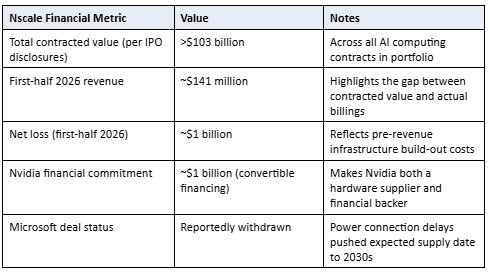
Nscale reported more than $103 billion in contracted value in its IPO disclosures against approximately $141 million in first-half 2026 revenue and a $1 billion net loss, illustrating the financing gap that defines the AI infrastructure build-out.
Nvidia has committed approximately $1 billion in convertible financing to Nscale, making the chipmaker both an equipment supplier and a financial backer — a dual role that reflects the capital intensity of the AI data-centre sector.
Microsoft reportedly withdrew from a Nscale data-centre arrangement in Britain after power connection delays pushed the expected supply date into the 2030s. Separately, rival CoreWeave faced financial-market pressure with bond yields reportedly exceeding 16%.
The Deal Structure: What $45 Billion in Cloud Commitments Actually Means
The headline figure of $45 billion — or $90 billion across both agreements — requires context to interpret accurately. AI cloud computing contracts of this type are not single upfront payments. They are long-term service agreements in which the customer pays for computing capacity over the life of the contract, typically measured in years. The contracted value represents the total expected spend over that period, not a near-term capital outlay.
This structure matters for two reasons. First, it means Anthropic’s exposure at any given point is a fraction of the headline number — it is paying for compute as it uses it, with commitments that phase in over time. Second, it means the data-centre developer — Nscale in this case — cannot simply bank the $45 billion and begin construction. It must finance the build using the contracted revenue as collateral, which requires convincing lenders and investors that the customer will honour the commitment over the full contract period.
How Long-Term Cloud Contracts Support Infrastructure Financing
The mechanism by which contracted revenue becomes construction financing is central to understanding both the opportunity and the risk in these arrangements. When Nscale signs a long-term agreement with Anthropic, it can present that contracted future revenue to debt investors or convertible note holders as evidence of future cash flow. Lenders, in turn, may be willing to advance capital today against those future revenues — effectively financing the data-centre construction on the basis of the customer commitment.
This model has become a defining feature of the AI infrastructure sector. Companies like Nscale, CoreWeave, and others have built large contract portfolios that dwarf their current revenues, using those portfolios to raise the capital needed to build the facilities that will eventually generate the revenue. The logic is circular and depends critically on two things: the customer actually using the contracted capacity, and the developer building the facilities on time and on budget.
The Monarch Campus: West Virginia, Vera Rubin and the Third-Building Option
The proposed second facility would be located at Nscale’s Monarch data-centre campus in West Virginia. The first agreement, announced in August 2026, already covers a facility at the same campus. The second proposed facility would add approximately 460 megawatts of computing capacity, which is a substantial addition — large data centres typically run in the range of tens to a few hundred megawatts.
Nvidia Vera Rubin: The Next Generation
The proposed second facility would be equipped with Nvidia’s Vera Rubin AI chips. Vera Rubin is the successor to Nvidia’s current high-end AI accelerator lineup, named after the astronomer Vera Rubin. The chips are designed for large-scale AI training and inference workloads of the kind Anthropic runs for its Claude models. The source article notes that the performance improvements of Vera Rubin come alongside significant deployment costs — next-generation chips are more powerful but also more expensive to purchase, install and operate.
For Anthropic, Vera Rubin capacity would provide the raw computing power needed to train and run increasingly large AI models. For Nscale, it represents a hardware procurement commitment at scale — sourced from its existing partner Nvidia, which has its own financial interest in seeing the facilities built.
Right of First Refusal on a Third Building
Anthropic also holds a right of first refusal on a planned third building at the Monarch campus, according to a person familiar with the negotiations cited in the source. A right of first refusal does not obligate Anthropic to take the third building — it simply gives Anthropic the option to match any third-party offer before Nscale can accept it. If Anthropic exercised that option at a similar contract value, total Monarch commitments could extend well beyond $90 billion. The right is included here as context for the scale of the potential relationship, not as a committed figure.
Nscale’s Financial Position: Contracted Value vs. Operational Reality
Understanding the proposed deal requires understanding the financial position of the counterparty. Nscale’s IPO disclosures, cited in the source article, reveal the structural tension at the centre of the AI infrastructure build-out.
What the Numbers Mean
A company with more than $103 billion in contracted value but only $141 million in first-half 2026 revenue is, by definition, not yet in a steady state. The contracted value represents future billings — revenue that will accrue as facilities are built and customers begin drawing down their commitments. The $1 billion net loss in the first half of 2026 reflects the cost of building those facilities before that revenue arrives.
This dynamic is not unusual for infrastructure developers — it is structurally similar to how satellite operators, fibre networks, or pipeline companies look in their early build-out phases. The key question is whether the contracted revenue materialises as expected and whether the financing cost of the build period remains manageable. For Nscale, both questions carry real uncertainty given the sector-wide turbulence described below.
Financing Risks Across the AI Infrastructure Sector
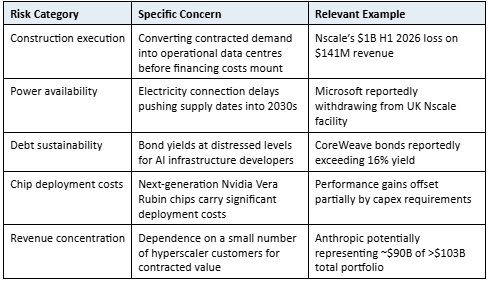
The Anthropic-Nscale negotiations take place against a backdrop of growing concern about the sustainability of debt-funded AI infrastructure expansion. Two developments cited in the source article illustrate the risks.
Microsoft’s Reported Withdrawal From the UK Nscale Deal
Microsoft reportedly withdrew from a proposed Nscale data-centre arrangement in Britain after power connection delays pushed the expected supply date into the 2030s. This is a significant data point for several reasons. Power availability is one of the most frequently cited constraints on AI data-centre expansion globally — grid connection queues in the UK, the US, and elsewhere have grown substantially as demand from AI workloads has accelerated. A delay that pushes delivery to the 2030s effectively renders the contract commercially unviable for a customer with near-term compute requirements.
The withdrawal also illustrates the execution risk embedded in large contracted-value figures. Contracted revenue that cannot be delivered because of power or construction delays does not become actual revenue, and the financing that was raised against it becomes a liability rather than a bridge to cash flow.
CoreWeave’s Bond Market Pressure
The source article also references rival AI infrastructure developer CoreWeave experiencing significant financial-market pressure, with bond yields reportedly exceeding 16%. Bond yields at that level are typically associated with distressed or high-yield debt, indicating that investors demanded a substantial risk premium to hold CoreWeave’s obligations. High financing costs reduce the margin between the revenue a data-centre developer earns from its contracts and the cost of the debt it used to build the facilities, compressing the economics of the business model.
CoreWeave and Nscale operate in the same structural position — large contracted backlogs, substantial pre-revenue losses, and reliance on debt markets to bridge the build period. Pressure on one player in the sector signals that investors are scrutinising the underlying economics more carefully than in earlier periods of AI infrastructure enthusiasm.
Risk and Opportunity: What the Deal Means for Both Parties
What It Means for Anthropic
For Anthropic, a second $45 billion commitment to Nscale deepens its reliance on a single infrastructure provider while potentially strengthening the economics of that relationship through volume. Additional computing capacity at the Monarch campus would support the training of larger and more capable Claude models, and the use of Vera Rubin chips would position Anthropic’s compute stack on the frontier of available hardware.
The arrangement also fits a broader pattern in how leading AI labs are securing long-term compute access. Rather than depending entirely on public cloud providers such as Amazon Web Services, Microsoft Azure, or Google Cloud — where costs are higher and capacity allocation is competitive — dedicated infrastructure agreements offer more predictable pricing and guaranteed capacity. The trade-off is counterparty risk: if Nscale cannot deliver the contracted facilities, Anthropic’s compute roadmap is disrupted.
What It Means for Nscale
For Nscale, successfully delivering the Monarch campus facilities would validate its business model and provide a foundation for its planned public listing. A $90 billion customer relationship — representing the majority of its current $103 billion contracted portfolio — would give public market investors a clear picture of its demand base. The risk is concentration: a portfolio heavily weighted to a single customer creates vulnerability if that customer’s needs change, if the relationship is disrupted, or if Nscale cannot deliver the contracted capacity on schedule.
The broader financing environment described above adds urgency to execution. Nscale must demonstrate that it can build operational data centres, attract grid power, deploy next-generation hardware, and generate revenue against its contracted backlog before its financing costs become unmanageable. Microsoft’s reported withdrawal from the UK facility is a cautionary example of what happens when those elements do not come together.
Frequently Asked Questions
What is the Anthropic-Nscale cloud agreement and how does it work?
Anthropic is negotiating a second long-term cloud computing agreement with Nscale, a British data-centre developer backed by Nvidia. The proposed agreement is valued at approximately $45 billion and would cover a new 460-megawatt facility at Nscale’s Monarch campus in West Virginia equipped with Nvidia Vera Rubin AI chips. Like the first $45 billion agreement announced in August 2026, the contract represents total expected spending over the life of the agreement rather than an upfront payment. Anthropic pays for computing services as it uses them, while Nscale uses the contracted revenue to finance construction.
What are Nvidia Vera Rubin chips and why are they relevant?
Nvidia Vera Rubin is the name of a next-generation AI accelerator chip series from Nvidia, succeeding the current high-end lineup used for large-scale AI training and inference. The source article states the proposed second Monarch facility would use Vera Rubin chips, providing additional computing resources for Anthropic’s Claude models. The chips deliver performance improvements over current-generation hardware but come with significant deployment costs. Nvidia also has a direct financial interest in the Nscale relationship through its approximately $1 billion convertible financing commitment to the developer.
Why does Nscale have $103 billion in contracted value but only $141 million in revenue?
Nscale’s contracted value represents the total expected billings across all its long-term cloud computing agreements over their full duration. Revenue, by contrast, is recognised as it is earned — as facilities are built and customers begin drawing down their commitments. A company in an early build-out phase will always show a large gap between contracted backlog and current revenue because the facilities that will generate that revenue have not yet been completed. The $1 billion net loss in the first half of 2026 reflects the construction and financing costs of that build period. The critical question is whether contracted revenue converts into actual billings as facilities come online.
What risks does the Microsoft withdrawal from Nscale’s UK deal create?
Microsoft reportedly withdrew from a Nscale data-centre arrangement in Britain after power connection delays pushed the expected delivery date into the 2030s. This illustrates the execution risk in AI infrastructure: large contracted values can evaporate if the underlying facilities cannot be built and powered on schedule. For Nscale, the withdrawal means a portion of its contracted backlog did not convert to revenue. More broadly, it highlights that electricity availability is a binding constraint on the AI data-centre build-out, and that customers will exit contracts if delivery timelines become commercially unviable.
Is the second $45 billion deal confirmed?
No. The source article, citing Reuters, describes the second agreement as still under discussion, with the explicit caveat that final terms could change. The first $45 billion agreement was announced in August 2026 and represents a confirmed commitment. The second agreement is a negotiation in progress. Anthropic also holds a right of first refusal on a third building at the Monarch campus, but that is an option, not a commitment.
Want to join the discussion? Login and create a profile to comment.