ARK Invest’s Updated Tesla Model Targets $4,400 by 2031 — One Business Line Carries 80% of the Forecast

ARK Invest has published an updated Tesla model with a base-case price target of approximately $4,400 per share by 2031, nearly twelve times Tesla’s October 19 closing price of $368.06. Robotaxis account for roughly 80% of ARK’s projected enterprise value for Tesla in 2031. The model adds new lines for Optimus humanoid robot sales and AI infrastructure spending that were not in ARK’s prior Tesla model, published in 2024.
Key Takeaways
ARK Invest’s base-case price target for Tesla is ~$4,400 per share in 2031, up from a $2,600 target for 2029 in its prior 2024 model. Tesla traded at $368.06 on October 19, putting the implied upside at roughly 12×.
Robotaxis account for ~80% of Tesla’s projected enterprise value in 2031, down from ~90% in 2029 as modelled in 2024, because Optimus Robot-as-a-Service is now expected to scale significantly alongside robotaxis.
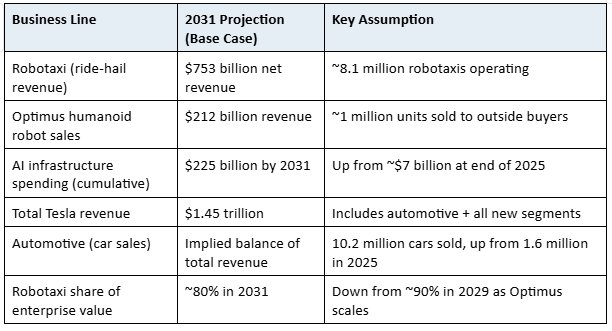
ARK’s base case projects ~8.1 million robotaxis generating $753 billion in net ride-hail revenue in 2031, alongside ~1 million Optimus units sold to outside buyers for $212 billion.
A new AI infrastructure line was added to the model: ARK projects Tesla’s cumulative AI spending to reach $225 billion by 2031, up from ~$7 billion at end of 2025.
Tesla’s robotaxi service launched in Austin, Texas in June 2025 and has expanded to 7 cities across 3 states, logging more than 1 million unsupervised driverless miles in about 7 months. ARK describes the ramp as slower than expected.
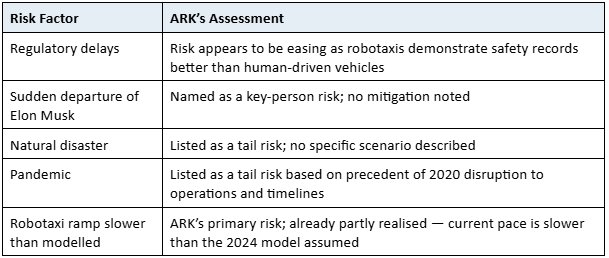
ARK names a slower robotaxi ramp as its primary risk, with four named causes: regulatory delays, Elon Musk’s departure, a natural disaster, or a pandemic. It notes regulatory risk appears to be easing.
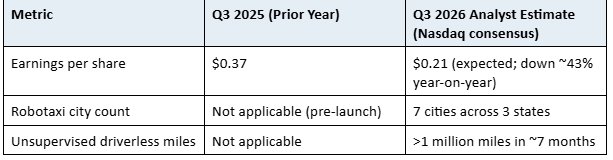
Tesla reports Q3 2026 earnings on October 21; analyst consensus tracked by Nasdaq expects $0.21 EPS, down from $0.37 a year earlier.
What ARK’s Model Actually Projects
ARK’s updated model, authored by analysts Tasha Keeney and Daniel Maguire, builds a 2031 revenue picture for Tesla that is dominated by two segments that did not exist at meaningful scale when ARK last published its Tesla model in 2024: robotaxis and humanoid robotics.
Why the Target Year Moved from 2029 to 2031
ARK’s 2024 model targeted $2,600 per share by 2029 and expected robotaxis to launch in 2025. That launch happened — Tesla launched in Austin in June 2025 — but the pace of expansion has been slower than the 2024 model assumed. ARK partly used that observed pace to reset the timeline, extending the forecast horizon to 2031 to allow more time for robotaxi and Optimus adoption to compound. The target price rose from $2,600 to $4,400 over a two-year longer horizon.
ARK explains the shift in enterprise-value composition: robotaxis made up about 90% of projected enterprise value in the 2029 model. In the 2031 update that falls to about 80%, not because the robotaxi projection is weaker, but because Optimus Robot-as-a-Service is now expected to have scaled enough by 2031 to represent a meaningful share of value in its own right.
How the 2024 Model Has Held Up — and Where It Missed
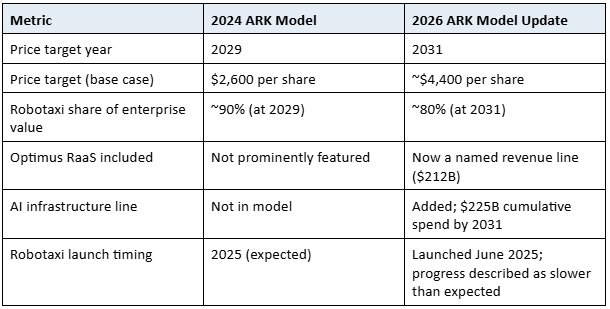
The 2024 model’s most significant call — that Tesla would launch a robotaxi service in 2025 — proved directionally correct. Tesla launched in Austin in June 2025 and has since expanded to seven cities across three states. By the time of writing, the fleet had logged more than one million unsupervised driverless miles in approximately seven months of operation.
Slower Than Expected: What That Means for the New Model
ARK’s description of the ramp as “slower than expected” is a meaningful disclosure. It means the 2026 model is already baking in a more conservative adoption curve than the 2024 model used. If robotaxi deployment accelerates from its current pace, the base case improves. If it continues at the current rate or slows further, the 2031 timeline itself comes under pressure.
Dan Ives of Yorkville Ives & Co. has offered a nearer-term view: he expects robotaxis to reach more cities in early to mid-2027, with Optimus following later that year. That framing is more conservative on near-term milestones than ARK’s full model requires — ARK’s $4,400 target does not depend on hitting specific city counts in 2027, but on aggregate fleet size and revenue by 2031.
The Optimus and AI Infrastructure Lines: What Was Added
The two additions that most distinguish the 2026 model from the 2024 one are the Optimus revenue line and the AI infrastructure spending assumption.
Optimus: $212 Billion from Robot-as-a-Service
ARK now includes approximately $212 billion in 2031 revenue from Optimus humanoid robots sold to outside buyers, based on a projection of roughly one million units. This is described in the model as Robot-as-a-Service, or RaaS — a recurring-revenue framing in which the economic relationship between Tesla and buyers of Optimus continues after the initial sale, through software, services or ongoing capability updates.
ARK analysts Keeney and Maguire noted explicitly that “Optimus Robot-as-a-Service (RaaS) is likely to inflect as robotaxis continue to proliferate.” The word “inflect” is significant: it implies an S-curve adoption pattern in which adoption is slow initially, then accelerates sharply once some threshold of cost, capability or distribution is crossed. ARK is projecting that threshold to be reached around 2031, coinciding with the robotaxi scaling period.
AI Infrastructure: $225 Billion by 2031
The model adds a cumulative AI infrastructure spending line that reaches $225 billion by 2031, up from approximately $7 billion at the end of 2025. This spending is framed as what drives Optimus performance — the computational and training infrastructure needed to make humanoid robots capable enough to operate at human-level skill.
ARK’s model uses this spending trajectory partly to set the timeline for when Optimus could reach human-level capability. A slower-than-projected infrastructure spend would push that threshold further out; a faster one could pull it forward. The $225 billion cumulative figure assumes a roughly 30× increase from the 2025 baseline over six years, which implies very large year-on-year capital expenditure increases.
Risks ARK Identifies to the $4,400 Target
ARK names a slower-than-expected robotaxi ramp as the primary risk to its forecast and lists four specific causes that could produce that outcome.
The Key-Person Risk
The listing of a “subjective departure by Elon Musk” as a named risk is notable. It acknowledges that the robotaxi and Optimus programs, as currently structured, are closely associated with Musk’s leadership and vision. ARK provides no mitigation for this risk — it is listed as a named possibility without a paired contingency. For investors weighing the $4,400 target, this is a concentration risk that sits outside the model’s quantitative framework.
ARK’s Own Disclosure
ARK’s published disclosure states that its forecasts carry a bias toward positive results, and that some or all projected outcomes may land substantially lower than modelled. That disclosure is standard for speculative long-horizon models, but it is worth reading alongside the $4,400 figure: the base case is not a median estimate, and the bull-case figure would sit above $4,400 while the bear case would sit substantially below it. ARK does not publish the bear-case figure in the source material covered here.
The Q3 Earnings Call: What to Watch on October 21
Tesla reports its third-quarter 2026 financial results on October 21. Analyst consensus tracked by Nasdaq expects earnings of $0.21 per share, compared to $0.37 per share in Q3 2025 — a year-on-year decline of approximately 43%.
Why the Earnings Call Matters for ARK’s Model
The Q3 earnings call will provide updated data on three of the four core inputs that ARK’s model rests on: robotaxi city and fleet expansion, Optimus production and deployment timing, and AI infrastructure capital expenditure. Car sales figures will also be reported, but those are the segment ARK treats as the smallest contributor to 2031 enterprise value.
Any guidance Tesla provides on the robotaxi expansion pace — new cities, fleet size targets, revenue per mile — will be immediately relevant to whether ARK’s 8.1 million robotaxi assumption for 2031 looks achievable on the current trajectory. Similarly, any update on Optimus production volumes or commercial deployment timelines will be read against the one-million-unit assumption embedded in the $212 billion revenue line.
Frequently Asked Questions
What is ARK Invest’s price target for Tesla?
ARK Invest’s updated base-case price target for Tesla stock is approximately $4,400 per share by 2031, according to a model updated in October 2026. Tesla traded at $368.06 on October 19, 2026, making the implied upside roughly 12 times the current price.
Why does ARK assign 80% of Tesla’s enterprise value to robotaxis?
ARK projects ~8.1 million robotaxis generating $753 billion in net ride-hail revenue by 2031. At that scale, the robotaxi segment dwarfs Tesla’s automotive and energy businesses. The 80% share is down from ~90% in the prior 2024 model because Optimus humanoid robots are now projected to contribute $212 billion in additional revenue, reducing robotaxi’s proportional share of total enterprise value.
How accurate has ARK’s previous Tesla model been?
ARK’s 2024 model set a $2,600 target for 2029 and predicted Tesla would launch a robotaxi service in 2025. The 2025 launch happened: Tesla launched in Austin in June 2025 and has since expanded to 7 cities across 3 states, logging more than 1 million unsupervised driverless miles. ARK describes the overall ramp as slower than the 2024 model assumed, which is part of why the target year moved to 2031.
What are the main risks to ARK’s $4,400 Tesla forecast?
ARK identifies a slower-than-expected robotaxi ramp as the primary risk, with four named causes: regulatory delays (which ARK says appear to be easing), a sudden departure by Elon Musk, a natural disaster, and a pandemic. ARK also discloses that its models carry a positive bias and that outcomes may land substantially lower than the base case.
What should investors watch in Tesla’s Q3 2026 earnings?
Analyst consensus expects Tesla to report Q3 2026 EPS of $0.21, down from $0.37 a year earlier. The earnings call on October 21 will be watched for updates on robotaxi city expansion, Optimus production and commercial deployment timing, and AI infrastructure capital expenditure — the three inputs that most directly determine whether ARK’s 2031 projections remain achievable on the current trajectory.
Want to join the discussion? Login and create a profile to comment.