Bitwise Projects Bitcoin at $1.6 Million by 2036 — But One Assumption Buried in the Gold Market Drives Four-Fifths of the Model's Value

Bitwise Asset Management's 2027 Bitcoin Long-Term Capital Market Assumptions, released October 28, project Bitcoin reaching $1,599,766 per coin by 2036 — a 34.3% annual compound return from the September 30, 2026 base price of $83,557. The report spans seven addressable markets, three scenarios, and a decade-long investment horizon, projecting Bitcoin as a $33.6 trillion asset by the end of the period. It is a rigorous, data-rich document from a firm with commercial skin in the game. But a close reading reveals that approximately 82% of the base-case valuation rests on a single assumption: Bitcoin's share of the gold-dominated store-of-value market rising from roughly 5.4% today to 25% by 2036. And the report's own comparative data suggest that gold's market value would need to grow at roughly 11% per year to support that projection — significantly faster than the 7.5% that follows from the bank forecasts the same report cites.
Key Facts and Figures at a Glance
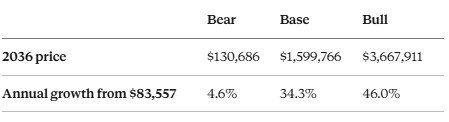
Base price: Bitcoin on September 30, 2026 = $83,557 (three months after the market's ~$58,000 bottom, which represented a 53% fall from the October 2025 peak of $126,080)
Source of base-case value by market:
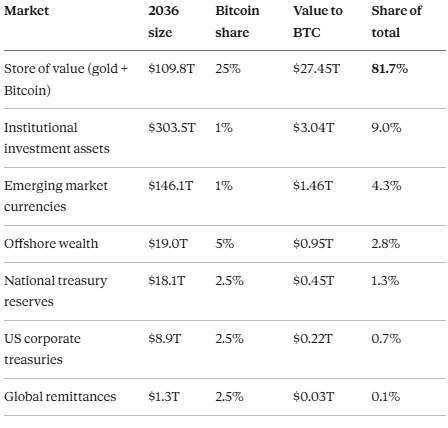
Market sizes and shares are Bitwise's base-case inputs. Value and percentage columns are Coindoo's calculations from those inputs.
Key path assumptions: Average annual volatility 27.8%; expected correlation with US stocks 0.43 (vs 0.25 measured over the past decade); Bitcoin's actual 10-year compound growth 63.5%.
About the Report and Its Author's Commercial Stake
Bitwise Asset Management is a San Francisco-based firm managing more than $14 billion in client assets. It sponsors a spot Bitcoin ETF — one of the products that generated a significant portion of the $108 billion now held in US spot Bitcoin funds — and publishes annual long-term capital market assumptions for Bitcoin in the format that institutional asset managers use to guide strategic portfolio construction decisions.
Long-term capital market assumptions (LTCMAs) are a standard tool in professional asset management: annual reports projecting expected returns, volatility, and correlations for major asset classes over a 10-year horizon. JPMorgan, BlackRock, Vanguard, and PGIM all publish them for traditional asset classes; Bitwise has built Bitcoin-specific versions following the same format, using the same analytical structure.
The commercial context is worth stating plainly, as the report itself acknowledges: Bitwise manages Bitcoin-focused products and has a financial interest in both Bitcoin's price and investor demand for Bitcoin exposure. This does not make its analysis wrong, but it is relevant when evaluating how to weight its assumptions, particularly the most optimistic inputs.
Bitwise compares its base-case rate of 34.3% to Bitcoin's actual 10-year compound annual growth rate of 63.5%, using the gap as evidence that its forecast is moderate relative to history. This comparison is accurate but has a base-rate problem: a $2 trillion asset reaching $33.6 trillion requires very different conditions than a $100 asset reaching $83,000. The relevant question is not whether 34.3% is lower than 63.5%, but whether the specific market assumptions that produce 34.3% are realistic. Last year's edition pointed to $1.3 million by 2035 at a 28.3% annual rate; the upward revision reflects "growth in the markets Bitcoin serves and increased confidence in the asset," per the report.
The Valuation Methodology: Seven Markets, One Division
The model's construction is elegant and transparent. Bitwise sizes seven markets for the year 2036 — store of value, institutional investment, emerging market currencies, offshore wealth, national treasury reserves, US corporate treasuries, and global remittances — assigns Bitcoin a percentage share of each, adds those values together, and divides by 21 million (Bitcoin's theoretical maximum supply). The result is the projected price per coin.
The choice of 21 million as the denominator is described as conservative. Only 20.1 million Bitcoin are in circulation today, and a meaningful portion of those are estimated to be permanently inaccessible — coins in Satoshi Nakamoto's early wallets that have never moved, coins sent to unspendable addresses, coins whose private keys were lost. Using the full theoretical cap of 21 million rather than the accessible circulating supply produces a lower price target, not a higher one. A more aggressive denominator assumption would generate a higher price.
This methodology has the significant virtue of making the model's inputs explicit and auditable. Every assumption that drives the price target can be traced to a specific number in a specific cell: the market's 2036 size, and Bitcoin's share of that market. The analysis that follows traces exactly what each of those cells contributes.
The Store-of-Value Assumption: Where 82% of the Model Lives
The most important number in Bitwise's model is not the final price. It is Bitcoin's projected 25% share of the store-of-value market in 2036.
Today, Bitwise measures the total store-of-value market at $31.1 trillion. Bitcoin's 20.1 million circulating coins, at September's price of $83,557, were worth approximately $1.68 trillion — roughly 5.4% of that market, with gold making up most of the remainder. The base case envisions Bitcoin's share rising from 5.4% to 25% while the total market itself expands from $31.1 trillion to $109.8 trillion.
Multiplying $109.8 trillion by 25% gives $27.45 trillion attributable to Bitcoin through the store-of-value channel. That single line contributes 81.7% of the base-case total valuation.
The 14.1% Annual Growth Rate in the Store-of-Value Market
Bitwise projects the store-of-value market expanding from $31.1 trillion to $109.8 trillion over ten years. That is a compound annual growth rate of approximately 14.1% — the average pace of the past decade, extended unchanged for another ten years.
That projection is not implausible — the past decade has seen gold rise from well below $1,300 per ounce to its current levels, driving significant store-of-value market expansion — but it is an assumption rather than a law. If the next decade's store-of-value market growth is slower, the entire price projection scales down.
The Hidden Gold Growth Requirement
The most analytically significant finding in Coindoo's reading of the Bitwise model is a tension the report does not explicitly flag.
If the store-of-value market reaches $109.8 trillion by 2036 and Bitcoin holds a 25% share, then the remaining 75% — predominantly gold — accounts for approximately $82.35 trillion. Bitwise's starting figure for gold's current market value is approximately $29 trillion. Getting from $29 trillion to $82.35 trillion over ten years implies gold's market value compounding at approximately 11% per year.
The same report, in a separate section comparing Bitcoin's expected returns to traditional assets, averages long-term forecasts from JPMorgan, PGIM, BlackRock, and Vanguard. That exercise produces an expected gold annual return of 5.5%. Gold's physical supply grows at approximately 2% per year. Together, those imply gold's total market value (price appreciation plus supply growth) expanding at approximately 7.5% annually — substantially below the roughly 11% that the store-of-value line requires.
The report does not reconcile these two figures. They come from different exercises — one extrapolating historical market growth, the other averaging bank return forecasts — and the report presents both without noting that they point in different directions on the critical underlying assumption.
The practical effect: If gold's market value grows at 7.5% rather than 11%, the store-of-value market in 2036 is approximately $63 trillion rather than $109.8 trillion. If Bitcoin's share is still 25%, Bitcoin's contribution from this channel falls from $27.45 trillion to approximately $15.75 trillion — reducing the base-case price by roughly $544,000 per coin before any changes to the other six markets.
This is not a fatal flaw in the model. Bitwise's arguments for why the store-of-value market could grow faster than bank forecasts suggest — rising government debt, record central bank gold purchases ($96 billion in 2025), the dollar's declining share of global reserves (now 56.7%) — are substantive and consistent with an observable shift in reserve asset preferences by major sovereign holders. The model's output depends heavily on that argument being correct.
The Institutional Allocation: The Second-Largest Driver
The second-largest contributor to the base-case valuation is institutional demand, adding approximately $3 trillion (9% of the total). The report's summary leads with this: that allocations of 1% to 5% from the roughly $147 trillion in institutional assets counted by Boston Consulting Group would mean $1.5 trillion to $7.4 trillion of Bitcoin buying over the decade.
The base case uses the bottom of that range — a 1% allocation from a projected $303.5 trillion institutional market (growing from today's $147 trillion as new assets are managed and existing portfolios grow). That produces $3.04 trillion attributable to institutional portfolios by 2036.
For calibration, the report notes that US spot Bitcoin ETFs — the most visible and measurable expression of institutional and retail demand for Bitcoin through regulated vehicles — had accumulated $108 billion less than three years after launch. That is approximately one-thirtieth of the $3 trillion the base case assigns to institutional portfolios by 2036, suggesting that reaching the base case requires sustained institutional accumulation at roughly 30 times the current pace across a much larger asset pool.
That does not make the 1% target unreachable — portfolio allocation shifts happen gradually but can compound meaningfully over a decade — but it gives the $3 trillion figure useful context.
The Five Smaller Markets: Supporting Cast, Not Story
The remaining five markets in the Bitwise framework — emerging market currencies, offshore wealth, national treasury reserves, US corporate treasuries, and global remittances — collectively contribute approximately $3.11 trillion, or about 9.3% of the base-case total.
Each of these lines reflects a distinct adoption thesis:
Emerging market currencies ($1.46T / 4.3%): Bitcoin as a parallel currency in economies where domestic currencies are unstable or controlled
Offshore wealth ($0.95T / 2.8%): High-net-worth individuals and family offices allocating to Bitcoin for privacy, portability, or diversification outside formal financial systems
National treasury reserves ($0.45T / 1.3%): Sovereign wealth funds and national treasuries adding Bitcoin to reserve assets alongside gold and USD — a scenario made more plausible by El Salvador's early adoption and subsequent US executive orders supportive of Bitcoin reserve exploration
US corporate treasuries ($0.22T / 0.7%): Following MicroStrategy's pioneering corporate treasury Bitcoin strategy, more US companies adopting Bitcoin as a balance-sheet asset
Global remittances ($0.03T / 0.1%): Bitcoin as a lower-cost cross-border payment mechanism for the global remittance market
Each represents a real potential demand source. Together they contribute less than half of what the store-of-value line alone generates, confirming where the model's real dependency lies.
The Bear Case: Still Above Today's Price Because the Market Grows
The $130,686 bear case is perhaps the model's most interesting data point for understanding its structure.
The bear case gives Bitcoin nothing from institutional investment, national treasury reserves, or corporate treasuries — zeroing out three of the seven market lines. It assigns Bitcoin only a 2.5% share of the store-of-value market — less than half Bitcoin's current ~5.4% share, meaning the bear case explicitly models Bitcoin losing ground relative to gold, not gaining it.
Yet the bear-case price of $130,686 is still substantially above September's base price of $83,557 — a 56.4% total gain, or about 4.6% per year.
The reason is the market growth assumption. Even in the bear case, Bitwise projects the store-of-value market growing from $31.1 trillion to $109.8 trillion. Bitcoin with a 2.5% share of $109.8 trillion is worth about $2.745 trillion — still significantly more than Bitcoin's current 5.4% of $31.1 trillion ($1.68 trillion). Market growth alone lifts Bitcoin above its current price even if its competitive position within the store-of-value market deteriorates.
This reveals an important property of the model: the $109.8 trillion store-of-value projection is a shared assumption across bear and base cases. If that projection proves wrong — if the store-of-value market grows more slowly than 14.1% per year — the bear case also weakens.
Sensitivity: What Moving One Number Shows
The clearest test of where the model's value comes from is varying Bitcoin's store-of-value share while holding every other input at the base case. Each percentage point of that market is worth approximately $52,300 per coin:
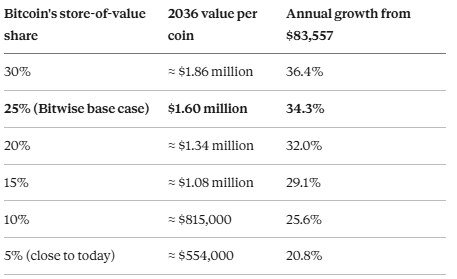
Coindoo's calculations from Bitwise's published inputs. Only the store-of-value share changes; all other inputs and the 21 million denominator stay at the base case.
The bottom row of this table shows the model's second key dependency: with Bitcoin's share held at approximately today's level (5%), the model still produces roughly $554,000 — approximately 6.6 times September's price — because the market itself grows. The reverse test is equally instructive: if Bitcoin's share rises to the base-case 25% but the store-of-value market is frozen at today's $31.1 trillion, the base case falls to approximately $663,000.
Share gains and market growth each account for roughly half the distance between those results and $1.6 million. Both are assumptions. Neither is guaranteed.
The Path From Here: Volatility, Correlation, and the Years in Between
A 2036 price projection tells an investor little about what the intervening decade looks like. Bitwise addresses this with specific path-risk projections.
Volatility at 27.8%: Bitwise expects average annual volatility of 27.8% over the decade — described as the midpoint between today's level and the lower volatility it projects by 2036, with near-term volatility likely to run above that average. The recent cycle's price action illustrates what 27.8% average volatility means in practice: Bitcoin fell from $126,080 to $58,717 in under nine months — a 53.4% peak-to-trough decline. Bitwise notes that if the June 2026 low holds as the cycle bottom, it would be the shallowest cyclical drawdown on record — after falls of 86%, 84%, and 77% in earlier cycles. The cycle is shallowing; it has not been eliminated.
Correlation with US stocks at 0.43: Bitwise projects Bitcoin's average correlation with US equity markets at 0.43 over the decade, above the 0.25 it measured over the past ten years. A higher correlation means Bitcoin is more likely to fall alongside equities during a broad market sell-off — reducing its value as a portfolio diversifier precisely when diversification is most needed. The practical implication for position sizing is that the 2036 price target, however plausible, does not come with a smooth return profile or consistent diversification benefit.
The Three Tail Risks That Could Break the Model
Bitwise names three scenarios that could render the model's output irrelevant regardless of how well the market-share assumptions play out:
Quantum computing: Sufficiently powerful quantum computers could theoretically break the elliptic curve cryptography that secures Bitcoin private keys. A credible near-term quantum threat would undermine the security assumption on which Bitcoin's value as a store of value rests.
AI-driven advances in mathematics: Advances in computational mathematics enabled by artificial intelligence could similarly threaten Bitcoin's cryptographic foundations before protocol upgrades could be deployed.
Regulatory reversal: The current US regulatory environment is more favourable to Bitcoin than at any prior point — but the report acknowledges that the Clarity Act, the crypto market-structure bill the industry had been pushing for, failed to advance in Congress this year. The failure is attributed largely to Democrats' concerns about the bill's ethics provisions, a reminder that regulatory momentum in crypto can stall on non-crypto political dynamics. A future administration could revisit the current supportive posture.
These are genuinely tail risks — low-probability scenarios that are not part of any of the three scenarios Bitwise models — but they are the events that would make the model's outputs irrelevant if they materialised.
Three Inputs to Monitor Annually
Bitwise publishes these assumptions each year, creating an annual checkpoint against which the model's progress can be assessed. Three public data points are sufficient to evaluate whether the model is on track:
Bitcoin's share of the store-of-value market: Dividing Bitcoin's market capitalisation by the combined value of Bitcoin and above-ground gold gives this ratio in real time. The base case requires it to move from approximately one-twentieth (today) to one-quarter (2036). Progress toward or away from that trajectory is the single most important input to track.
Gold's market value: Since gold makes up most of the store-of-value market, its annual growth rate largely determines whether the $109.8 trillion projection is credible. If gold's market value is growing at 7-8% per year (consistent with bank forecasts) rather than the 11% the store-of-value line implies, the projection is likely overstated.
US spot ETF holdings: At $108 billion, ETF holdings are the clearest public measure of institutional demand Bitwise describes. They are not a direct input to the model (the model's institutional line is based on the full $303.5 trillion market, not just ETF vehicles), but they are the best publicly available proxy for whether institutional allocation is accelerating on the path Bitwise projects.
Summary
Bitwise's 2027 Bitcoin Long-Term Capital Market Assumptions project Bitcoin at $1,599,766 by 2036 in the base case, representing 34.3% annual compound growth from September 30, 2026's $83,557 price. The model is transparent, methodologically rigorous, and grounded in publicly verifiable market estimates. Its central insight is genuine: the seven markets it identifies — from store of value to institutional assets to national treasury reserves — represent plausible long-duration demand sources for Bitcoin if the asset continues to gain institutional and sovereign acceptance. But 81.7% of the base-case value comes from a single market share assumption: Bitcoin rising from roughly 5.4% to 25% of a store-of-value market that itself expands from $31.1 trillion to $109.8 trillion. That expansion requires gold to compound at approximately 11% per year — a rate meaningfully above the 7.5% implied by the same report's survey of institutional gold return forecasts. The model does not reconcile this gap. The bear case lands at $130,686, still above today's price because the store-of-value market is assumed to grow even in that scenario. Each percentage point of Bitcoin's store-of-value share is worth approximately $52,300 per coin. The most useful monitoring exercise is not tracking the final price but tracking Bitcoin's actual share of the gold-plus-Bitcoin market annually — which is the single assumption that most determines whether $1.6 million remains a credible destination by 2036.
Want to join the discussion? Login and create a profile to comment.