Can Bitcoin Hold $80,000 This Week? Inflation, Oil Data and ETF Flows in Focus

Bitcoin has bounced back to roughly $82,500 after briefly slipping below the $80,000 mark last week. The recovery looks encouraging, but it faces an important test on Wednesday, when fresh US crude oil inventory data could reignite the same inflation worries that sparked the latest selloff.
Key Takeaways
BTC dropped to $79,770 on Thursday after a hotter-than-expected US inflation report, then recovered to about $82,500.
US consumer prices rose 3.7% year over year in September, above the 3.6% forecast.
Markets now price in roughly an 87% probability that the Fed leaves rates unchanged on October 28.
US spot Bitcoin ETFs saw about $228 million in net outflows last week, a sign that institutional demand is still soft.
Wednesday’s EIA crude oil inventory report is flagged by Bitunix analysts as the next major catalyst.
Despite a weak market overall, BAT nearly doubled, while ZK and STRK each gained more than 40%.
Macro Conditions Are Driving the Crypto Market
A Hot Inflation Print Triggered the Selloff
Bitcoin fell to $79,770 on Thursday as investors digested another uncomfortable US inflation reading. The Consumer Price Index (CPI) showed that prices rose 3.7% on an annual basis in September, slightly above the 3.6% economists had expected.
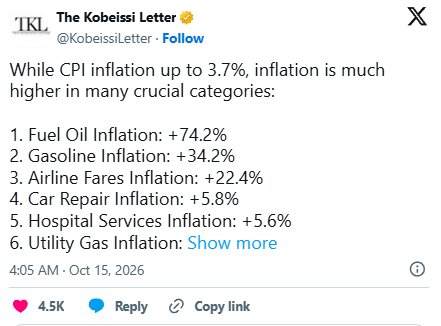
The CPI miss did not arrive in isolation. Stronger-than-expected producer price (PPI) and retail sales figures reinforced the view that the US economy is still running hot, raising concerns that the Federal Reserve could tighten monetary policy again with another interest rate hike.
Risk-Off Sentiment Spread Across Markets
The pressure was not limited to digital assets. Technology stocks posted heavy losses, and investors cut their exposure to riskier assets across the board, cryptocurrencies included. This highlights how closely Bitcoin continues to trade alongside broader risk sentiment when macroeconomic uncertainty rises: when traders expect tighter financial conditions, speculative assets are often the first to be sold.
What Fueled the Bitcoin Rebound
By Monday, the mood had improved. Oil prices and US Treasury yields both moved lower, which eased some of the immediate inflation concerns. Lower energy costs reduce pressure on headline inflation, while falling yields make non-yielding assets such as Bitcoin relatively more attractive.
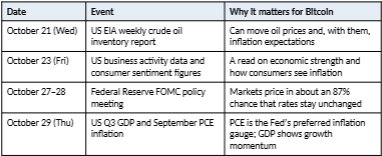
At the same time, traders scaled back their expectations of an immediate Fed rate hike. Markets are now pricing in roughly an 87% probability that interest rates will remain unchanged at the conclusion of the Federal Reserve meeting on October 28. That shift in rate expectations gave risk assets, including BTC, some breathing room.
The Weak Spot: Bitcoin ETF Outflows
Still, the recovery has a clear vulnerability. US spot Bitcoin exchange-traded funds (ETFs) recorded approximately $228 million in net outflows last week. Spot ETF flows have become one of the most closely watched indicators of institutional appetite for Bitcoin, because they reflect real capital entering or leaving the asset through regulated investment products.
So far, institutional demand has not shown a convincing turnaround. A price rebound that is not backed by renewed ETF inflows tends to be more fragile, as it relies more heavily on short-term traders than on longer-term capital.
Why Oil Could Decide Bitcoin’s Next Move
According to analysts at crypto exchange Bitunix, the weekly crude oil inventory report from the US Energy Information Administration (EIA), due on Wednesday, is the most important near-term catalyst for the market. The link between oil and Bitcoin runs through inflation expectations and, ultimately, through Federal Reserve policy.
Bearish Case: A Larger Inventory Draw
If oil inventories fall by more than expected, it would point to tighter supply and could push energy prices higher. Rising oil prices would strengthen inflation fears, increase the risk of further monetary tightening and add fresh pressure on Bitcoin and other risk assets.
Bullish Case: An Unexpected Inventory Build
Conversely, a surprise increase in inventories could weigh on crude prices. Cheaper oil would ease concerns about additional rate hikes and could give the Bitcoin recovery a stronger foundation.
Bitcoin Price Levels to Watch
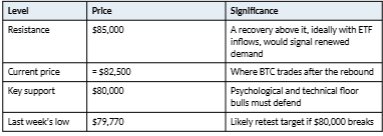
From a technical perspective, $80,000 remains the immediate support level for BTC. It is both a round psychological number and the area that buyers have just defended. A sustained break below it could open the door to another test of last week’s low near $79,770.
On the upside, a recovery above $85,000 would offer more convincing evidence of renewed buying demand, especially if it coincides with a return to net inflows into spot Bitcoin ETFs. A move driven by institutional capital would carry more weight than one powered mainly by short-term speculation.
Why Some Altcoins Are Defying the Crypto Selloff
The weakness extended well beyond Bitcoin. According to Bitunix data, only 40% of the 300 cryptocurrencies it tracks posted gains last week, and the median return across that group was −2.03%. Even so, a handful of smaller tokens rallied sharply against the trend.
Basic Attention Token (BAT) Surges 99%
Basic Attention Token (BAT), the token linked to the Brave browser, jumped 99.43% over the week. The rally was supported by interest in the expanding Brave ecosystem, which reported 128 million monthly users and more than 200,000 registrations for the Brave Rewards Card.
Speculative trading may have amplified the move. BAT futures open interest, the total value of outstanding derivatives contracts, rose 60% in a single day. At the same time, funding rates stayed negative, meaning short sellers were paying long holders to keep their positions open. That combination of rising open interest and negative funding can create the conditions for a short squeeze, where a rising price forces bearish traders to buy back their positions and pushes the price even higher.
ZK and STRK Rally on Zero-Knowledge Interest
Ethereum layer-2 scaling tokens ZK (ZKsync) and STRK (Starknet) each gained more than 40%. Both networks are built on zero-knowledge proof technology, and the moves point to selective investor interest in this part of the Ethereum scaling landscape.
However, these isolated rallies should be read with caution. Strong gains in a few tokens do not necessarily signal a broader crypto market recovery or a meaningful increase in real-world adoption.
Key Events That Could Move Bitcoin Before November
The coming days are packed with macroeconomic data that could shape inflation expectations, Federal Reserve policy and, as a result, the direction of the crypto market:
Bottom Line: Will $80,000 Support Hold?
Bitcoin’s rebound has given buyers room to defend the $80,000 level, but the recovery is resting on a fragile base. Spot ETF flows remain negative, and the macro calendar is crowded with releases that could quickly shift the inflation outlook.
Whether support survives the week will depend on two things: how inflation expectations evolve, starting with Wednesday’s oil data, and whether stronger demand, particularly from institutional investors, returns to the market.
Frequently Asked Questions
Why did Bitcoin fall below $80,000?
BTC dropped to $79,770 after September US CPI came in at 3.7% versus the expected 3.6%. Strong PPI and retail sales data added to fears of another Fed rate hike, prompting a broad sell-off in risk assets.
What is the key support level for Bitcoin right now?
$80,000 is the immediate support. A sustained break below it could lead to a retest of last week’s low around $79,770.
What would confirm a stronger Bitcoin recovery?
A move above $85,000, ideally accompanied by renewed net inflows into US spot Bitcoin ETFs, would be stronger evidence that buying demand is returning.
How can oil prices affect Bitcoin?
Higher oil prices can lift inflation expectations, which raises the chance of tighter Fed policy and tends to weigh on risk assets such as Bitcoin. Lower oil prices can have the opposite effect.
When is the next Fed decision?
The Federal Reserve meets on October 27–28. Markets currently price in about an 87% probability that rates will remain unchanged.
Disclaimer: This article is for informational purposes only and does not constitute financial or investment advice. Cryptocurrency markets are highly volatile; always do your own research before making any trading decisions.
Want to join the discussion? Login and create a profile to comment.