Elon Musk Predicts "Guppy-Level Death" for 200+ AI Cloud Providers as Debt Markets Freeze — Gartner Says 80% Will Lose Independence by 2030
Elon Musk issued one of his most direct warnings yet about the financial fragility of the AI infrastructure boom on October 25, predicting that more than 200 specialised AI cloud providers — known as neoclouds — will face collapse or forced consolidation as debt financing dries up. Musk framed the coming shakeout as a consequence of overleveraged business models encountering a fundamental reality: lenders no longer want to finance companies whose only meaningful revenue stream is renting out GPU capacity. The warning was preceded twelve days earlier by a forecast from Gartner estimating that more than 80% of neocloud providers could lose their operational independence by 2030, with over $3.5 trillion in AI infrastructure spending potentially exposed to impairment across the decade. The convergence of these assessments from opposite ends of the AI investment ecosystem — a technology founder and a research firm — suggests the neocloud shakeout is not a hypothetical risk but an expected structural correction.
Key Takeaways
Elon Musk predicted on October 25 via X that more than 200 neocloud AI cloud providers will face "guppy-level death and consolidation" as debt markets tighten financing conditions for companies without diversified revenue
Musk cited SpaceX as an example of a company with sufficient credit quality and revenue diversification to access large-scale GPU financing, claiming it secured $40 billion in debt for GPU purchases — though Bloomberg reported those negotiations were still ongoing at the time
CoreWeave and Nebius have seen their shares decline approximately 37% and 30%, respectively, over the past month, illustrating that investor concern about debt-funded AI infrastructure is already showing up in market prices
Gartner's October 14 forecast preceded Musk's warning: the research firm estimated that more than 80% of neocloud providers would cease operating independently by 2030
Gartner projected that AI providers will spend nearly $1 trillion on infrastructure in 2026 and a further $6 trillion between 2027 and 2030 — but predicted that AI-related revenue will fall short of the levels required to generate profitable returns on all planned investment
Despite the consolidation outlook, Gartner expects the market for AI-optimised cloud infrastructure to grow from $66 billion in 2027 to $174 billion by 2030 — suggesting that demand itself continues to expand even as the number of viable independent providers contracts
What Musk Actually Said — and What "Guppy-Level Death" Means
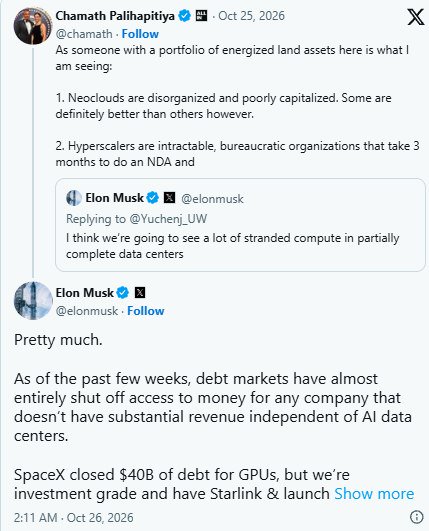
Musk's October 25 post on X addressed the financing environment facing the neocloud sector with characteristic directness, framing the situation in a single sentence that captured both the mechanism and the expected outcome: debt markets had "largely stopped providing financing to companies without major revenue streams outside AI data centers," and as a result, the sector's 200+ neocloud operators were going to experience "guppy-level death and consolidation," with only a small number surviving.
The term "guppy-level death" is a reference to the food-chain dynamics of a competitive market under stress. Guppies are small, numerous fish that exist at the bottom of the aquatic food chain — and in market terminology, the phrase invokes a scenario where small, financially weak participants are systematically eliminated through a combination of failures, acquisitions, and distressed consolidations, while larger, stronger entities survive by absorbing the resources of those that collapse.
Applied to the neocloud sector, Musk's prediction describes a market structure transformation: 200+ independent AI cloud providers entering a period of sustained financial stress that most will not survive in their current form, leaving a much smaller number of well-capitalised operators — whether they are original neoclouds that proved their business model or larger technology companies that acquire distressed neocloud assets — controlling the surviving GPU infrastructure.
The mechanism Musk identified as the trigger is specific: debt market tightening. Neoclouds are capital-intensive businesses that have relied heavily on borrowed money to finance the acquisition of expensive Nvidia GPU hardware and the construction of the data centres required to house and operate it. As long as lenders were willing to provide that financing at affordable rates, the business model was operationally feasible — even if margins were thin and the long-term return on invested capital remained uncertain.
When lenders become unwilling to extend new financing — or to refinance existing debt on terms that companies can actually service — the model breaks down regardless of whether the business is generating revenue growth. A company with $50 billion in debt and unsecured bonds yielding 15% can show triple-digit percentage revenue growth and still find itself unable to refinance affordably enough to remain solvent. This is the precise scenario unfolding at CoreWeave, which reported Q2 2026 revenue up 112% year over year while simultaneously watching its bond yields price in deep financial distress.
SpaceX as the Counter-Model: Why Capital Structure Determines Survival
Musk positioned SpaceX explicitly as the contrast case to the distressed neoclouds — and the contrast illustrates what distinguishes the companies likely to survive the coming shakeout from those that will not.
Musk claimed that SpaceX had secured $40 billion in debt financing for GPU purchases — a sum that, if accurate, would make it one of the largest single GPU acquisition programmes in history. He attributed SpaceX's ability to access this financing at scale to two factors: its investment-grade credit standing and its diversified revenue base.
Investment-grade credit is a designation assigned by ratings agencies (Moody's, S&P, Fitch) to companies whose financial profile — balance sheet strength, cash flow stability, debt coverage ratios — meets the threshold for lower-risk debt investment. The practical significance for borrowing costs is enormous. Investment-grade borrowers typically pay interest rates only modestly above government bond yields — perhaps 1-3 percentage points above the risk-free rate for strong issuers. High-yield or "junk" borrowers — the category into which most neoclouds fall — pay 5-15+ percentage points above the risk-free rate, depending on perceived default risk. At the scale of AI infrastructure financing, that spread differential translates into billions of dollars in annual interest cost difference between an investment-grade borrower and a high-yield one.
Revenue diversification provides the stability that justifies investment-grade status. SpaceX's Starlink satellite internet service generates recurring subscription revenue from millions of residential, commercial, and government customers across more than 100 countries. Its launch business generates revenue from commercial satellite operators, NASA, the Department of Defence, and private clients. These revenue streams are contractual, predictable, and largely uncorrelated with the success or failure of any specific AI application — giving lenders confidence that SpaceX can service its debt obligations even if AI cloud revenue disappoints.
Neoclouds, by definition, lack this diversification. Their revenue derives almost entirely from renting GPU capacity to AI developers, researchers, and enterprises. If AI model training demand slows, if large customers shift spending back to hyperscalers, or if GPU hardware costs decline rapidly enough to reduce the premium that neocloud operators can charge for their services, the entire revenue base is at risk simultaneously. Lenders increasingly recognise this concentration risk — and are pricing it accordingly.
The Bloomberg caveat on the SpaceX financing is worth keeping in mind: Bloomberg reported that negotiations over the terms of the $40 billion deal were still ongoing at the time of Musk's post, raising uncertainty about whether the transaction had been fully finalised when Musk described it. Whether the deal ultimately closes on the terms Musk implied, and when, remains to be confirmed.
The Market Is Already Pricing the Shakeout
Musk's October 25 prediction was not a forecast of a future that markets had not yet begun to price. The equity market had already been expressing serious concern about neocloud financial viability throughout October 2026.
CoreWeave (CRWV) — the most prominent publicly listed neocloud, Nvidia-backed, and carrying roughly $52 billion in debt accumulated to build AI data centres — saw its shares decline approximately 37% over the past month. Its unsecured bonds trade at yields near 15%, a distress-level pricing that reflects bond market participants seeing meaningful probability that the company will struggle to refinance on affordable terms. The company reported Q2 2026 revenue of approximately $2.5 billion — up 112% year over year — and the market still applied a severe discount to its equity because the cost of capital may exceed the return on invested capital.
Nebius — the AI cloud infrastructure company that separated from the Russian internet group Yandex and relisted on Nasdaq — has seen its shares decline approximately 30% over the same period. The parallel decline across the sector confirms that the market is rerating the neocloud category as a whole, not passing judgment on any single company's operational execution.
This market action provides concrete evidence that what Musk described as a coming crisis is already, in financial market terms, an ongoing one. The stock and bond prices of neocloud operators reflect the expected probability-weighted outcome of a shakeout — not a theoretical future scenario.
Gartner's October 14 Forecast: The Research Firm Got There First
Musk's October 25 post was preceded by a more formal quantitative analysis from Gartner, the technology research and advisory firm, published on October 14 — eleven days before Musk's warning.
Gartner's forecast reached a broadly aligned conclusion through different methodology: the research firm estimated that more than 80% of neocloud providers would cease operating as independent entities by 2030. The firm's analysis attributed this outcome to a fundamental mismatch between the scale of AI infrastructure investment being made and the revenue that AI applications are likely to generate within the timeframe required to justify those investments.
The Spending Numbers: A Potential Trillion-Dollar Overcommitment
Gartner's projections on AI infrastructure spending are striking for their magnitude and their implied imbalance:
2026: AI providers are expected to spend nearly $1 trillion on infrastructure in the current year alone
2027–2030: A further $6 trillion in AI infrastructure spending is projected over the four-year period
Total at risk: Over $3.5 trillion of this AI infrastructure spending could be exposed to impairment — meaning investments that may not generate returns sufficient to recover their cost — by the end of the decade
The $3.5 trillion impairment exposure figure is one of the more consequential numbers in Gartner's forecast. Infrastructure impairment occurs when the economic value of an asset falls below its book value — when a data centre, a GPU fleet, or the capacity rights associated with them prove to be worth less than what was paid for them. At the scale Gartner is projecting, a wave of AI infrastructure impairments would constitute one of the largest capital misallocations in the history of the technology industry.
The mechanism driving potential impairment is straightforward: if AI revenue growth does not scale fast enough to fill the capacity being built, infrastructure assets will be stranded — expensive GPU clusters that sit underutilised because there are not enough paying customers to justify their construction. Gartner explicitly predicted that AI-related revenue will fall short of the levels required to deliver profitable returns on all planned investments.
The Optimistic Counter-Signal Within Gartner's Data
Gartner's forecast is not uniformly bearish, however. Despite its prediction that most independent neoclouds will lose their independence, the firm also projects that the overall market for AI-optimised cloud infrastructure will grow substantially — from $66 billion in 2027 to $174 billion in 2030, an increase of roughly 2.6x over four years.
This apparent contradiction between "most providers disappear" and "the market grows" is actually internally consistent, and it mirrors patterns seen in many technology infrastructure consolidation cycles. Total demand for a service can continue growing even as the number of providers collapses, when the survivors capture a disproportionate share of that demand. If five hyperscalers or well-capitalised neoclouds absorb the market share of 200 distressed ones, the AI cloud market can reach $174 billion in 2030 with far fewer independent operators than exist today.
Gartner's projection implies that the winners of the neocloud shakeout — the companies that survive the debt reckoning and come out the other side as viable independent operators, or that are acquired by larger entities with stronger balance sheets — will inherit a significantly larger and still-growing market. The question the current crisis is answering is which companies will be around to benefit from that market growth and which will not.
The Structural Trap: Why Revenue Growth Cannot Always Rescue Leveraged Infrastructure Companies
One of the most counterintuitive aspects of the neocloud crisis — illustrated most vividly by CoreWeave's 112% revenue growth alongside 37% equity decline — is that strong revenue growth does not automatically rescue a company from a debt crisis when the cost of capital exceeds the return on capital.
Understanding why requires looking at the mathematics of leveraged infrastructure investment.
A company that borrows $50 billion at 15% interest is paying $7.5 billion per year in interest expense before accounting for any principal repayment. To service that debt from operations, the company needs to generate sufficient cash flow after all its other operating costs — staff, power, maintenance, facilities — to cover $7.5 billion annually. For a company generating $2.5 billion per quarter in revenue ($10 billion annualised), this is achievable only if operating margins are very high — and AI cloud margins are typically constrained by the cost of the GPU hardware itself, which represents a large fraction of revenue.
The refinancing problem compounds this. When individual tranches of existing debt mature, the company must either repay them from cash or issue new debt. If debt markets will only provide new financing at 15% yields (or not at all), each refinancing event either consumes cash reserves or locks in a higher cost of capital for a further period. A company whose revenue is growing at 112% per year might seem capable of growing its way out of this problem — but the timing and cost of refinancing often move faster than revenue growth can compensate.
This is the fundamental dynamic that Musk's warning and Gartner's forecast are both addressing: not that AI cloud demand does not exist, but that the capital structures of the companies serving that demand were built on financing assumptions that no longer hold, and the consequences of that mismatch will play out through failures and consolidations regardless of how strong the underlying market growth remains.
Implications for Crypto Investors and Bitcoin Miners Pivoting to AI
For investors in the cryptocurrency and digital asset space, the neocloud crisis carries several dimensions of direct relevance that extend well beyond a conventional technology sector story.
Bitcoin miners converting to AI hosting: Several Bitcoin mining companies — including Core Scientific, IREN (formerly Iris Energy), and others — have been pivoting portions of their data centre capacity toward AI hosting as a strategy for diversifying revenue and improving returns on their power-dense facilities. These companies are effectively becoming neoclouds in their own right, or at minimum becoming dependent on neocloud customers to fill their AI hosting capacity. If the neocloud sector undergoes the consolidation Musk and Gartner predict, the demand for AI hosting at Bitcoin miner-converted facilities may contract, potentially undermining the pivot strategies that these miners have been investing in.
GPU miners and infrastructure overlap: The hardware that powers AI cloud computing and the hardware that powered proof-of-work cryptocurrency mining are substantially the same GPU architecture. The companies and individuals who built expertise in GPU infrastructure management during the Ethereum mining era are natural participants in the AI infrastructure market. A severe neocloud shakeout could create distressed asset opportunities in GPU hardware and data centre capacity — potentially attracting capital from cryptocurrency infrastructure investors with relevant operational expertise.
The leveraged AI trade unwind: Multiple commentators have identified the "unwind of the leveraged AI trade" as a driver of broader cross-asset selling pressure. Musk's prediction and Gartner's forecast both suggest this unwind has further to run — that the repricing of neocloud equity and debt seen in October is not the end of the correction but an early phase of a multi-year consolidation. For cryptocurrency market participants calibrating their macro exposure, the trajectory of the AI infrastructure debt cycle is a meaningful variable in the broader risk environment.
Nvidia's concentration risk: Nvidia's dominance as the GPU supplier to the neocloud sector means that a large-scale neocloud failure wave would reduce demand for Nvidia's products — the primary channel through which both technology sector equity investors and cryptocurrency-adjacent investors have expressed AI conviction. The second-order effects on Nvidia's revenue and margins from a neocloud shakeout are not yet fully priced into most models.
Historical Parallel: The Dot-Com Fibre Buildout
The dynamics Musk and Gartner are describing have a historical precedent that illuminates both the risks and the longer-term outcomes: the fibre-optic infrastructure overbuild of the late 1990s and early 2000s.
During the dot-com boom, telecommunications companies raised enormous amounts of debt to fund the construction of fibre-optic networks designed to carry the internet traffic that digital commerce and communication were expected to generate. The capital investment was real, the infrastructure was built, and the demand growth projections ultimately proved directionally correct — internet traffic did grow to require that infrastructure and far more. But the buildout happened years ahead of when demand could justify the capital deployed, and the companies that built it ahead of demand were destroyed by the resulting financial reckoning: Global Crossing, WorldCom, and dozens of smaller competitors filed for bankruptcy. Their infrastructure was ultimately acquired at cents on the dollar by survivors and new entrants.
The AI infrastructure parallel is not perfect — GPU computing is more modular and repurposable than dedicated fibre routes, and the AI application development cycle is faster than the early commercial internet — but the structural pattern is recognisable: enormous capital deployed ahead of sufficient revenue, financed at terms that assumed demand would scale faster than it has, with a correction now being forced by debt market reality rather than by any change in the long-term demand trajectory.
As with fibre, the likely outcome is that the infrastructure gets built and eventually generates returns — but through a process that destroys many of the original investors and hands the assets to a smaller number of better-capitalised survivors. Gartner's expectation that AI cloud infrastructure spending grows from $66 billion to $174 billion between 2027 and 2030 suggests the long-term demand story remains intact, even as the near-term survival story for leveraged neoclouds looks considerably more difficult.
Summary
Elon Musk's October 25 prediction of "guppy-level death and consolidation" for 200+ neocloud AI cloud providers is not a fringe view — it is broadly consistent with Gartner's October 14 forecast that more than 80% of neocloud operators will lose their independence by 2030, with over $3.5 trillion in AI infrastructure spending potentially exposed to impairment across the decade. The mechanism both assessments identify is the same: business models built on borrowed money and single-revenue-stream GPU rental are facing a debt market that has stopped providing affordable financing to companies without the credit quality and revenue diversification to justify large-scale lending at reasonable rates. SpaceX's claimed $40 billion GPU financing — with investment-grade credit and Starlink and launch revenue supporting it — represents the model that survives; 200+ single-purpose GPU rental companies without equivalent financial foundations represent the model that does not. CoreWeave's 37% October decline on 112% revenue growth illustrates that strong top-line performance cannot overcome a capital structure misaligned with current financing reality. Gartner's simultaneous projection of AI-optimised cloud infrastructure growing from $66 billion to $174 billion between 2027 and 2030 signals that the long-term demand story remains intact — the question being answered by the current financial crisis is not whether the market will be large, but which companies will survive to serve it.
Want to join the discussion? Login and create a profile to comment.