Ethereum and Solana Staking Hit New Records in Q3 2026 — But Yields Keep Falling

Staking on both Ethereum and Solana reached all-time highs in the third quarter of 2026, but investors found themselves earning less for every token committed. A new quarterly staking report from Bitwise, the digital asset manager, shows the paradox playing out across both networks: participation is at record levels while annualised yields have continued to compress — a direct consequence of a larger pool of stakers competing for the same pool of block rewards.
The divergence between the two chains is sharpest on fees. Solana's real economic value (REV) — the combined revenue from transaction fees and priority tips — surged 49% quarter-on-quarter to $76 million, powered by a wave of memecoin trading and the rapid expansion of tokenised equity markets on the network. Ethereum's network revenue moved in the opposite direction, falling from roughly $63 million in Q2 to approximately $40.6 million in Q3, continuing a trend of declining on-chain fee income as the Ethereum community deliberately expands cheap blockspace.
Key Takeaways
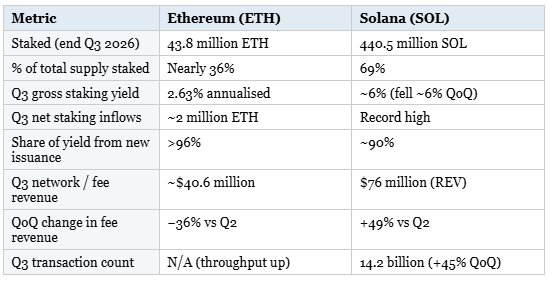
Ethereum staking: 43.8 million ETH locked, nearly 36% of total supply — a new record.
Ethereum yield: Average annualised staking yield fell to 2.63% in Q3, down from 2.81% in Q2. Newly issued ETH accounts for more than 96% of that yield; MEV and priority tips make up the rest.
Ethereum inflows: ~2 million ETH net inflows in Q3; 7.96 million ETH in the first nine months of 2026.
Solana staking: 440.5 million SOL staked, equal to 69% of total supply — also a record.
Solana fees: $76 million in Q3, up 49% quarter-on-quarter, driven by memecoins and tokenised equities.
Solana tokenised equities: Trading volume grew 45% to more than $6.9 billion in Q3.
Bitmine: The leading Ethereum corporate treasury grew its staked ETH position by more than 1,000% between December 2025 and late September 2026.
Ethereum Staking: Six Straight Quarters of Inflows, Yields Still Sliding
Record amounts locked, record-low yields
At the close of September, 43.8 million ETH — just under 36% of Ethereum's circulating supply — was committed to validators through the proof-of-stake consensus mechanism, according to Bitwise's Q3 staking report. The figure marks the sixth successive quarter in which the network registered positive net staking inflows. In Q3 alone, just under 2 million ETH entered staking on a net basis.
Looking at the first nine months of 2026 as a whole, cumulative net inflows reached 7.96 million ETH — a substantial vote of confidence in Ethereum's staking model despite a sustained yield compression that shows no sign of reversing.
The average annualised gross staking yield fell to 2.63% in Q3, down from 2.81% in Q2. The arithmetic is straightforward: as more ETH flows into the validator set, the fixed block reward is divided among a larger pool of stakers, so each individual position earns proportionally less. "As more ETH is staked, rewards are distributed across a larger pool, reducing the yield earned on each ETH," the Bitwise researchers wrote.
New issuance dominates staking returns
The composition of that yield matters as much as the level. More than 96% of Ethereum's staking return in Q3 came from newly issued ETH — the protocol's inflationary reward for running a validator. The remaining slice, less than 4%, came from execution-layer revenue: priority fees (tips) paid by users and maximal extractable value (MEV) captured by validators who optimise transaction ordering.
The heavy dependence on issuance means Ethereum staking yields are essentially a function of the network's monetary policy parameters rather than of organic demand for blockspace. In a world where Ethereum is actively expanding capacity — the gas limit doubled to 60 million after the Dencun upgrade family — on-chain fees have come under structural pressure, leaving issuance to carry almost the entire weight of validator compensation.
Ethereum network revenue: the fee story
Ethereum's network revenue — fees collected by the protocol, split between validators and the burn mechanism — fell to approximately $40.6 million in Q3 from roughly $63 million in Q2, a decline of more than a third. The drop reflects both lower average gas prices and fewer high-fee interactions, as Layer 2 rollups continue to handle an increasing share of user activity at a fraction of the cost of mainnet.
That revenue split works roughly as follows: about three-quarters flows to validators and stakers as an execution bonus, while the remainder is burned under EIP-1559, reducing ETH supply. Because fees represent such a small share of total staking yield — less than 4% — the fall in revenue had a limited direct impact on staker returns, but it does affect the overall economics of Ethereum's monetary policy.
Institutional Staking: Who Is Driving Ethereum Inflows?
Bitwise identifies institutional demand as the primary engine behind Ethereum's staking growth in 2026. Three categories of large buyer have been most active: spot Ethereum ETFs that pass staking rewards to shareholders, corporate treasury companies that hold ETH on their balance sheets and stake for yield, and other large institutional holders building long-term positions.
Bitmine: 1,000% staking growth in nine months
The single most visible example is Bitmine, the publicly traded Ethereum treasury company chaired by veteran analyst Tom Lee. According to the Bitwise report, Bitmine's staked ETH position expanded from approximately 410,000 ETH in December 2025 to 5.07 million ETH as of September 27, 2026 — an increase of more than 1,000% in under ten months.
That staking position, worth around $12.7 billion at mid-year prices, represents roughly 86% of Bitmine's total ETH holdings. The company has disclosed buying Ethereum for 65 consecutive weeks and operates MAVAN, its own institutional staking platform, through which a portion of those holdings are deployed. At a 2.63% annualised yield, a position of that size generates several hundred million dollars per year in staking revenue — making Bitmine one of the largest single sources of passive Ethereum network income among non-custodial entities.
Bitmine's rise illustrates a broader structural shift: the same playbook that MicroStrategy (now Strategy) ran with Bitcoin — accumulating a scarce digital asset at scale and holding it on a public-company balance sheet — is being replicated on Ethereum, with the added dimension of productive yield from staking.
Ethereum Validator Dynamics: More ETH, Fewer Validators
An important nuance in Ethereum's staking data is that total staked ETH has continued to rise even as the number of active validators has fallen. As of early October, the validator count stood at around 881,000, down from roughly 1.1 million at the start of the year. The apparent contradiction resolves when you consider the effect of the Pectra upgrade — a major protocol update that allowed validators to increase their maximum effective balance from 32 ETH to 2,048 ETH. Large operators have been consolidating multiple 32-ETH validators into single large-balance validators, reducing headcount while keeping total staked ETH constant or growing.
This consolidation has two consequences. First, it makes running an Ethereum validator operation more capital-efficient for institutional stakers. Second, it creates a longer entry queue: at one point in July, the staking queue contained around 2.5 million ETH awaiting activation, with estimated wait times exceeding 43 days. High queue depth is itself a sign of strong demand — more capital is trying to enter the staking system than can be processed in any given period.
Solana Staking: Record Participation, Fees Outpace Ethereum
69% of supply staked — the highest among major proof-of-stake networks
Solana's active staking total reached 440.5 million SOL by the end of Q3 — equivalent to 69% of the network's total token supply and the highest staking ratio of any of the six networks covered in Bitwise's report. The figure represents a new record for the network and reflects sustained confidence from both retail and institutional token holders in Solana's validator infrastructure.
Despite the record participation, gross staking yields declined by approximately 6% quarter-on-quarter, mirroring the same dynamic at work on Ethereum: a larger pool of staked tokens means each validator earns a smaller proportion of the total block reward. Approximately 90% of Solana staking returns continue to come from newly issued tokens under the network's inflation schedule, with transaction fees and Jito-based MEV making up the balance.
Transaction activity surges 45%
Solana processed 14.2 billion transactions in Q3 2026 — a 45% increase from the second quarter — while average transaction costs stayed roughly flat. The combination of substantially higher volume at similar per-transaction costs points to a network absorbing organic demand growth without meaningfully adjusting its fee market, a consequence of Solana's architecture, which favours low and predictable fees over variable pricing.
$76 million in fees: memecoins and tokenised equities
Even with flat per-transaction costs, aggregate fee revenue — measured as real economic value (REV) — jumped 49% to $76 million in Q3, up from approximately $51 million in Q2. Bitwise attributes the increase primarily to two sources: memecoin trading activity and the rapidly expanding market for tokenised equities on Solana.
On the tokenised equities side, trading volume grew 45% quarter-on-quarter to more than $6.9 billion in Q3 — a figure that would have seemed implausible only a year earlier. For context, the entire on-chain tokenised equity market barely registered measurable volumes as recently as June 2025, when monthly volumes stood at roughly $1.34 million. The explosion in activity has been driven by the launch of tokenised versions of high-profile stocks and pre-IPO companies on Solana-native platforms, with Backpack Securities capturing a dominant share of SpaceX-linked tokenised product trading.
The memecoin-to-tokenised-stock evolution of Solana's fee base is significant for a different reason: it signals a gradual shift in the network's economic driver from purely speculative activity toward instruments that have direct counterparts in traditional financial markets. Whether that shift proves durable depends on the regulatory treatment of tokenised equities in major jurisdictions — a question that remains unsettled.
Ethereum vs. Solana: Q3 2026 Staking Metrics at a Glance
Why Yields Are Falling — and Whether That Is a Problem
The compression of staking yields across proof-of-stake networks is not a sign of system failure; it is, in part, the expected outcome of a maturing market. When staking was new and participation rates were low, early stakers earned outsized returns for providing security to a lightly tested network. As more capital flows in, the risk premium implicit in staking naturally falls.
On Ethereum specifically, the yield trajectory also reflects a deliberate design choice. The network's validator reward curve is structured so that yields decrease as more ETH is staked, creating a natural equilibrium: lower yields discourage excessive staking, which would lock up too much ETH and reduce liquid supply. At the current 36% participation rate, the network is operating within its intended parameters.
The relevant question for investors is whether a 2.63% yield — broadly comparable to very short-term US government debt — is sufficient to justify the capital commitment and technical overhead of running a validator or delegating to a liquid staking protocol. For institutional holders like Bitmine, the answer is clearly yes: the yield is supplementary income on a position held primarily for capital appreciation and balance-sheet exposure, not a standalone investment case. For retail stakers, the calculus is more sensitive to ETH's price trajectory.
On Solana, the picture is different. A gross yield of around 6% is more competitive in absolute terms, but the near-total dependence on inflation (roughly 90% of returns) means the real yield — after accounting for the dilutive effect of new token issuance on all SOL holders — is considerably lower. Solana's inflation schedule is designed to decline over time, so the inflationary component of yield will shrink further, putting more pressure on fee revenue to compensate.
What the Data Suggests for Q4 and Beyond
The Bitwise report does not offer forward projections, but the underlying trends point in a few directions.
Continued ETH staking inflows: With institutional demand structurally present — through ETFs, corporate treasuries, and Pectra-enabled large-balance consolidation — the staking ratio is likely to keep rising. Each percentage point increase further dilutes per-staker yields.
Solana fee growth dependency: Solana's stronger fee performance this quarter rested heavily on memecoin volumes, which are notoriously cyclical. If tokenised equities trading sustains or accelerates, it would provide a more durable source of network revenue and could partially offset the next decline in memecoin activity.
Pectra's full effect on validator counts: The consolidation of validators has only partially run its course. More large operators are expected to migrate to higher-balance validators, which could further reduce the headline validator count even as staked ETH continues to grow.
Institutional staking platforms: Bitmine's MAVAN platform and the broader emergence of institutional-grade staking infrastructure suggest that the trend of large-balance, yield-optimised staking is still in early innings. How much ETH ultimately finds its way into corporate treasuries is one of the more consequential open questions in Ethereum's monetary policy.
Frequently Asked Questions
What is proof-of-stake staking and why do yields change?
Proof-of-stake staking means locking up tokens as collateral to participate in validating transactions. In return, validators receive a share of the protocol's block reward (newly issued tokens) plus any fees paid by users. Yields fall as more tokens are staked because the same reward pool is divided among more participants. Both Ethereum and Solana use this model.
What is the difference between gross staking yield and real yield?
Gross staking yield is the nominal return a staker receives, expressed as an annualised percentage of staked tokens. Real yield subtracts the effect of inflation — the dilution that newly issued tokens impose on all holders of the asset. On Solana, where roughly 90% of staking returns come from new issuance, the real yield is significantly lower than the headline figure.
What is MEV, and why does it matter for Ethereum stakers?
Maximal extractable value (MEV) refers to the additional profit validators can earn by choosing the order in which transactions are included in a block — for instance, by front-running pending trades or arbitraging price differences between decentralised exchanges. On Ethereum, MEV and priority fees together contributed less than 4% of staking yield in Q3, a share that has been declining as cheap blockspace reduces the frequency of lucrative MEV opportunities.
What is "real economic value" (REV) on Solana?
REV is Solana's preferred metric for measuring network fee income. It aggregates base transaction fees with priority fees (tips paid by users to get faster inclusion) and Jito tip payments (MEV-related revenue captured through the Jito block engine). It provides a cleaner picture of economic activity on the network than base fees alone, since priority fees have become the dominant component.
What are tokenised equities on Solana?
Tokenised equities are blockchain-based representations of shares in real-world companies, issued and traded on Solana-native platforms such as Backpack Securities. They allow investors to buy and sell fractional exposure to stocks like SpaceX or Micron entirely on-chain, without going through a traditional brokerage. Trading volume in this category surged from $1.34 million per month in June 2025 to more than $6.9 billion in Q3 2026 — a roughly 5,000-fold increase in just over a year.
Is Bitmine's Ethereum strategy similar to MicroStrategy's Bitcoin strategy?
The structural parallel is widely drawn. Both companies accumulate a single digital asset at scale on a public-company balance sheet, using equity issuance and debt to fund purchases. The key difference is that Ethereum is a productive asset: Bitmine stakes the bulk of its ETH holdings, generating what the company projects as several hundred million dollars per year in staking revenue at current yields — a cash-flow dimension absent from MicroStrategy's Bitcoin-holding strategy.
Want to join the discussion? Login and create a profile to comment.