Ethereum Price Prediction: Can ETH Climb Back Above $4,000 in 2027 After a Challenging 2026?

Ethereum is trading near $2,445 following a wave of spot ETF outflows. A return to $4,000 in 2027 is possible, but it would require a substantial rally and a clear revival in investor demand. Staking, the upcoming Glamsterdam upgrade and a handful of key price levels will shape the ETH outlook.
Key Takeaways
ETH traded near $2,445 on October 19, about 39% below the $4,000 mark.
Reclaiming $4,000 would require a gain of roughly 64%.
US spot Ethereum ETFs saw about $955 million in net outflows between October 1 and October 16.
Cumulative ETF inflows since launch still stand near $13 billion.
About 35% of the ETH supply was reported staked in September.
The Glamsterdam upgrade goes live on the Hoodi testnet on October 26; no mainnet date has been set.
Ethereum could return above $4,000 in 2027, but the second-largest cryptocurrency by market capitalization faces a steep climb after struggling through much of 2026. Institutional selling and weak market momentum have overshadowed steady progress in the underlying network, leaving the ETH price well below its earlier highs.
On October 19, ETH traded near $2,445, roughly 39% under the $4,000 threshold. Getting back to that level would take a gain of about 64%, which is why a sustained recovery in investment demand has become so important for the Ethereum price prediction for 2027.
Can Ethereum Recover to $4,000 in 2027?
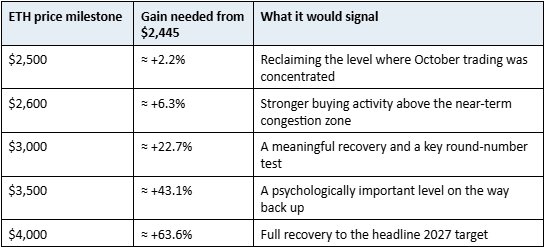
Near-Term Levels: $2,500 and $2,600
Ethereum has spent October struggling to build a lasting recovery, with most recent trading concentrated around $2,500. The first task for buyers is to reclaim $2,500 and then establish stronger buying activity above the $2,600 area. Holding above that zone would suggest that demand is starting to absorb the selling pressure that has weighed on ETH for weeks.
The Road to $3,000, $3,500 and $4,000
If ETH can sustain an advance, $3,000 would come back into focus as the next major checkpoint, followed by the psychologically important $3,500 and $4,000 levels. Each of these round numbers tends to attract attention from traders and can act as a point where profit-taking slows a rally.
It is important to stress that these figures are scenario milestones, not confirmed future resistance levels. A genuine recovery toward $4,000 would need broader market participation and stronger capital inflows, not just a short-lived improvement in sentiment.
Tempered Expectations Compared With Earlier Forecasts
The current outlook is also noticeably more cautious than earlier expectations that Ethereum could quickly reach five-figure valuations. Past long-term ETH price predictions show how sharply sentiment can change as prices and market conditions evolve, and why any forecast for 2027 should be treated as a range of scenarios rather than a fixed target.
Nearly $1 Billion in ETF Outflows Weighs on the ETH Recovery
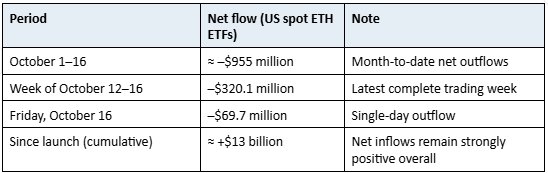
Institutional demand is currently one of the most visible obstacles to an Ethereum rebound. According to fund flow data from Farside Investors, US spot Ethereum ETFs recorded approximately $955 million in net withdrawals between October 1 and October 16.
The latest full trading week, October 12–16, accounted for $320.1 million of those outflows, including $69.7 million on Friday alone. That steady pace of redemptions shows that institutional investors have been reducing exposure rather than buying the dip.
Why Cumulative Inflows Still Matter
Despite the recent selling, cumulative net inflows into spot ETH ETFs since the products launched remain close to $13 billion. This contrast is important: short-term withdrawals do not prove that institutions have permanently abandoned Ethereum. They do, however, show that fresh institutional capital is not currently supporting the price.
For a sustained move toward $4,000 to become more realistic, ETF flows would likely need to stabilize first and then turn consistently positive. Spot ETF flows are widely followed as a gauge of institutional appetite because they reflect real money entering or leaving ETH through regulated investment vehicles.
ETH Staking and Supply Dynamics
Ethereum’s supply profile adds another layer to the outlook. Around 35% of all ETH was reported to be staked in September. Staked ETH is locked to help secure the network through its proof-of-stake consensus mechanism, which reduces the amount of ether immediately available for trading on exchanges.
However, this should not be overstated. Staking does not remove tokens permanently: validators can exit and withdraw their ETH, although the process is not instant. More importantly, a smaller liquid supply cannot by itself generate stronger demand. Reduced circulating supply can amplify a rally once buyers return, but it cannot start one on its own.
Could the Glamsterdam Upgrade Help Ethereum Recover in 2027?
Ethereum’s next major technical milestone is getting closer. The Ethereum Foundation has confirmed that the Glamsterdam upgrade will activate on the Hoodi testnet on October 26, with the test network’s gas limit rising to 200 million. Hoodi is one of Ethereum’s public test networks, used by developers and validators to rehearse protocol changes before they reach mainnet.
What Glamsterdam Is Designed to Improve
The planned changes focus on improvements to block construction, parallel transaction processing and execution efficiency. The headline proposals associated with the upgrade are enshrined proposer-builder separation (ePBS), which brings the separation between block proposers and block builders into the core protocol, and block-level access lists, which are designed to let clients process transactions in parallel more effectively. A higher gas limit increases how much computation each block can hold, which is central to Ethereum’s layer-1 scaling roadmap.
What the Upgrade Does Not Guarantee
The Glamsterdam test shows that developers are continuing to push Ethereum’s scaling roadmap forward despite weak market conditions. Still, there are two important caveats. First, no date has been set for mainnet activation. Second, a successful testnet deployment does not automatically translate into a financial return for ETH holders. Network upgrades strengthen the long-term fundamentals, but price recovery ultimately depends on demand.
Other Potential Catalysts: Staking Products and Corporate Treasuries
Staking-Enabled Investment Products
The longer-term investment case for Ethereum also includes the potential for investment products that offer staking yield. Institutional investors may be attracted to the combination of ETH price exposure and staking income, which could strengthen demand if broader financial conditions improve. This feature sets ETH apart from assets that do not generate any native yield.
Ethereum Treasury Companies
Corporate ownership offers another possible source of demand. Several publicly traded companies are already pursuing Ethereum treasury strategies, holding ETH on their balance sheets as a reserve asset. Continued accumulation by these firms could provide a source of buying pressure independent of ETF flows.
Bottom Line: Is $4,000 ETH Realistic in 2027?
A return to $4,000 in 2027 is within the range of possible outcomes, but it is far from guaranteed. ETH would need to rise roughly 64% from current levels, and the latest data show institutional money flowing out rather than in.
On the positive side, cumulative ETF inflows remain large, a significant share of supply is staked, and network development continues with Glamsterdam. The key variables to watch are whether ETF flows turn positive, whether ETH can reclaim $2,500–$2,600 and then $3,000, and whether the Glamsterdam upgrade progresses toward a mainnet date.
Frequently Asked Questions
How much does Ethereum need to rise to reach $4,000?
From around $2,445, ETH would need to gain approximately 64% to reach $4,000.
How much did Ethereum ETFs lose in October?
According to Farside Investors, US spot ETH ETFs saw about $955 million in net outflows from October 1 to October 16, including $320.1 million during the week of October 12–16.
What is the Glamsterdam upgrade?
Glamsterdam is Ethereum’s next planned network upgrade, focused on block construction, parallel transaction processing and execution efficiency. It goes live on the Hoodi testnet on October 26; a mainnet date has not yet been set.
How much ETH is staked?
About 35% of the ETH supply was reported staked in September, which limits the amount immediately available for trading.
What key price levels should ETH traders watch?
The near-term levels are $2,500 and $2,600, followed by $3,000, $3,500 and $4,000 as longer-term recovery milestones.
Disclaimer: This article is for informational purposes only and does not constitute financial or investment advice. Cryptocurrency markets are highly volatile; always do your own research before making any trading decisions.
Want to join the discussion? Login and create a profile to comment.