Ethereum’s Finality Overhaul: How Cutting Settlement Time from 16 to 4 Minutes Could Reshape Crosschain Transfers and Bridge Economics

Key Takeaways
Ethereum researchers have filed a draft proposal to cut transaction finality from roughly 16 minutes to approximately 4 minutes by decoupling the two jobs currently bundled into a single validator attestation.
The authors are Ben Edgington, Francesco D’Amato, Roberto Saltini, Yann Vonlanthen, and Mikhail Kalinin — all affiliated with Ethereum Foundation consensus research.
The core mechanism separates fork-choice voting (picking the next block) from finality voting (permanently locking in older blocks), letting finality run on its own faster clock.
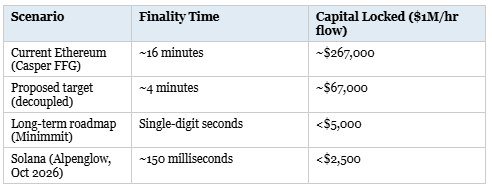
The change has direct cost implications for crosschain bridges and stablecoin transfer services: a service fronting $1 million per hour could cut its idle capital from ~$267,000 (at 16 min) to ~$67,000 (at 4 min).
Circle’s CCTP already prices in the finality risk: its fast crosschain USDC route from Ethereum costs a minimum of 0.01% (1 basis point), while the standard route carries no Circle transfer fee.
The proposal is unfinished, with voting timings, penalties, and parts of the security analysis still marked as TBD. It has no activation date.
Solana activated its Alpenglow upgrade on October 21, 2026, targeting finality of approximately 150 milliseconds — still roughly 1,600 times faster than the 4-minute Ethereum target.
The long-term Ethereum roadmap, outlined in Vitalik Buterin’s strawmap, targets single-digit-second finality by 2029 via a series of incremental forks and an eventual shift to the Minimmit consensus protocol.
Introduction: Why Finality Is the Hidden Tax on Every Crosschain Trade
Every time a user moves funds from Ethereum to another blockchain — bridging USDC to Base, routing ETH to an L2, or settling a crosschain swap — there is a moment where the transaction exists in an uncomfortable middle state. The funds have left the sender’s Ethereum account, but the network has not yet made an irrevocable commitment that they will never be rewound. That window is called the pre-finality period, and on Ethereum today it lasts approximately 16 minutes.
For retail users, this wait is largely invisible. The bridge or transfer service typically credits the destination account immediately, absorbing the finality risk on the user’s behalf. But someone has to pay for that risk. When a bridge fronts $10,000 while it waits for Ethereum to finalize the source transaction, that capital is tied up and unavailable for other uses. At scale, across thousands of concurrent users and millions of dollars in daily bridge volume, the aggregate cost of this pre-finality float becomes material.
A research team at the Ethereum Foundation has filed a draft proposal aimed at cutting that wait fourfold, from roughly 16 minutes to approximately 4 minutes. The mechanism is elegant in concept: rather than forcing finality to move at the same speed as block-by-block voting, the proposal separates those two jobs and gives finality its own faster clock. If it succeeds, the change would not just improve user experience — it would structurally reduce the cost of operating every crosschain bridge and stablecoin transfer service that settles on Ethereum.
This article explains how Ethereum finality works today, what the proposal changes at the technical level, what it means for bridge economics and stablecoin infrastructure, and how it fits into the broader race between Ethereum and Solana on settlement speed.
Section 1: How Ethereum Finality Works Today
The Gasper Consensus Mechanism
Ethereum’s current consensus layer is called Gasper, a combination of two protocols: LMD GHOST (Latest Message Driven Greediest Heaviest Observed SubTree), which handles fork choice — determining which chain tip is canonical at any given moment — and Casper FFG (Friendly Finality Gadget), which handles finality — permanently locking in historical blocks so they can never be reorganized.
Both protocols run on the same attestation structure. Every 12 seconds, the network advances by one slot, and validators cast attestations that simultaneously encode both a fork-choice vote (which block they believe is the current chain tip) and a finality vote (which checkpoint they are supporting as a candidate for permanent finalization). There are currently over one million active Ethereum validators, and roughly 30,000 of them attest in any given slot.
Why Finality Takes 16 Minutes
Casper FFG finalizes blocks through a two-phase process. First, a checkpoint (a block at the start of each epoch, where an epoch is 32 slots of 12 seconds each = 6.4 minutes) must be justified — it receives supermajority support from validators. Then, in the next epoch, the network must justify a second checkpoint that builds on the first, which causes the first to become finalized. This two-phase pipeline means that under normal conditions, a block reaches finality after approximately two full epochs, or roughly 12.8 minutes at the minimum, with an average closer to 16 minutes accounting for slot timing and network propagation.
In practice, this means that between 63 and 95 of the most recent blocks are in an unfinalised, reorganization-vulnerable state at any given time. They are visible on-chain and presumed valid, but the network has not yet made an irreversible commitment to them. Services that build on Ethereum — bridges, stablecoin issuers, DEXes with crosschain routing — must choose between waiting for finality or accepting the risk of a reorg.
The Single-Attestation Bottleneck
The root cause of the 16-minute delay is the coupling of fork choice and finality into a single attestation structure. Because both jobs are carried in the same vote, and because validators rotate through attestation slots sequentially, finality can only advance as fast as the slowest constraint between the two tasks. Fork choice needs to be fast — the network must agree on the current chain tip with each 12-second slot. But finality is a much heavier security commitment that requires the participation of the full validator set across two epochs.
By bundling both jobs together, Gasper effectively forces finality to wait for every cycle of fork-choice voting to complete. The result is a finality period measured in epochs (minutes), not seconds.
Section 2: The Proposal — Splitting the Attestation
Who Filed It and When
The draft was filed by Ben Edgington (who coordinates Ethereum’s fast-finality research), Francesco D’Amato, Roberto Saltini, Yann Vonlanthen, and Mikhail Kalinin — all researchers affiliated with the Ethereum Foundation’s consensus team. Edgington has described his role as “cat-herder” for the fast-finality effort, and the proposal is the output of a research track that has been active since at least early 2026. The team’s immediate stated goal was to obtain a formal proposal number, which enters the idea into Ethereum’s official upgrade pipeline.
The Core Mechanism: Decoupled Finality
The proposal’s central idea is to give finality its own separate voting track, independent of the slot-by-slot fork-choice attestations. Instead of a single attestation that does both jobs, validators would cast two types of votes:
A fork-choice vote (functionally similar to the current LMD GHOST attestation) that helps the network agree on the current chain tip at each slot. This vote would be cast by a smaller rotating committee — potentially as few as 256 to 512 validators — rather than the full validator set.
A finality vote cast through a separate, dedicated finality gadget that runs on its own timescale, not bound by slot duration or epoch length. The full validator set would participate in this track to maintain the security guarantees of the existing Casper FFG model.
By allowing the finality gadget to run on a faster, independent clock, the proposal breaks the coupling that forces finality to wait for two full epochs. The initial target is a fourfold improvement, from roughly 16 minutes to roughly 4 minutes. But the researchers view this as a first step: the architecture is designed so that the finality clock can be tightened further over time as client implementations, networking, and aggregation techniques improve.
How the Mechanism Enables Future Speed Gains
The decoupled design creates a modular architecture that makes future upgrades easier to deploy independently. Under the current Gasper model, any change to finality timing requires coordinating changes to the same attestation structure that handles fork choice — a complex, high-stakes operation. Under the decoupled model, the finality gadget can be upgraded on its own without touching the fork-choice layer.
The Ethereum Foundation’s research roadmap envisions a series of further speed improvements that this architecture enables, including:
Validator consolidation: EIP-7702 and Electra allow up to 64 validators to be merged into a single one, reducing the raw number of attestations the network must process per epoch and allowing finality rounds to run faster.
Attestation batching: Aggregating attestations at the point of origin (rather than at the aggregator layer) to reduce network overhead.
Networking improvements: Protocol upgrades including ethp2p and SNARK-based aggregation, which can reduce the bandwidth cost of finality voting.
Single-round finality protocols: Research into protocols such as Minimmit and Goldfish, which could eventually achieve finality in a single round of voting rather than two, potentially reducing finality time to single-digit seconds.
The Quantum-Resistance Angle
A secondary benefit flagged by the researchers is architectural readiness for post-quantum cryptography. If quantum computers eventually become capable of breaking the elliptic-curve cryptography used in current Ethereum validator signatures, the network would need to swap in quantum-resistant signature schemes — a change that touches every attestation in the system.
Under the current coupled architecture, such a swap would require changing the attestation structure that handles both fork choice and finality simultaneously — a high-coordination, high-risk upgrade. The decoupled design makes it possible to upgrade each track independently, reducing the complexity of a future quantum-resistance migration. This is a long-range consideration: no current quantum computer is close to breaking 256-bit elliptic curve cryptography, and Ethereum’s long-term roadmap envisages post-quantum signature migration as part of the broader 2029 upgrade path.
Section 3: What the Proposal Does Not Yet Resolve
Ben Edgington was explicit in the initial filing that “many aspects remain TBD.” The unresolved elements include:
Voting timing parameters: The exact cadence at which the finality gadget runs — whether every 1 minute, 2 minutes, or some other interval — is not yet specified. The 4-minute target is a design goal, not a fixed commitment.
Penalty mechanics: How validators are penalized for missing finality votes or for equivocating (casting conflicting votes) on the finality track has not been defined.
Security analysis: Parts of the formal safety and liveness proofs for the decoupled model remain incomplete. The Ethereum Foundation’s consensus team has used Lean 4 for formal verification of related models, but full proofs for this proposal are pending.
Activation date: No testnet deployment or mainnet activation timeline has been announced. The proposal entering the EIP pipeline is the beginning of a process that typically takes one to two years from draft to mainnet activation.
This level of incompleteness is normal for early-stage Ethereum proposals. The Ethereum development process explicitly separates the research and specification phases from the implementation and testing phases. Getting an EIP number is a milestone that formalizes research into a trackable proposal, not an announcement of imminent deployment.
Section 4: The Bridge Economics Argument
How Pre-Finality Float Creates Real Costs
To understand why finality speed matters for bridge economics, consider the mechanics of a crosschain stablecoin transfer. When a user sends $10,000 of USDC from Ethereum to another network — Arbitrum, Base, or Optimism — a typical bridge or transfer service has two options: wait 16 minutes for the Ethereum transaction to finalize before releasing funds on the destination chain, or release funds immediately from its own reserve capital and wait to be repaid once finality is confirmed.
For a service that wants to offer instant or near-instant transfers, the second model is the only viable one. But it has a cost: the fronted capital is locked up for 16 minutes per transaction. At scale, the aggregate locked capital equals:
Locked capital = (Transfer rate per minute) × (Finality time in minutes)
The Ethereum Foundation’s research illustrates this with a concrete example. A service fronting a steady $1 million per hour in crosschain transfers would have:
At 16-minute finality: approximately $267,000 in idle capital awaiting settlement at any given moment
At 4-minute finality: approximately $67,000 in idle capital — a reduction of $200,000
That $200,000 in freed capital either reduces the service’s working capital requirement (lowering its financing costs) or allows it to serve a larger volume of transfers without raising additional capital. At higher transfer rates — $10 million per hour, $100 million per hour — the freed capital scales proportionally. For the largest bridge operators, which collectively process tens of billions of dollars per month, the aggregate capital efficiency gain from faster Ethereum finality could be measured in the hundreds of millions of dollars.
Circle CCTP: A Live Example of Finality Pricing
Circle’s Cross-Chain Transfer Protocol (CCTP) provides one of the clearest real-world examples of how Ethereum finality costs are priced into stablecoin infrastructure. CCTP allows USDC to move natively between blockchains — the source-chain USDC is burned and an equivalent amount is minted on the destination chain, rather than being wrapped or bridged in a way that creates a derivative token.
Circle offers two routes for CCTP transfers:
The standard route carries no Circle transfer fee. It waits for Ethereum to finalize the burn transaction before minting on the destination chain — meaning users or applications wait the full 16-minute finality period.
The fast route charges a minimum of 0.01% (1 basis point) of the transfer amount per transaction. It mints on the destination chain before the source transaction is finalized, with Circle absorbing the finality risk and charging a fee that reflects the cost of pre-financing the transfer.
Circle also caps the total value of fast transfers that are simultaneously awaiting Ethereum finalization. Each completed finalization frees up capacity for new fast transfers. This cap reflects the finite amount of capital Circle is willing to have in pre-finality float at any given time — a direct function of Ethereum’s finality period.
A reduction in Ethereum finality time from 16 minutes to 4 minutes would directly affect both the fee structure and the capacity cap. The cost of pre-financing a fast USDC transfer would fall by approximately 75% (since capital is tied up for one-quarter as long), creating competitive pressure to reduce the 0.01% fast-transfer fee. The capacity cap could simultaneously be increased without raising Circle’s peak capital exposure, allowing more users to access fast transfers concurrently.
Section 5: The Ethereum vs. Solana Finality Gap
Solana’s Alpenglow Upgrade
The Ethereum finality proposal arrived in the same week that Solana activated its Alpenglow upgrade on October 21, 2026. Alpenglow replaces Solana’s existing TowerBFT consensus mechanism with a new protocol called Votor, targeting transaction finality of approximately 150 milliseconds. This is not an aspirational figure for a future version of the network — it was the stated target for the live activation.
To put the comparison in concrete terms: Solana’s post-Alpenglow finality of 150 milliseconds is approximately 6,400 times faster than the current 16-minute Ethereum finality, and approximately 1,600 times faster than the 4-minute target of the Ethereum proposal filed this week. Even Ethereum’s long-term Minimmit-based single-digit-second finality, which would not be achievable until multiple forks beyond the current I* candidate, would still be 10 to 60 times slower than Solana’s current post-Alpenglow performance.
This is the competitive context in which Ethereum’s finality research is being conducted. The comparison is not necessarily fair — Ethereum and Solana make different architectural trade-offs regarding decentralization, validator set size, and economic security — but it shapes the urgency of the research agenda and the public discourse around both proposals.
Why the Comparison Is Complicated
Finality speed is not the only relevant dimension when comparing settlement systems. Several structural differences between Ethereum and Solana affect how the numbers should be interpreted:
Validator set size: Ethereum has over one million active validators; Solana has a few thousand. Achieving fast finality with a larger, more geographically distributed validator set is inherently more difficult, because more messages must be exchanged and aggregated before a supermajority can be confirmed. Solana’s Alpenglow can target 150ms partly because the validator set is small enough for rapid BFT-style coordination.
Economic security: Ethereum’s large staked ETH base (worth hundreds of billions of dollars) means that attacking the finality layer would require acquiring and risking an enormous amount of capital. Solana’s validator economics are different, and the security model of a 150ms BFT protocol with a smaller validator set is not directly comparable to Casper FFG’s two-epoch pipeline.
L2 ecosystem: Ethereum’s L2 landscape (Arbitrum, Base, Optimism, zkSync, etc.) means that a significant portion of Ethereum transactions already achieve effective finality in seconds on L2s, with Ethereum L1 finality serving as the ultimate settlement layer for withdrawals and dispute resolution. The 16-minute L1 finality is most relevant for bridging out of Ethereum to other L1s, not for everyday L2 activity.
Section 6: Where the Proposal Fits in the Ethereum Roadmap
The Seven-Fork Strawmap Through 2029
In 2026, Vitalik Buterin and the Ethereum Foundation outlined a multi-fork roadmap (informally called the strawmap) targeting a series of improvements through 2029. The roadmap envisions approximately seven protocol forks, with the following broad trajectory for finality:
Near-term (I* fork, candidate for 2027)**: Decoupled consensus — the mechanism described in the current proposal — is identified as a headliner candidate. If adopted, it would deliver the 4-minute finality targe
Slot time reduction: Buterin has described a series of incremental slot-time cuts from the current 12 seconds down through 8, 6, 4, 3, and eventually 2 seconds. Shorter slot times reduce the base unit of time in the finality calculation.
Minimmit adoption: The longer-term goal is to replace Casper FFG with a single-round finality protocol such as Minimmit, which would dramatically reduce the number of voting rounds needed and push finality into single-digit seconds.
Post-quantum bundling: The largest consensus changes are expected to ship alongside a migration to hash-based post-quantum signatures and a STARK-friendly hash function, making the cryptographic infrastructure quantum-resistant.
The strawmap is explicitly aspirational and not a fixed commitment. Ethereum’s upgrade process is driven by research progress, client team capacity, and community consensus, all of which evolve. The I* fork is a candidate vehicle, not a scheduled deployment. But the presence of decoupled finality on the strawmap means it has formal research and development momentum behind it, and the filing of this proposal gives it a specific proposal number to track.
The Relationship Between L1 Finality and L2 Security
One dimension of the finality debate that affects Ethereum more than it affects Solana is the role of L1 finality in the security model of Layer 2 rollups. Optimistic rollups like Arbitrum and Optimism post transaction batches to Ethereum L1 and rely on L1 finality to guarantee that those batches cannot be reorganized once confirmed. The 16-minute L1 finality does not affect the user experience on L2 for most transactions, but it determines the minimum time for a fraud proof window to begin — and, critically, the time it takes for assets to be withdrawn from an L2 back to Ethereum L1.
A reduction in L1 finality from 16 minutes to 4 minutes would shorten the minimum fraud-proof window and accelerate withdrawal times from optimistic rollups. For ZK rollups, which use validity proofs rather than fraud proofs, faster L1 finality reduces the latency between a ZK proof being posted to L1 and that proof becoming irreversible. In both cases, the security and user-experience improvements on L2 flow directly from faster L1 finality.
Frequently Asked Questions
What is Ethereum transaction finality and why does it take 16 minutes?
Ethereum transaction finality is the point at which the network permanently and irrevocably commits to a block, making it impossible for validators to reorganize it away. Under the current Casper FFG mechanism, finality requires two successive epochs of validator voting — each epoch is 32 slots of 12 seconds, or 6.4 minutes — giving a minimum of about 12.8 minutes and an average of roughly 16 minutes under normal conditions.
What is the new proposal and who wrote it?
The proposal was filed by Ben Edgington, Francesco D’Amato, Roberto Saltini, Yann Vonlanthen, and Mikhail Kalinin, all Ethereum Foundation consensus researchers. It proposes decoupling fork-choice voting from finality voting by giving each job its own independent attestation track. The initial target is to reduce finality from about 16 minutes to about 4 minutes. The proposal has no activation date and several aspects remain unresolved.
What does “decoupled finality” mean?
Currently, each Ethereum validator casts a single attestation that simultaneously performs two jobs: helping the network pick the current chain tip (fork choice) and supporting the permanent locking of older blocks (finality). Decoupling means separating these into two independent voting tracks. Fork choice would use a smaller, faster committee of validators; finality would run its own separate gadget on a faster clock, unbounded by the epoch-based schedule that governs the current system.
How does faster Ethereum finality reduce crosschain bridge costs?
Bridges and stablecoin transfer services that offer instant crosschain transfers must front capital during the pre-finality window — releasing funds on the destination chain before the source-chain transaction is finalized. The longer the finality wait, the more capital is tied up at any given time. A service processing $1 million per hour has approximately $267,000 locked at 16-minute finality; at 4-minute finality, that drops to roughly $67,000. Freeing $200,000 reduces the service’s financing cost or allows it to serve a larger volume without additional capital.
How does Circle USDC price in Ethereum finality risk?
Circle’s Cross-Chain Transfer Protocol (CCTP) offers a standard route (no Circle fee, waits for Ethereum finalization) and a fast route that charges a minimum of 0.01% (1 basis point) per transfer to absorb the pre-finality risk and release funds on the destination chain before the source transaction is final. Circle also caps the total value of fast transfers simultaneously in the pre-finality window. Faster Ethereum finality would reduce both the cost and the capacity constraints of this fast route.
How does the 4-minute target compare to Solana?
Solana activated the Alpenglow upgrade on October 21, 2026, targeting finality of approximately 150 milliseconds using the new Votor consensus protocol. The proposed 4-minute Ethereum target would still be about 1,600 times slower than Solana’s post-Alpenglow performance. However, the two networks have different validator set sizes, economic security models, and architectural trade-offs. Ethereum’s long-term roadmap targets single-digit-second finality via a future shift to the Minimmit consensus protocol, which would narrow but not close the gap with Solana.
When will faster Ethereum finality be activated?
No activation date has been set. The proposal has been entered into Ethereum’s formal upgrade pipeline, which is the first step in a process that typically takes one to two years from draft to mainnet. Decoupled consensus is identified as a candidate for the I* fork, which the strawmap places as a potential 2027 deployment. The proposal itself notes that “many aspects remain TBD,” including voting timing parameters and penalty mechanics.
Conclusion: A 75% Cut in Finality Has Compounding Effects Across the Ecosystem
The Ethereum fast-finality proposal is not a flashy product announcement. There is no launch date, no marketing campaign, and several critical technical details remain unresolved. What it represents is a formal entry into Ethereum’s research and development pipeline of an idea that has direct, quantifiable economic consequences for the infrastructure that sits on top of Ethereum.
The bridge economics argument is the most concrete path from the technical change to a user-visible outcome. A 75% reduction in pre-finality float does not just lower costs for bridge operators — it expands capacity, reduces fees, and makes instant crosschain transfers economically viable at higher volumes and lower price points. Circle’s CCTP fee structure illustrates exactly how finality time is priced today: the 0.01% fast-transfer premium is a direct measure of the cost of absorbing Ethereum’s 16-minute risk window. A fourfold reduction in finality time should, all else equal, make that premium compressible toward zero.
The Solana comparison will continue to dominate the narrative — 150 milliseconds is simply a more compelling headline than 4 minutes, and Alpenglow activated on the same day this draft was filed. But the comparison somewhat misses the point. Ethereum is not trying to match Solana’s finality speed on Solana’s terms; it is trying to improve its own settlement infrastructure while maintaining the decentralization and economic security properties of a network with over one million validators and hundreds of billions of dollars in staked value.
A four-minute Ethereum finality, if delivered, would be a meaningful step in that direction — and the decoupled architecture it introduces would create the foundation for the further improvements, including slot-time reductions, Minimmit adoption, and post-quantum cryptography, that the strawmap envisions through 2029. The proposal is the beginning of a long road, not the destination.
Want to join the discussion? Login and create a profile to comment.