France Votes to Tax Crypto-to-Stablecoin Swaps — What Investors Need to Know

French lawmakers have voted to strip away one of the last remaining tax shelters available to crypto investors in France: the ability to convert volatile digital assets into stablecoins without triggering an immediate capital gains bill. The move — passed by the slimmest possible majority in the National Assembly — arrives as hundreds of thousands of protesters take to French streets over the rising cost of living, spotlighting the country's deepest fiscal tensions in years.
On 16 October 2026, the National Assembly approved amendment I-3898 by 38 votes to 37, with 25 abstentions. If the wider 2027 finance bill (PLF 2027) becomes law, the change would take effect on 1 January 2027.
Key Takeaways
The French National Assembly passed amendment I-3898 on 16 October 2026 by 38 votes to 37.
It would apply France's existing 31.4% flat tax (PFU) to swaps from cryptocurrency into qualifying fiat-backed stablecoins.
Only e-money tokens (EMTs) under the EU's MiCA regulation are affected — coins such as USDC and EURC. Simply holding stablecoins remains tax-free.
Regular crypto-to-crypto swaps (e.g. Bitcoin to Ether) keep their existing tax deferral.
The measure is not law yet: it still needs to pass the Senate and survive the remainder of the budget process. The government has opposed it on administrative grounds.
What the National Assembly Actually Voted On
The amendment was introduced by Nicolas Sansu, a left-wing deputy from the GDR (Democratic and Republican Left) group, and co-signed by 16 colleagues. It targets Article 150 VH bis of the French General Tax Code (Code général des impôts), which currently governs how digital-asset gains are taxed.
Under existing law, a "taxable event" only occurs when a crypto investor converts assets into ordinary fiat currency (euros or other legal tender) or uses them to pay for goods and services. Swaps that stay within the digital-asset world — including conversions into stablecoins — are treated as tax-neutral exchanges, with the gain merely deferred until a later cash-out.
The Sansu amendment would classify conversions into e-money tokens (EMTs) — a MiCA regulatory category covering fiat-backed stablecoins pegged to a single official currency — as a taxable disposal. No new rate is created; instead, gains would be taxed under the existing prélèvement forfaitaire unique (PFU) of 31.4%. That rate is made up of 12.8% income tax and 18.6% in social charges (the social-charge component rose from 17.2% when it was revised in January 2026).
The amendment's authors frame it as closing a loophole rather than introducing a new burden, and point to the United Kingdom and Italy as European jurisdictions that already tax equivalent conversions.
The road to the floor vote
The Finance Committee of the National Assembly first adopted the measure on 7 October 2026. However, the committee subsequently rejected the entire revenue section of the government's 2027 budget by 31 votes to 3, which meant the stablecoin amendment was not automatically carried forward. Supporters were required to re-table it when the full chamber debated the revenue section from 13 October, leading to the 38–37 floor vote on 16 October.
The government opposed the amendment during that debate, arguing that tracking crypto-to-stablecoin transactions in real time would be administratively complex to enforce.
How France Currently Taxes Cryptocurrency
France already operates one of the more structured crypto tax frameworks in the European Union.
The 31.4% flat tax
Private crypto investors — classified as "occasional investors" under French law — pay a flat capital gains rate of 31.4% on their net gains. This prélèvement forfaitaire unique (PFU) combines a 12.8% income tax tranche with 18.6% in social charges. Professional traders, by contrast, are taxed under a business-income regime and fall outside the scope of this amendment.
The portfolio-based gain calculation — and how it would change
Currently, France uses a portfolio-wide formula when calculating a taxable gain: the gain is proportional to the fraction of the total portfolio value being cashed out. The amendment introduces a new per-asset, weighted-average cost basis method:
An investor's average acquisition price is calculated separately for each crypto-asset (e.g. all Bitcoin held is averaged together).
The taxable gain on a disposal equals the difference between the sale price and that weighted-average cost.
For assets held before 1 January 2027, investors may either reconstruct the historical per-asset purchase price or allocate the portfolio's total historical cost among assets in proportion to their values at 31 December 2026. That election is irrevocable and must be declared on the first post-2026 tax return.
To prevent double taxation, the amendment specifies that the stablecoin received in a taxable swap takes a cost basis equal to the value used to calculate the outgoing gain — so converting those stablecoins into euros later would not generate a second bill on the same profit.
How the New Rule Would Work in Practice
A worked example
Suppose an investor holds one Bitcoin purchased for €10,000. The price rises to €20,000 and the investor swaps the Bitcoin into USDC rather than cashing out into euros.
Under current rules: no taxable event. The €10,000 gain is deferred.
Under the amendment: the swap is treated as a disposal. The €10,000 gain is taxed at 31.4%, producing a €3,140 tax liability — even though the investor never received a single euro.
The USDC received would carry a cost basis of €20,000. A later conversion to euros at the same price would generate zero additional gain.
Gain calculation with multiple purchases
An investor who bought 1 BTC at €30,000 and another BTC at €50,000 holds both at a weighted-average cost of €40,000 per coin. Selling one at €60,000 would produce a taxable gain of €20,000, before allowable fees.
Which stablecoins are in scope
The amendment applies to electronic money tokens (EMTs) as defined under MiCA — broadly, fiat-backed stablecoins referencing a single official currency. Circle's USDC (dollar-pegged) and EURC (euro-pegged) are the most prominent examples. French crypto publication Cryptoast notes that Tether's USDT could also fall within scope, because the test is the MiCA legal definition of an EMT rather than whether the issuer is MiCA-compliant; Tether does not currently meet MiCA requirements, but USDT arguably meets the statutory definition.
What is not affected
The following are explicitly outside the amendment's scope:
Simply holding stablecoins — no tax event is triggered.
Ordinary crypto-to-crypto swaps not involving an EMT (e.g. trading Bitcoin for Ether or Solana) — the existing deferral continues.
Professional traders — taxed under a separate commercial regime.
At a Glance: Current Treatment vs. Proposed Treatment
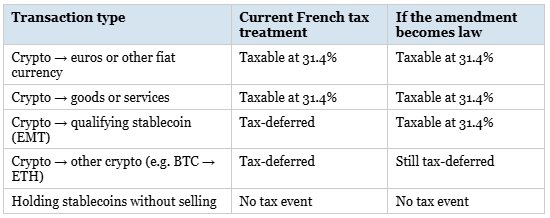
Other Crypto Tax Measures Proposed in the 2027 Budget
The stablecoin swap tax attracted the most coverage, but it was not the only crypto-related amendment considered during the PLF 2027 committee stage.
Crypto exit tax (amendment CF1822)
A second Sansu amendment would introduce an exit tax on unrealised crypto gains when a French taxpayer relocates abroad. It would apply to households whose combined crypto holdings — including assets held with custodians and self-custody wallets — exceed €800,000, provided the individual was a French tax resident for at least six of the previous ten years. The threshold mirrors the one already used for the exit tax on share portfolios, and deferral rules borrowed from the equity regime would apply. All crypto assets held on the departure date — including holdings in overseas exchanges or hardware wallets — would need to be declared.
Loss carry-forward (amendment CF798)
A separate amendment from deputy Daniel Labaronne would allow crypto losses to be carried forward for up to ten years to offset future capital gains — extending to digital assets the same treatment already available to equity investors. Currently, crypto losses in France cannot be carried forward and are simply lost if not offset in the same tax year.
Like the stablecoin amendment, both of these measures had to be re-tabled after the committee rejected the revenue section, and neither is guaranteed to survive the full legislative process.
France's Fiscal Squeeze: The Budget Context
The stablecoin vote lands against a difficult fiscal backdrop. The French government is targeting a reduction in the public deficit from 5.4% of GDP in the current year to 5% in 2027. Meanwhile, the Finance Ministry projects that France's public-debt-to-GDP ratio will reach approximately 119% in 2026, rising further to around 122% in 2027 — levels that make revenue-raising amendments politically attractive even where the sums involved are modest.
For lawmakers who backed the amendment, taxing stablecoin conversions is one part of a broader effort to ensure that crypto wealth — which has grown significantly during successive bull markets — contributes to the public finances in proportion to its gains. The government's counter-argument is pragmatic: stablecoin conversions are harder to monitor than euro cashouts, and creating a new compliance category risks generating disputes without meaningful additional revenue.
France's Cost-of-Living Protests: What Is Happening on the Streets
The parliamentary vote took place as France's streets filled with protesters for the second time in as many weeks. The unrest started in mid-September at a Paris high school, where students blockaded classes demanding more teachers, more funding, and better school conditions. Within weeks the movement had spread to Marseille, Strasbourg, and dozens of other cities.
On 6 October, the French Interior Ministry counted 266,000 marchers nationwide — including 56,000 in Paris — though protest organisers put the figure considerably higher. Teachers and other public-sector workers joined the marching students, and the movement broadened into wider anger over wages, public services, and household bills.
Some demonstrations descended into violence, with fires and looting reported across several cities. More than 2,500 people were taken into custody in connection with the broader unrest, according to a Reuters report. A 15-year-old boy lost a hand in an incident involving a police stun grenade; Interior Minister Laurent Nuñez defended the police response as proportionate; Prime Minister Sébastien Lecornu said the government would investigate "accidents" involving officers.
The two stories — a divisive tax vote and mass street protests over living standards — share a common root: France's unresolved tension between fiscal consolidation and the public's appetite for well-funded services. The stablecoin tax, if it raises any revenue at all, would contribute a fraction of what is needed to close the gap. But for the left-wing lawmakers who introduced it, it carries symbolic weight: a signal that investment gains should not escape tax simply by sheltering in digital dollar tokens.
Notably, protesters have not specifically called for a stablecoin tax, and the measure itself would do nothing to reduce energy bills, fund schools, or raise public-sector wages.
What Happens Next: The Legislative Road Ahead
The amendment is not law, and the path to the statute book remains uncertain.
The National Assembly was scheduled to hold a formal vote on the complete revenue section of the 2027 budget on or around 20 October 2026.
If the revenue section passes, the bill moves to the Senate, which can amend or remove the stablecoin provision independently.
If the Senate produces a different text, a joint parliamentary committee (CMP) attempts to reconcile the two versions.
If the government invokes Article 49.3 of the Constitution to force the budget through without a vote, it can choose which committee amendments to keep — and, having opposed this one, would be unlikely to retain it.
Only if the provision survives every stage would it take effect from 1 January 2027.
What This Means for Crypto Investors in France
Nothing changes today. The tax deferral on crypto-to-stablecoin swaps remains in place while the budget works through parliament. But French investors who regularly rotate profits into USDC, EURC, or similar MiCA-regulated stablecoins — whether to ride out volatility, preserve gains, or wait for re-entry opportunities — should monitor the process carefully.
If the amendment becomes law:
Every swap into a qualifying stablecoin would crystallise a taxable gain in that tax year, regardless of whether euros are ever withdrawn.
Accurate per-asset purchase records would become essential, since the new gain calculation is asset-by-asset rather than portfolio-wide.
Investors with large unrealised gains who are considering moving tax residency should be aware that a separate exit-tax amendment could apply to holdings above €800,000.
The loss carry-forward amendment, if enacted, would partially offset the new burden by letting losses from poor trades reduce future gains over a ten-year window.
Anyone managing significant crypto exposure in France would be well advised to consult a qualified tax adviser once the final text of the PLF 2027 is confirmed.
Frequently Asked Questions
Is France's stablecoin tax already in force?
No. The National Assembly approved the amendment on 16 October 2026, but it must still pass the Senate and survive the full budget process. If enacted, it would apply from 1 January 2027.
What tax rate applies to stablecoin swaps under the amendment?
The amendment does not introduce a new rate. Gains would be taxed at France's existing 31.4% flat tax (PFU), which combines 12.8% income tax with 18.6% in social charges.
Does holding a stablecoin trigger tax in France?
No. Simply holding stablecoins — whether USDC, EURC, USDT, or any other — does not trigger a tax event under either current rules or the proposed amendment. Only the act of converting a cryptocurrency into a qualifying stablecoin would become taxable.
Which stablecoins are covered by the amendment?
E-money tokens (EMTs) under MiCA — fiat-backed stablecoins pegged to a single official currency. Circle's USDC and EURC are the clearest examples. USDT may also fall within scope depending on how French tax authorities apply the MiCA EMT definition.
Are crypto-to-crypto swaps affected?
No. Swapping one cryptocurrency for another — for example, trading Bitcoin for Ether or Solana — would retain the existing tax deferral. Only conversions into qualifying fiat-backed stablecoins (EMTs) would lose that deferral.
Why did France's government oppose the amendment?
The government raised practical concerns about compliance and enforcement, arguing that tracking individual crypto-to-stablecoin conversions in real time would be administratively complex. It did not object on principled grounds.
Want to join the discussion? Login and create a profile to comment.