Hyperliquid Calls for Five Key Changes to the SEC’s Proposed Crypto Regulation

Hyperliquid Policy Center has submitted five recommendations to the US Securities and Exchange Commission (SEC), asking the regulator to revise its proposed Regulation Crypto Assets framework. The requests cover airdrops, decentralized trading, developer protections, token buybacks and state securities registration, and arrive just before the public comment period closes on October 20, 2026.
Key Takeaways
Hyperliquid Policy Center wants changes in five areas: airdrops, secondary trading, developer certification, buybacks and state registration.
It asks the SEC to confirm that free airdrops generally do not meet the investment-of-money requirement.
The draft rules include fundraising exemptions capped at $5 million over four years and $75 million over 12 months.
The group wants federal preemption of certain state rules to continue after projects meet the safe harbor.
The deadline for public comments is October 20, 2026.
What Is the SEC’s Regulation Crypto Assets Proposal?
Regulation Crypto Assets is the SEC’s proposed rulebook for how crypto projects can issue tokens and operate within US securities law. Among other things, it sets out exemptions that allow qualifying projects to raise funds without full securities registration, as well as a conditional safe harbor for developers whose tokens are no longer tied to investment contracts.
The draft includes two separate fundraising exemptions with different limits and time frames. Under the startup exemption, qualifying projects could raise up to $5 million over four years. A second exemption would allow fundraising of up to $75 million within a 12-month period.

The proposal is still open for public consultation and remains subject to review and revision before any final rules are adopted.
Hyperliquid Policy Center’s Five Recommendations at a Glance
Hyperliquid’s submission looks beyond the moment a token is first issued. It also addresses what happens afterward, including trading, developer certification and compliance with state securities rules. The policy center argues that the fundraising exemptions are only valuable if tokens can actually be transferred or sold on a functioning market, so the rules need to cover activity after the initial distribution as well.
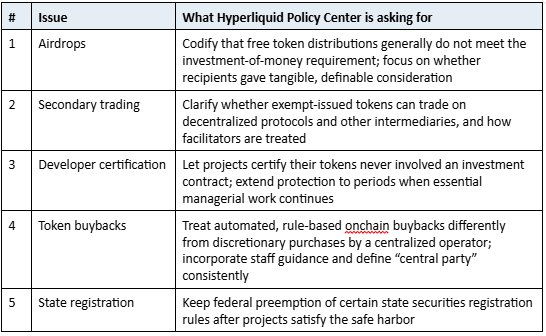
1. Airdrops: Free Tokens and the Investment-of-Money Test
Under US securities law, whether a digital asset is offered as part of an investment contract is generally assessed using the Howey test, which originates from a 1946 US Supreme Court case. One of its elements is an “investment of money”. If recipients do not pay anything for a token, it is harder to argue that this element is met.
Hyperliquid wants the final rules to formalize the SEC’s existing interpretation that receiving tokens without payment generally does not satisfy the investment-of-money requirement. Instead, it asks the regulator to focus on whether recipients exchanged tangible, definable consideration for the assets.
Administrative Steps vs Work for Tokens
This approach would draw a line between simple administrative tasks, such as connecting a crypto wallet or completing sanctions screening, and actual work performed in exchange for tokens. According to the group, making that distinction explicit would give developers and airdrop recipients clearer expectations while a network is still being built. The issue is particularly relevant for Hyperliquid, whose HYPE token was distributed to users through a large airdrop.
2. Secondary Trading on Decentralized Protocols
For secondary trading, the policy center asks the SEC to clarify whether tokens issued under the proposed exemptions can later trade on decentralized protocols or through other intermediaries. While the draft covers certain offering exemptions, it does not set out a complete framework for how those assets can be traded after issuance.
The submission also seeks clarity for decentralized protocols and market participants that facilitate trades without registering as intermediaries. At the same time, it acknowledges that existing securities rules for exchanges, brokers and dealers will continue to apply where relevant. For decentralized finance (DeFi) platforms such as decentralized exchanges (DEXs), this question goes to the heart of whether they can support exempt tokens at all.
3. Developer Safe Harbor and the Certification Condition
The draft offers developers a conditional safe harbor for crypto assets that are no longer linked to investment contracts. However, Hyperliquid takes issue with one of its certification requirements.
As currently written, the group argues, projects would effectively have to imply that their tokens were previously part of an investment contract in order to qualify for protection. The policy center wants projects to be able to certify instead that their tokens never had that connection in the first place.
It also argues that the safe harbor should apply during periods when essential managerial work is still ongoing, rather than becoming available only after that work ends or stops permanently. In practice, most blockchain networks continue to be maintained and upgraded long after launch.
4. Automated Token Buybacks vs Discretionary Purchases
Token buybacks have become a common feature of crypto protocols, and the policy center wants them treated with more nuance. It asks the SEC to distinguish between buybacks executed automatically according to published blockchain rules and purchases that a centralized operator chooses to make at its own discretion.
The group argues that these two models should not automatically be treated the same way when regulators assess who directs a project’s economic activity. A buyback that runs on transparent, pre-set onchain logic is a different arrangement from one controlled by a company or team. Hyperliquid itself uses protocol revenue to buy back HYPE through an automated mechanism, which makes this point directly relevant to its own model.
Defining a “Central Party”
The recommendations also call for the SEC to incorporate existing staff guidance on token buybacks and to use consistent terminology around the concept of a “central party”. In addition, the center cautions against treating a network’s validators as a centralized group simply because they share common incentives.
5. Keeping Federal Preemption After the Safe Harbor
The final recommendation concerns the relationship between federal and state law. The SEC’s proposal would override some state securities registration requirements for eligible offerings and subsequent transactions, a concept known as federal preemption.
Hyperliquid wants that preemption to remain in place even after projects have satisfied the safe-harbor conditions. It warns that losing these protections at that stage could leave developers or token holders facing uncertainty over registration requirements in individual states.
The group distinguishes the SEC’s exemptions from broader legislative frameworks such as the CLARITY Act. It also acknowledges that state antifraud laws, as well as activities falling outside the exemptions, would continue to apply.
Why These Recommendations Matter for the Crypto Industry
Taken together, the five recommendations focus on the full lifecycle of a token, from distribution and trading to ongoing development and long-term compliance. For token issuers, airdrop recipients, DeFi protocols and validators, the way the SEC handles these questions could shape how crypto projects launch and operate in the United States.
Clearer rules on airdrops and secondary trading could reduce legal uncertainty for new networks, while the treatment of buybacks and the meaning of “central party” could influence how protocols design their tokenomics.
What Happens Next?
The SEC’s Regulation Crypto Assets proposal is still subject to review and revision following the consultation. The deadline for public comments is October 20, 2026. After that, the agency will review the submissions it has received, including Hyperliquid’s, before deciding on any changes to the final rules.
Frequently Asked Questions
What is Hyperliquid asking the SEC to change?
Hyperliquid Policy Center has made five recommendations covering airdrops, secondary trading, developer certification under the safe harbor, token buybacks and federal preemption of state registration rules.
What fundraising limits does the SEC proposal include?
The draft includes a startup exemption allowing up to $5 million over four years and a separate exemption allowing up to $75 million over 12 months.
Are airdrops considered securities under the proposal?
Hyperliquid is asking the SEC to formalize its existing view that receiving tokens without payment generally does not meet the investment-of-money requirement, while focusing on whether recipients gave tangible consideration.
When does the SEC comment period close?
Public comments on the Regulation Crypto Assets proposal are due by October 20, 2026.
Disclaimer: This article is for informational purposes only and does not constitute legal, financial or investment advice.
Want to join the discussion? Login and create a profile to comment.