Hyperliquid’s Policy Arm Asks the SEC to Write Airdrops and Buybacks Into the Final Regulation Crypto Assets Rule

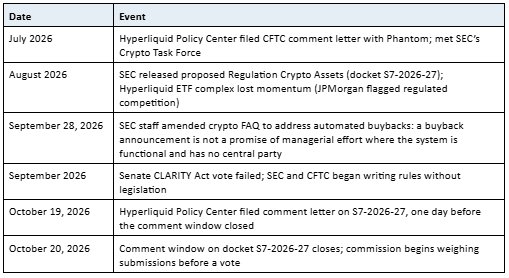
The Hyperliquid Policy Center filed a comment letter with the SEC on October 19, the day before the comment window on docket S7-2026-27 closed, backing the proposed Regulation Crypto Assets framework and requesting five specific revisions. The letter, signed by chief executive Jake Chervinsky and senior counsel Brad Bourque, is the group’s most detailed public engagement with the SEC’s rulemaking process to date.
Key Takeaways
The Hyperliquid Policy Center filed a comment letter with the SEC on October 19, one day before the docket S7-2026-27 comment window closed, supporting Regulation Crypto Assets and requesting five revisions.
The letter was signed by CEO Jake Chervinsky and senior counsel Brad Bourque, and covers airdrops, secondary trading, developer protections, buybacks and state law preemption.
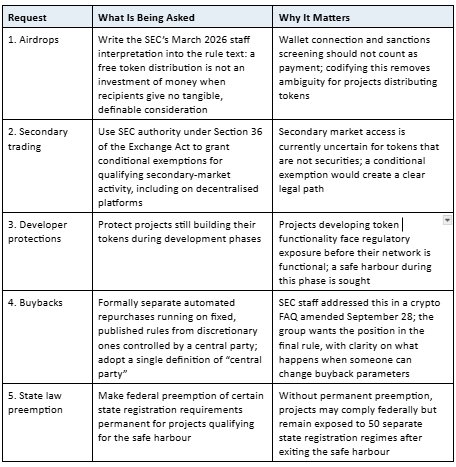
On airdrops, the group asks the SEC to codify its March 2026 staff interpretation into rule text, establishing that connecting a wallet or passing sanctions screening does not constitute payment.
On buybacks, the group wants the SEC to formally separate automated repurchases (fixed, published rules) from discretionary ones (centrally controlled), and to adopt a single definition of “central party.”
The buyback request is directly relevant to HYPE’s token economics: Hyperliquid uses trading fees to buy back HYPE. Bitwise’s CIO valued the buyback stream at $800 million to $1 billion per year in May 2026.
The regulatory context shifted after the Senate CLARITY Act vote failed in September; the SEC and CFTC moved to write rules without legislation. SEC Chair Paul Atkins has said legislation is still needed to make any rules durable.
After the comment deadline, the commission weighs submissions before a vote; the airdrop and buyback language in the final rule text will carry more practical weight for token-launch decisions than the dollar caps alone.
What Regulation Crypto Assets Proposes
The SEC released the proposed Regulation Crypto Assets framework in August 2026 under docket number S7-2026-27. The proposal creates two exemption tiers for qualifying crypto projects.

The proposal is designed to give early-stage projects a path to raise capital and distribute tokens in the US without triggering full securities registration requirements, provided they meet defined conditions. The comment period that closed on October 20 was the primary mechanism for the industry to shape those conditions before a final vote.
Why the Comment Process Matters More Than the Dollar Caps
The $5 million and $75 million caps are the headline numbers, but practitioners and policy advocates have consistently argued that the definitions in the rule — what counts as an investment of money, what makes a buyback discretionary, when developer activity is regulated — will determine whether the framework is usable in practice. A project that qualifies for the $75 million exemption but cannot structure its airdrop or buyback program to comply with undefined terms faces the same practical uncertainty as one that has no exemption at all.
This is the core argument behind the Hyperliquid Policy Center’s five requests: the dollar figures are acceptable; the definitional gaps need to be closed.
The Five Requests: What the Policy Center Is Asking For
The Airdrop Request in Detail
Free token distributions — airdrops — have been a standard mechanism for bootstrapping user adoption in crypto networks since at least 2017. The legal question is whether receiving an airdrop constitutes purchasing a security, which turns on whether the recipient provided investment of money in exchange.
In March 2026, SEC staff released an interpretation addressing this question: a free token distribution is not an investment of money when recipients give no tangible, definable consideration. The Hyperliquid Policy Center’s airdrop request is not asking for a new legal position — it is asking the SEC to move an existing staff interpretation off an amendable FAQ and into the binding rule text.
Why Wallet Connection Should Not Count as Payment
The group specifically argues that two actions that are commonly required for airdrop eligibility — connecting a cryptocurrency wallet and passing sanctions screening — should not be treated as tangible, definable consideration. The argument rests on the nature of these actions: connecting a wallet is a technical prerequisite for receiving any on-chain distribution, not a commercial exchange. Sanctions screening is a compliance requirement imposed by the distributor, not a payment made by the recipient.
If wallet connection or compliance checks were treated as consideration, almost every airdrop would become a securities offering by default, regardless of whether any money changed hands. Codifying the March staff position in the final rule text would give projects a stable legal foundation for free distribution programs.
The Buyback Request: Why It Touches HYPE Directly
The buyback request has a direct commercial dimension for Hyperliquid. The platform uses a portion of its trading fee revenue to buy back HYPE tokens from the open market through an automated mechanism. The system runs on fixed, published parameters rather than discretionary decisions by a central party.
SEC staff addressed automated buybacks in the crypto FAQ amended on September 28. The updated FAQ states that a buyback announcement does not constitute a promise of managerial effort where the buyback system is functional and there is no central party controlling it. This is a meaningful position because the Howey test — the legal framework used to determine whether something is a security — asks in part whether investors are relying on the managerial efforts of others. A fully automated buyback, by this reasoning, does not create that reliance.
The Open Question: What Happens When Parameters Change?
The SEC staff position as currently written addresses the steady-state case: an automated system with no central party. What it does not address is the transitional case: what happens if someone changes the buyback’s parameters — adjusting the rate, the trigger conditions, or the funding source? That decision would be discretionary, made by someone, and could arguably constitute exactly the kind of managerial effort the Howey test is looking for.
The Hyperliquid Policy Center wants the final rule to answer this question explicitly, and to adopt a single, consistent definition of “central party” across the framework. Without that definition, the boundary between a compliant automated buyback and a non-compliant discretionary one is a matter of interpretation rather than rule. For a platform whose token valuation is partly derived from a fee-funded buyback stream, the practical stakes of that boundary are significant.
The Valuation Dimension
Bitwise’s Chief Investment Officer argued in May 2026 that HYPE was mispriced because the market was valuing it at roughly 10 to 14 times a buyback stream he estimated at $800 million to $1 billion annually. Whether that multiple is appropriate depends in part on how the buyback stream is classified: a regulatory determination that the stream creates managerial-effort reliance would change how institutional investors are permitted to treat it. A clear rule separating automated from discretionary repurchases would resolve that classification question.
The Regulatory Timeline That Led Here
The comment letter is the latest step in a sequence of regulatory and legislative developments that has shaped Hyperliquid’s policy engagement over the past several months.
Why the SEC and CFTC Are Writing Rules Without Congress
The Senate CLARITY Act, which would have created a legislative framework for digital asset regulation, did not pass in September. After that failure, the SEC and CFTC moved forward with their own rulemaking processes rather than waiting for Congress to act. SEC Chair Paul Atkins has publicly acknowledged that legislation would be needed to make any agency rules durable — rules written without statutory authority can be challenged in court or reversed by a subsequent administration more easily than statute-backed regulations. That context frames the comment process: the rules being written now may be revised later, but they will set the immediate operating environment for crypto projects deciding where to launch.
What Happens After the Comment Deadline
With the October 20 comment window now closed, the SEC begins the process of reviewing all submitted comments before the commission votes on a final version of Regulation Crypto Assets. There is no fixed statutory deadline for that vote. The commission can take months to review a large comment record, particularly on a rule that attracted submissions from major industry participants.
The practical implication for token projects is that the current uncertainty about airdrop and buyback classification persists until a final rule is published. Projects deciding whether to launch tokens in the US, distribute them via airdrop, or implement fee-funded buyback mechanisms are making those decisions against the backdrop of SEC staff positions and proposed rules, not final binding regulations. That gap between staff guidance and final rule is precisely what the Hyperliquid Policy Center’s letter is trying to close.
What the Final Rule Will and Will Not Resolve
Even if the SEC adopts all five of the group’s requests, Regulation Crypto Assets addresses only the SEC’s jurisdiction. The CFTC regulates commodity derivatives, and digital assets that are classified as commodities rather than securities fall primarily under its oversight. The two agencies have overlapping and sometimes contested jurisdiction over crypto markets, which is why Paul Atkins’ comment about the need for legislation remains relevant: a comprehensive, durable framework requires Congress to resolve the jurisdictional boundary between the two agencies in a way that administrative rulemaking cannot.
Frequently Asked Questions
What is Regulation Crypto Assets and what does it propose?
Regulation Crypto Assets is a proposed SEC framework released in August 2026 under docket S7-2026-27. It would allow qualifying crypto projects to raise up to $5 million over four years under a startup exemption, or up to $75 million in any 12-month period under a fundraising exemption, without triggering full securities registration requirements.
What did the Hyperliquid Policy Center ask the SEC to change?
The group filed five requests: (1) codify the March 2026 airdrop staff interpretation into rule text; (2) grant conditional secondary-market exemptions under Section 36 of the Exchange Act, including for decentralised platforms; (3) protect projects still developing their tokens; (4) formally separate automated from discretionary buybacks and define “central party”; and (5) make federal preemption of state registration requirements permanent for qualifying projects.
Why does the buyback rule matter for HYPE?
Hyperliquid uses trading fee revenue to buy back HYPE through an automated mechanism. Bitwise’s CIO estimated the buyback stream at $800 million to $1 billion per year in May 2026. Whether that stream is treated as managerial effort — a key factor in securities classification under the Howey test — depends on whether the SEC formally distinguishes automated from discretionary buybacks. The group wants that distinction in the final rule.
What does the SEC’s September 28 crypto FAQ say about buybacks?
The amended FAQ states that a buyback announcement does not constitute a promise of managerial effort where the buyback system is functional and there is no central party controlling it. The Hyperliquid Policy Center wants this staff position moved into the binding final rule text, with additional clarity on what happens when buyback parameters are changed.
What happens next after the comment window closed?
The SEC reviews all submitted comments and then votes on a final version of the rule. There is no fixed deadline for that vote. SEC Chair Paul Atkins has said legislation is still needed to make the rules durable, meaning any rules written at the agency level may be subject to legal challenge or future revision.
Want to join the discussion? Login and create a profile to comment.