Microsoft Exits Nscale’s UK AI Data Center Project as Grid Delays Push Power Access Into the 2030s
Microsoft has withdrawn from what was billed as Britain’s largest AI supercomputer project after electricity connection delays threatened to push power access into the early-to-mid 2030s. The move puts fresh pressure on Nvidia-backed Nscale just as it prepares to list on the New York Stock Exchange at a reported valuation of up to $35 billion.
Key Takeaways
Microsoft has pulled out of Nscale’s Loughton, Essex AI data center project after electricity grid delays threatened power supply until the early-to-mid 2030s.
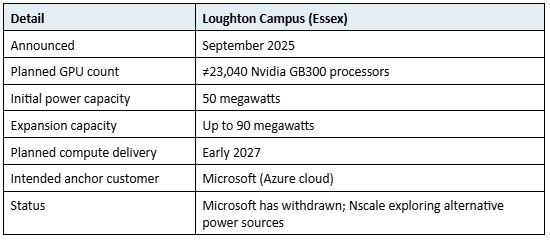
The site was planned to house around 23,040 Nvidia GB300 GPUs with 50 megawatts of initial capacity, expandable to 90 megawatts.
Microsoft says its broader partnership with Nscale across Europe and the US remains in place.
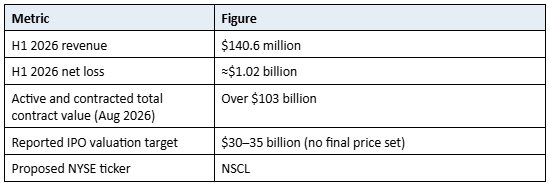
Nscale has filed for an IPO on the New York Stock Exchange under ticker NSCL, with a reported valuation target of $30–35 billion.
Nscale reported $140.6 million in revenue and a net loss of about $1.02 billion in the first half of 2026.
The episode adds to investor scrutiny of heavily leveraged AI infrastructure companies, including CoreWeave.
What Was the Loughton Project?
In September 2025, Nscale and Microsoft announced a joint plan to develop a large-scale AI computing facility at Loughton in Essex. The site was marketed as Britain’s largest AI supercomputer, designed to host approximately 23,040 of Nvidia’s next-generation GB300 processors. The initial build-out called for 50 megawatts of computing capacity, with the ability to scale to 90 megawatts as demand grew.
Microsoft was expected to be the anchor customer, taking computing capacity through its Azure cloud platform. The agreement formed part of a wider wave of AI infrastructure investment announcements in the United Kingdom, where the government has actively promoted the country as a destination for data center development.
Under the original timeline, the Nvidia GB300 hardware was due to arrive at Loughton in early 2027, with Microsoft using the facility to serve Azure customers.
Why Did Microsoft Leave?
The trigger for Microsoft’s withdrawal was the electricity supply. The local grid serving the Loughton campus has been unable to commit to delivering sufficient power within a commercially viable timeframe. Grid connection delays in the UK have become a recurring obstacle for large data center projects; the issue at Loughton reportedly means the site may not receive its required power until the early-to-mid 2030s.
For an AI data center that was supposed to begin serving customers in 2027, a wait of up to a decade for electricity access is not commercially workable. Data center operators need power commitments in place before they can install hardware, sign service agreements and begin generating revenue from compute capacity.
Microsoft: One Site, Not One Relationship
Microsoft confirmed the withdrawal in a statement reported by Reuters on October 19. The company stressed that the decision applies specifically to the Loughton location and does not reflect a change in its relationship with Nscale as a whole. Microsoft said it continues to collaborate with Nscale on infrastructure projects elsewhere in Europe and the United States.
Nscale also confirmed the development and said it remains committed to the Loughton campus. The company said it is exploring alternative power supply arrangements, though no specific solution or replacement anchor customer has been announced.
What the Grid Problem Reveals About AI Infrastructure
The Loughton situation is an example of a structural challenge that has emerged across the AI data center industry: the gap between ambition and infrastructure. AI training and inference workloads are power-intensive, and the demand for computing capacity has outpaced the ability of electricity grids in many markets to connect new large-scale facilities quickly.
In the United Kingdom, grid connection queues have lengthened significantly as data center developers, renewable energy projects and industrial users compete for available network capacity. Connection timelines that once took two to three years can now stretch to a decade or more in congested areas, making site selection and power contracting among the most critical factors in any large data center development.
Power Access as a Gating Factor
The broader lesson is that securing a major customer and funding is not the only hurdle in AI infrastructure development. A facility can have credible backers, advanced hardware orders and signed compute agreements, yet still face fundamental delays if the local electricity network cannot deliver power on schedule. This dynamic is increasingly shaping where hyperscalers and AI compute providers choose to build.
Nscale’s IPO: The Stakes and the Numbers
The timing of Microsoft’s withdrawal is significant because Nscale is in the middle of preparing for a public listing. The company has filed to list on the New York Stock Exchange under the proposed ticker NSCL.
Nscale reported $140.6 million in revenue for the first half of 2026, alongside a net loss of approximately $1.02 billion. As of August 2026, its filing also disclosed more than $103 billion in active and contracted total contract value, a figure reflecting multiyear commitments from customers who want future computing capacity.
What $103 Billion in Contracts Actually Means
The $103 billion total contract value figure is a forward-looking pipeline, not revenue already collected. Nscale can only convert that figure into income as it completes data centers, installs hardware and delivers actual computing services to customers. That requires functioning facilities, which in turn require reliable power.
Reports have put Nscale’s potential IPO valuation at up to $35 billion, though Reuters has also cited a figure closer to $30 billion. Investors have reportedly discussed lower valuations still, and no final offering price has been set. The loss of the Loughton anchor customer raises a question that prospective public market investors will scrutinize: how quickly and reliably can Nscale convert its contracted pipeline into delivered revenue?
CoreWeave, Nscale and the AI Infrastructure Financing Debate
Nscale’s setback arrives at a moment of heightened investor scrutiny for the broader AI infrastructure sector. Fellow Nvidia-backed compute provider CoreWeave has recently experienced its own difficulties: its stock declined sharply, and yields on its 2031 bonds climbed above 16%, reflecting growing concern in debt markets about the financial structure of AI infrastructure companies.
The two companies face different immediate problems. CoreWeave’s challenge centres on the cost and availability of debt financing, while Nscale’s issue at Loughton is the absence of electricity supply at a specific site. Yet both cases point to the same underlying tension in AI infrastructure finance.
Build Now, Earn Later — and the Risks That Creates
AI data center companies typically borrow heavily to build and equip facilities before those facilities generate meaningful revenue. The model depends on future customer payments being large enough, and reliable enough, to service the debt taken on during construction. When a customer withdraws, or a facility is delayed, the financial model comes under strain even if the company’s broader order book remains intact.
The combined picture from CoreWeave and Nscale is prompting investors to ask harder questions about the gap between the headline contract values that AI infrastructure companies report and the timing and certainty of the cash flows that will actually back them. For Nscale, the task ahead of its IPO is to reassure investors that the Loughton setback is isolated and that the rest of its pipeline can be delivered on schedule.
What Happens Next for Nscale?
Nscale has said it is looking at alternative power solutions for the Loughton site and intends to continue developing the campus. Whether it can find a workable electricity supply arrangement, and how long that might take, will determine the site’s future.
In the meantime, the company’s other infrastructure projects across Europe and the United States, where it continues to work with Microsoft and other partners, remain unaffected by this particular setback. The IPO process is ongoing, and the company has not indicated any change to its listing timeline.
For investors evaluating the IPO, the key questions are whether the Loughton situation is genuinely contained, how the $103 billion contract pipeline is distributed across Nscale’s portfolio of sites, and whether the company has sufficient power supply certainty at its other locations to convert that pipeline into revenue within the timeframes its customers expect.
Frequently Asked Questions
Why did Microsoft pull out of the Nscale UK data center?
Microsoft withdrew because grid connection delays at the Loughton, Essex campus mean the site may not receive sufficient electricity until the early-to-mid 2030s. A facility that cannot get power cannot host hardware or serve customers, so the project was no longer commercially viable for Microsoft on its original timeline.
Does this affect Microsoft’s overall relationship with Nscale?
Microsoft has said the withdrawal concerns only the Loughton location. The company says it continues to work with Nscale on AI infrastructure projects in other parts of Europe and the United States.
What is Nscale’s IPO valuation?
Reports have cited a target valuation of between approximately $30 billion and $35 billion for Nscale’s planned New York Stock Exchange listing under the ticker NSCL. No final offering price has been set.
What is Nscale’s financial position ahead of the IPO?
Nscale reported $140.6 million in revenue and a net loss of approximately $1.02 billion in the first half of 2026. It disclosed more than $103 billion in active and contracted total contract value as of August 2026, though that figure represents future commitments rather than collected revenue.
How does the Nscale situation compare to CoreWeave?
Both are Nvidia-backed AI infrastructure companies facing investor scrutiny, but the immediate issues differ. CoreWeave’s challenge is primarily in its debt markets, where bond yields have risen sharply. Nscale’s current problem is the loss of a specific customer at a site delayed by power grid issues.
Disclaimer: This article is for informational purposes only and does not constitute financial or investment advice. Information about IPO valuations and financial figures is based on publicly reported sources and may be subject to change.
Want to join the discussion? Login and create a profile to comment.