MoneyGram Uses Stablecoins to Keep Remittance Money Inside Its App — But Key Questions Remain
MoneyGram has relaunched its app with stablecoin-powered balances and a new corridor that lets US senders pay app users directly in Colombia and El Salvador. The redesign, which went live on October 19, is the third step in a four-month infrastructure build. The strategy aims to turn a one-time cash payout into a recurring digital account relationship — but several details, including which token backs balances outside the United States, have not been disclosed.
Key Takeaways
MoneyGram’s redesigned app, launched October 19, adds a US-to-Colombia and US-to-El Salvador app-to-app transfer corridor.
The app now offers transfers, dollar balances, bill payments, mobile top-ups and cash access in one place, with support for 40 languages.
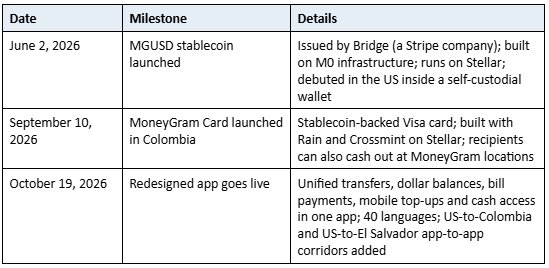
The strategy follows three launches in four months: MGUSD stablecoin (June 2), MoneyGram Card in Colombia (September 10) and the redesigned app (October 19).
MGUSD is issued by Bridge (a Stripe company), built on M0 infrastructure and runs on Stellar; it launched inside a self-custodial wallet in the US.
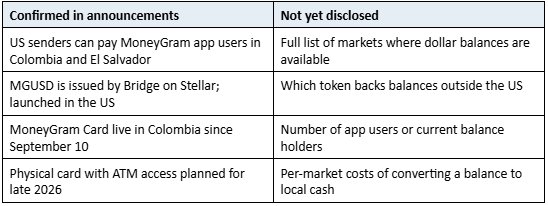
MoneyGram has not confirmed which token backs balances in Colombia or El Salvador, or the full list of markets where dollar balances are available.
A physical card with ATM access is planned for late 2026; its launch and any new market announcements would be the next test of the account strategy.
The Core Change: Payout Is No Longer the End of the Transfer
For most of its history, a MoneyGram transaction ended when a recipient collected cash at a retail counter. The sender paid a fee, the money moved, and the relationship was over until the next transfer. MoneyGram’s new app architecture is designed to change that endpoint.
The key addition in the October 19 release is straightforward: customers in the United States can now send money directly to MoneyGram app users in markets including Colombia and El Salvador. The release lists app users alongside bank accounts, debit cards, third-party wallets and retail pickup as delivery options. Of all those options, the app is the only one where funds stay within a MoneyGram account after arrival.
Why Retention Changes the Business Model
The commercial logic is about frequency. A cash payout is a single fee-earning event. A balance that remains in the app can generate further transactions: additional transfers, card spending, bill payments, mobile top-ups and eventual cash withdrawals. Each of those can run through MoneyGram’s rails rather than a competitor’s.
Chief Product and Technology Officer Luke Tuttle described the philosophy behind the product direction in the October announcement: "Our product strategy starts with the consumer, not the technology." The app is designed to keep the stablecoin infrastructure out of the user’s view entirely. Whether recipients choose to keep money in the app depends on what holding a balance actually does for them in each market.
Three Launches in Four Months: The Infrastructure Build
The redesigned app is the consumer front end of an account infrastructure MoneyGram has assembled since early summer. Three distinct product releases have laid the groundwork.
The Gap the Sequence Leaves Open
Reading the three launches together reveals one significant undisclosed detail. MGUSD launched in the US and is clearly named. The September card release in Colombia described a "stable-dollar balance" without specifying the token behind it, and the October app release refers only to "stablecoin-powered capabilities" in unnamed markets. MoneyGram has not confirmed whether balances outside the US run on MGUSD, on a different token or on a combination.
This matters because the on-chain supply of MGUSD on Stellar is publicly visible. If balances in Colombia and El Salvador are backed by MGUSD, growth in that supply after the app launch would be an independent signal of whether recipients are holding rather than cashing out. If a different token is in use, that signal does not apply.
What a Dollar Balance Means in El Salvador vs Colombia
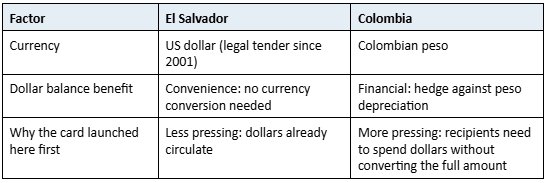
MoneyGram named two specific markets in the new app-to-app corridor. The economics of holding a dollar balance work differently in each.
El Salvador: Convenience, Not Currency Protection
El Salvador has used the US dollar as its official legal tender since 2001. Salvadoran recipients already earn, save and spend in dollars, so holding a dollar balance in the MoneyGram app provides no currency hedge. The choice is simply between keeping money in a digital account or collecting it as cash. The app is worth using only if enough everyday spending can happen digitally and if cash counters are accessible when they cannot.
In this context, MoneyGram’s app competes directly with every other place a Salvadoran can hold dollars digitally, including local bank accounts, mobile wallets and other fintech apps.
Colombia: A Currency Decision Built In
Colombia uses the Colombian peso. A recipient who receives dollars and holds them rather than converting immediately is making an implicit currency call. If the peso weakens against the dollar, the same balance buys more local goods later. If the peso strengthens, the balance buys less. Holding gives the recipient control over the timing of conversion but does not lock in a favourable rate.
This dynamic makes Colombia the market where a dollar balance functions as a genuine financial product rather than purely a convenience. It may also help explain why MoneyGram chose Colombia for the card launch in September: a recipient holding a dollar balance needs a practical way to spend those dollars without having to convert the entire amount at once.
The Network Behind the App
MoneyGram counts nearly 500,000 retail locations globally and says its network reaches more than five billion digital endpoints, including bank accounts, wallets and cards. The location figure covers the full network, not only the outlets that handle balance withdrawals. The company notes that dollar balances are offered in select markets only, and that available receive methods vary by corridor.
What the Fine Print Says
MoneyGram’s published app terms provide the practical constraints that sit beneath the product marketing. Fees and exchange rates vary depending on the amount being sent, the payment method, the delivery method and the pickup location. Funds availability can also depend on agent or bank operating hours, system availability and regulatory checks in the destination market.
The June MGUSD release described a balance customers can access around the clock, which is accurate for the digital portion. However, for a recipient whose next rent payment or grocery run requires cash, the operating hours of the nearest MoneyGram counter set the real availability limit. The 24/7 digital balance and the counter with fixed hours are two parts of the same system.
What Is Confirmed and What Remains Undisclosed
Placing the three product announcements side by side makes clear what MoneyGram has confirmed and what it has not.
How to Tell Whether the Strategy Is Working
MoneyGram has published no figures on app user numbers or balances held. Retention is the stated strategic aim, not yet a reported result. For recipients who need cash within a few days of receiving a transfer, the balance is only a temporary waiting room before the same cash payout. In El Salvador especially, the app faces competition from any other digital option already available to people who live and earn in dollars.
Two Signals to Watch
Two data points would help outside observers assess whether the strategy is gaining traction.
The first is on-chain. MGUSD’s circulating supply on the Stellar blockchain is publicly visible. Sustained growth in that supply from now through early 2027 would suggest that money is staying on MoneyGram’s rails after landing in recipient wallets, rather than being withdrawn immediately. A flat or declining supply would point toward continued cash-out behaviour. This measure has a blind spot as long as MoneyGram has not confirmed which token backs balances outside the US.
The second signal is the physical card. MoneyGram has said a card with ATM access is planned for late 2026. Whether it ships on schedule and whether MoneyGram simultaneously announces new balance markets would indicate how quickly the account model is spreading beyond Colombia. A card that reaches more markets would reduce the friction of spending a digital balance locally, which is one of the practical barriers to retention.
Frequently Asked Questions
What changed in MoneyGram’s app update on October 19?
MoneyGram consolidated transfers, dollar balances, bill payments, mobile top-ups and cash access into a single redesigned app available in 40 languages. It also added a corridor allowing US senders to pay MoneyGram app users directly in Colombia and El Salvador.
What is MGUSD?
MGUSD is MoneyGram’s own dollar stablecoin, issued by Bridge (a Stripe company) and built on M0’s infrastructure. It runs on the Stellar blockchain and launched in the United States on June 2, 2026, inside a self-custodial wallet in the MoneyGram app.
Which token backs MoneyGram balances in Colombia and El Salvador?
MoneyGram has not disclosed this. The company confirmed MGUSD is used in the US. The Colombia card release mentioned a "stable-dollar balance" without naming the token, and the October app release refers to stablecoin-powered capabilities without specifying which asset.
Why did MoneyGram launch its card in Colombia before El Salvador?
MoneyGram has not given a specific reason. However, the economics differ: Colombian recipients hold dollars as a hedge against peso movements and need a practical way to spend them without converting the whole amount, which makes a dollar-denominated card more immediately useful there than in El Salvador, where dollars are already the everyday currency.
How can I track whether MoneyGram’s stablecoin strategy is gaining traction?
MGUSD’s circulating supply on Stellar is publicly visible on-chain. Growth in that supply after the October 19 app launch would be an indicator that recipients are keeping balances rather than cashing out immediately. The planned physical card launch in late 2026, and any accompanying market expansion announcements, would be the next milestone to watch.
Want to join the discussion? Login and create a profile to comment.