"Multiple Chains, One Coin": CZ's Ecosystem Strategy Takes Shape as BNB Builds a New L1 and ASTER Goes Live
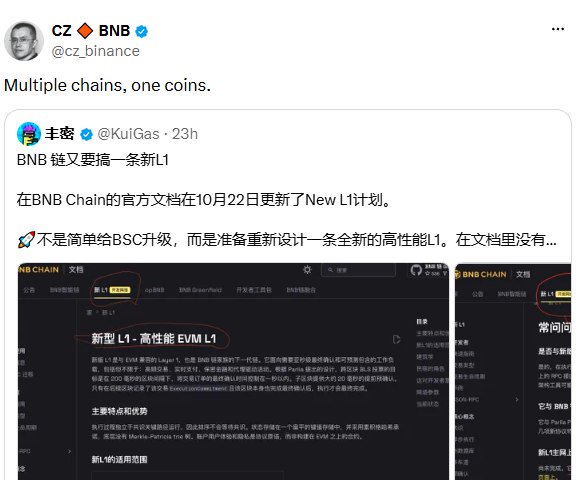
Changpeng Zhao's vision for the BNB ecosystem is becoming more concrete. BNB Chain is developing a new Layer 1 blockchain designed for high-frequency trading, on-chain order books, and real-time payments — targeting 200-millisecond blocks and sub-second finality — while ASTER, a trading-focused L1 backed by CZ's investment firm YZi Labs, has already been live on mainnet since March 2026. CZ summarised the philosophy in a single X post responding to the BNB Chain proposal: "Multiple chains, one coins." That phrase is not just a description of the infrastructure — it is a thesis about how decentralised ecosystems scale: through specialised chains connected by a shared asset, rather than through a single general-purpose blockchain trying to serve every use case at once.
Key Takeaways
BNB Chain is developing a new Layer 1 blockchain to operate alongside BNB Smart Chain (BSC), not replace it — targeting latency-sensitive applications including high-frequency trading, on-chain order books, and real-time payments
Technical development targets: 200-millisecond blocks, 20-millisecond transaction pre-confirmations, sub-second finality; public testnet planned for late 2026, mainnet targeted for early 2027
BNB will serve as the native asset for gas fees and staking on the new chain — no new token is planned — implementing the "multiple chains, one coin" model CZ articulated
ASTER (Aster Chain) launched its mainnet on March 17, 2026, backed by YZi Labs (formerly Binance Labs); it targets throughput above 100,000 TPS with 50-millisecond median block times, with a specific focus on privacy-preserving trading infrastructure
The BNB new L1 and Aster Chain are not identical products targeting the same market — BNB's new chain addresses a broader range of high-performance use cases, while Aster is more narrowly focused on protecting trader order flow from public visibility
The multi-chain strategy raises a genuine question the article examines: whether specialised blockchains strengthen or fragment the BNB ecosystem, and whether a shared token is sufficient to maintain cohesion
What "Multiple Chains, One Coin" Actually Means
CZ's response to the BNB Chain new Layer 1 proposal — "Multiple chains, one coins" — is compact enough to be dismissed as a slogan but substantive enough to represent a genuine architectural philosophy, and understanding it requires looking at how the multi-chain approach contrasts with the alternatives.
The simplest approach to blockchain scaling is to make a single chain do everything better: faster, cheaper, higher throughput. This is the approach taken by most first-generation smart contract platforms. The limitation is that different applications have fundamentally different requirements. A high-frequency trading system needs sub-20-millisecond pre-confirmations and guaranteed execution ordering. A decentralised social network needs cheap, high-volume writes with moderate latency. A privacy-preserving payment system needs encrypted transaction data and selective disclosure. No single blockchain can simultaneously optimise for all of these without compromising somewhere.
The alternative — the direction CZ's comment points toward — is a network of specialised blockchains, each optimised for a particular category of use case, connected through interoperability infrastructure and unified by a shared asset. This is not a new concept in the blockchain industry: Cosmos pioneered the inter-blockchain communication (IBC) model, connecting a constellation of sovereign chains; Polkadot introduced the parachain model, where application-specific chains share security from a central relay chain; Avalanche developed subnet architecture that allows custom virtual machines with independent validators. What CZ is articulating for the BNB ecosystem is a version of this same specialisation-plus-interoperability thesis.
The key differentiator in the BNB approach is the token model. Both Cosmos and Polkadot have their own native assets (ATOM and DOT respectively) for their hub or relay chain, but individual application chains within those ecosystems typically have their own tokens for fees and governance. CZ's "one coin" formulation proposes keeping BNB as the fee and staking asset across multiple specialised chains — preserving the utility and demand for a single established asset rather than fragmenting that utility across a proliferating number of new tokens.
BNB's New Layer 1: What's Being Built and Why
BNB Chain's proposed new L1 is specifically designed for latency-sensitive financial applications — the category of use case where the gap between blockchain performance and traditional financial infrastructure has historically been widest and most commercially consequential.
The Performance Targets
The technical specifications published in BNB Chain's official documentation define an ambitious performance profile:
200-millisecond blocks: At this block time, the new chain would produce five blocks per second — roughly ten times the block frequency of BNB Smart Chain and dramatically faster than Ethereum. Block time directly affects how quickly transactions enter a finalized state visible to other network participants.
20-millisecond transaction pre-confirmations: Pre-confirmation is a commitment made by the block proposer — typically before the block is fully produced and broadcast — that a specific transaction will be included in the next block. At 20 milliseconds, a trader submitting an order can receive a near-instant acknowledgement that the transaction is committed, enabling user experiences that approximate centralised exchange speeds.
Sub-second finality: Finality is the point at which a transaction is irreversible — when the blockchain's consensus rules make it cryptographically impossible to revert the transaction. Current Ethereum finality takes two to three minutes under its proof-of-stake consensus. Sub-second finality on BNB's new L1 would allow dependent operations — such as settlement of a matched trade, release of collateral, or triggering a related position — to proceed almost immediately after the initial transaction.
These three targets are not independent; they describe a coherent performance stack designed for financial applications where speed determines whether a user receives the price they intended or a worse one. In traditional equity markets, latency advantages of single-digit milliseconds are worth enormous sums to high-frequency trading firms. On-chain equivalents of those applications have been constrained by block times orders of magnitude slower — a constraint the new L1 is designed to address.
It is important to note that these remain development targets, not guaranteed performance benchmarks. The public testnet is planned for late 2026, with mainnet activation targeted for early 2027. The actual performance characteristics will be validated through testnet operation before mainnet deployment.
Applications: High-Frequency Trading, Order Books, Real-Time Payments
The documentation identifies three primary application categories the new L1 is designed to serve:
High-frequency trading (HFT): HFT strategies typically involve large numbers of small orders executed in extremely rapid succession, exploiting tiny price discrepancies across markets or providing liquidity while capturing the bid-ask spread. On-chain HFT has been largely impractical on existing blockchains because block times introduce latency that erases the price edges these strategies depend on. A 200-millisecond block time with 20-millisecond pre-confirmations changes this calculation substantially.
On-chain order books: The dominant trading model in DeFi has been the automated market maker (AMM) — a smart contract that sets prices algorithmically based on a liquidity pool rather than matching discrete buy and sell orders. AMMs work well for low-frequency trading but perform poorly for active price discovery and institutional-scale trading because they cannot maintain a visible order book, allow limit orders, or handle the order cancellation rates that professional traders require. An on-chain order book, operating at the performance levels the new L1 targets, could bring professional trading infrastructure to a decentralised environment.
Real-time payments: Payment applications need fast confirmation for user experience parity with card networks and bank transfers. Sub-second finality enables use cases — point-of-sale payments, gaming micropayments, streaming payment subscriptions — where the current settlement latency of most blockchains creates unacceptable user experience friction.
The Token Model: BNB as Universal Gas
Critically, the new L1 will use BNB as its native asset for both transaction fees and staking. This decision has significant implications for BNB's utility and, by extension, its demand dynamics.
In a traditional multi-chain expansion model, each new chain launches with its own native token — which dilutes the utility that might otherwise accrue to the ecosystem's primary asset and creates fragmentation for users who need to hold multiple tokens to participate across different chains. By using BNB across multiple chains, the model concentrates fee and staking utility in a single asset. Every transaction on the new L1 consumes BNB, every validator earns BNB rewards, and every user needs BNB to participate — extending the asset's relevance beyond BSC without requiring them to acquire a separate token.
ASTER / Aster Chain: The YZi Labs-Backed Trading L1 That's Already Live
While BNB Chain's new L1 remains in development, ASTER offers a live example of how a specialised trading blockchain in the CZ ecosystem actually operates.
Aster Chain launched its mainnet on March 17, 2026, making it the more immediate point of reference for how specialised performance blockchains operate within the broader BNB ecosystem context. ASTER is backed by YZi Labs — the investment firm formerly known as Binance Labs that was rebranded as CZ stepped back from the Binance CEO role. CZ remains involved in YZi Labs' investment activities, though the article notes that this involvement does not mean he directly controls every project the firm backs.
Aster Chain's Technical Profile
Aster Chain targets throughput above 100,000 transactions per second with a median block time of 50 milliseconds — considerably faster than BNB Smart Chain's current performance and, if achieved in sustained network conditions, competitive with centralised exchange infrastructure. The 50-millisecond block time is faster than even the 200-millisecond target on BNB's new L1, reflecting Aster's even more aggressive latency optimisation for its specific market.

Privacy-Preserving Trading: The Key Differentiator
What distinguishes Aster Chain most clearly from a general-purpose high-performance blockchain is its emphasis on encrypted order flow and privacy features specifically designed for derivatives traders.
Encrypted order flow is a mechanism by which a trader's orders are submitted to the network in an encrypted or commitment form that conceals the order's details until the block in which it will be executed is finalized. The purpose is to prevent a class of attack known as front-running — or more broadly, maximal extractable value (MEV) exploitation — where a participant who can observe pending transactions uses that information to execute transactions ahead of them and extract value at the original trader's expense.
Front-running is a well-documented problem in DeFi. On most public blockchains, the details of pending transactions are visible in the mempool — the waiting area for unconfirmed transactions — before they are included in a block. Sophisticated bots and validators can observe a large pending swap or order, position themselves ahead of it, and capture a portion of the price impact the original transaction would have generated. For derivatives traders handling large positions, the cost of front-running and MEV extraction can be substantial.
Aster Chain's encrypted order flow is designed to eliminate this attack surface at the protocol level. By making pending order details invisible to potential front-runners until execution is finalised, the network protects traders' position information and prevents systematic value extraction by validators or searchers. This is a specific problem that Aster is solving for a specific audience — traders handling sensitive positions who need assurance that their orders will not be exploited before they clear.
How BNB's New L1 and Aster Chain Relate — and Where They Differ
The most important nuance in the CZ ecosystem picture is that the BNB new L1 and Aster Chain are not competing directly for the same market, despite both being high-performance blockchains with trading-related applications.
BNB Chain's new L1 is designed as a general high-performance platform that happens to be well-suited to trading, payments, and real-time applications. Its latency targets (200ms blocks, 20ms pre-confirmations) are extremely fast by general blockchain standards, but the chain's design covers a broad range of use cases rather than optimising exclusively around the specific privacy requirements of professional derivatives trading.
Aster Chain is designed around a more narrowly defined problem: protecting sophisticated traders from front-running and order information disclosure. Its 50-millisecond block time is even faster than BNB's new L1, and its privacy architecture — encrypted order flow, position information protection — addresses requirements that a general-purpose high-performance chain does not necessarily provide by default.
The relationship between them is therefore closer to specialisation within a complementary architecture than to direct competition. A developer building a real-time payments system or a high-frequency market-making protocol might choose the BNB new L1 for its broader ecosystem integration and BNB token compatibility. A derivatives platform or institutional trading infrastructure where front-running protection is mission-critical might choose Aster Chain for its specific privacy guarantees.
CZ's "Multiple chains, one coins" formulation implies that both can coexist and mutually reinforce the broader ecosystem — one through its direct BNB integration, the other through YZi Labs' backing creating an implicit alignment with the BNB ecosystem's broader development community and user base.
The Strategic Question: Does Multi-Chain Strengthen or Fragment?
The intellectual honesty of the original article's analysis is worth preserving: the multi-chain strategy raises a genuine strategic challenge that a shared token alone does not automatically resolve.
The Case for Multi-Chain Specialisation
The strongest argument for specialised blockchains is that they allow genuine technical optimisation for specific use cases rather than perpetual compromise. A blockchain designed for high-frequency trading can make architectural decisions — validator set composition, consensus mechanism, block structure, state management — that a general-purpose chain cannot make without penalising other application types. The result should be a blockchain that actually performs better for its target applications than any single general-purpose alternative could.
The shared BNB token provides economic continuity across specialised chains. If a user holds BNB, they can participate across the BNB new L1, BSC, and any future chain that adopts BNB for fees without needing to acquire different assets for each chain. For the ecosystem's existing user base, this reduces friction enormously relative to a model where every new chain introduces a new token. For BNB as an asset, it expands the range of activities that generate demand for the coin without diluting that demand across multiple competing assets.
From a portfolio perspective — relevant to crypto investors watching BNB's price dynamics — a "multiple chains, one coin" model means that successful adoption on additional chains accrues to BNB's value rather than to multiple separate assets, concentrating rather than fragmenting the value capture.
The Liquidity Fragmentation Risk
The genuine risk in multi-chain expansion is liquidity fragmentation. In DeFi, liquidity depth on any individual pool or order book determines the execution quality that traders receive. When the same liquidity base is split across multiple chains — each with its own pools, order books, and active trading pairs — each individual venue becomes thinner and less efficient than a consolidated alternative would be.
A trader on BNB's new L1 who wants to execute a large position in a market that is also active on BSC and Aster Chain may find worse execution on each individual chain than they would on a consolidated venue. Bridging liquidity between chains helps but introduces latency, bridge fees, and smart contract risk that partially offset the benefits.
Shared developer attention is a related concern. The Ethereum ecosystem has observed that each new Layer 2 network, while technically sound, competes for the same pool of smart contract developers, protocol designers, and community contributors. A developer choosing to build on BNB's new L1 is a developer not building on BSC, and vice versa. If the specialised chains don't attract enough distinct use cases and user bases to justify separate developer communities, the total output of the ecosystem may be lower than if development effort were concentrated.
Does BNB Demand Automatically Follow Chain Activity?
The most probing question the strategy raises for BNB holders is whether activity on new chains necessarily translates into demand for the BNB token. The shared fee model provides a mechanism for this — every transaction on the new L1 requires BNB — but the magnitude of demand depends on transaction volume, fee levels, and whether the applications built on the new chains generate economic activity that creates meaningful fee pressure.
If BNB's new L1 attracts high-frequency trading strategies that generate millions of daily transactions, the fee demand for BNB could be substantial. If adoption is modest or if fee levels are set very low to encourage usage, the incremental demand may be marginal relative to BSC's existing contribution to BNB fee burn and staking requirements.
Context: Where This Sits in the Broader Multi-Chain Landscape
The approach CZ is articulating for BNB is not unique in the industry — it reflects a broader shift across the blockchain space toward ecosystem models that prioritise specialisation and interoperability over single-chain dominance.
Ethereum's Layer 2 ecosystem has pursued an analogous strategy through a different mechanism: rather than sovereign Layer 1 chains using ETH as gas, Ethereum's rollup-based L2s (Arbitrum, Optimism, Base, and others) settle to Ethereum's main chain while optimising throughput and cost at the execution layer. Some of these rollups are themselves becoming specialised — Base for consumer crypto, Arbitrum for DeFi and gaming — while maintaining ETH as a shared asset for settlement.
The BNB multi-chain model differs in that the new chains are Layer 1 networks with their own consensus rather than rollups settling to a parent chain, giving them greater architectural independence but also requiring independent validator security. This design choice trades the security inheritance of the rollup model for the performance flexibility of a sovereign chain — a reasonable trade-off specifically for applications where sub-second finality and microsecond latency are priorities that rollup settlement to Ethereum cannot currently deliver.
Summary
BNB Chain's new Layer 1 and ASTER's already-live Aster Chain together illustrate the multi-chain ecosystem architecture that CZ has summarised as "Multiple chains, one coins." The BNB new L1 targets 200-millisecond blocks, 20-millisecond pre-confirmations, and sub-second finality for high-frequency trading, on-chain order books, and real-time payments — with BNB serving as the gas and staking asset and a public testnet planned for late 2026. Aster Chain — live since March 17, 2026, with 50-millisecond block times and 100,000+ TPS targets — serves the narrower market of privacy-preserving derivatives trading through encrypted order flow. The two chains are complementary rather than competing, but the strategy they represent involves real trade-offs: specialisation enables genuine performance optimisation for specific use cases, but multiple chains can fragment liquidity, developer attention, and user activity if the ecosystem's growth does not outpace the fragmentation. Whether a shared BNB token is sufficient to maintain ecosystem cohesion across multiple specialised networks — and whether chain activity translates into proportional BNB demand — are the strategic questions that the coming months of testnet development and ASTER mainnet maturation will begin to answer.
Want to join the discussion? Login and create a profile to comment.