Peter Schiff: Stock Market Crash Will Be "Bullish" for Gold — And Crypto Holders Should Brace for the Storm

Gold's $116 single-day drop on October 22 rattled precious metals markets and sent the price briefly below the closely-watched $4,000 support level. But for veteran economist and outspoken gold advocate Peter Schiff, the sell-off is not a bearish signal for the commodity — it is the setup for the next leg higher. Schiff argues the move was driven by traders unwinding leveraged AI technology bets ahead of a broader stock market correction, and that when that correction arrives, gold will be the primary beneficiary. He also issued a pointed warning to cryptocurrency investors who may be interpreting recent relative stability in Bitcoin as a sign of safety.
Key Takeaways
Gold fell $116 on October 22, closing just above the $4,000 support level before briefly dipping toward $3,990
Peter Schiff interprets the sell-off as markets "bracing for a tech wreck and an unwind of the leveraged AI trade" — not a fundamental shift against gold
Schiff argues a stock market crash would ultimately prove bullish for gold, which he says "already corrected"
He identifies four warning signs of a pre-midterm collapse: record-high equity valuations, rising bond yields, a softening jobs market, and accelerating inflation
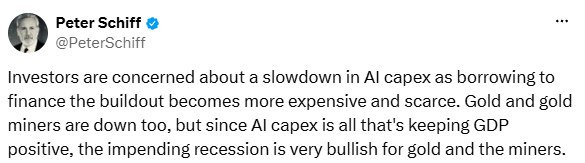
Schiff contends that AI-related capital expenditures are the only factor currently keeping U.S. GDP growth positive — and that unwinding those investments would trigger a recession that benefits gold and silver miners
He challenged cryptocurrency holders against complacency, warning that Bitcoin's relative calm may be "just the calm before the storm"
In a separate post, Schiff questioned claims that the U.S. economy is "booming" under President Trump, citing lower GDP growth and higher inflation compared to the prior two years
Gold's $116 Drop: Support Tested at $4,000
October 22 saw a sharp, broad-based sell-off across multiple asset classes — equities, commodities, and cryptocurrencies all came under selling pressure in what appeared to be a simultaneous de-risking event by institutional traders.
Gold bore a significant portion of the metals market's pain, declining $116 in a single session and closing just above the psychologically and technically significant $4,000 per ounce level. The $4,000 mark had been identified by many precious metals analysts as a key support zone — a price level at which buying interest was expected to be substantial enough to arrest any further decline.
That support level was tested more rigorously later on October 22, when gold briefly slid toward $3,990 per ounce, breaching the four-digit threshold momentarily before recovering. By the time of press, gold had stabilised at $4,023.96 — battered but intact above the critical support zone that many traders had been watching.
Schiff's Interpretation: A Tech Wreck, Not a Gold Bear Market
Peter Schiff, the American economist and chief executive of Euro Pacific Asset Management who has been one of the most prominent voices advocating gold as a long-term safe haven, offered a pointed reading of Thursday's sell-off on his X (formerly Twitter) account.
Rather than interpreting gold's decline as a signal that the precious metal is entering a sustained downtrend, Schiff argued the move was being driven by a specific macro narrative — the anticipation of a collapse in technology stocks and the unwinding of leveraged positions built on artificial intelligence investment themes:
"Gold fell $116 today, closing just above $4,000 support. Traders seem to be bracing for a tech wreck and an unwind of the leveraged AI trade. They may be right to expect that, but they're wrong that gold will fall too. Gold already corrected. A stock market crash will be bullish."
The logic embedded in this assessment is worth unpacking for crypto and macro investors alike.
What Is the "Leveraged AI Trade"?
Over the past two years, a substantial volume of institutional and retail capital has been directed into technology stocks — particularly semiconductor manufacturers, AI infrastructure providers, and software companies positioned to benefit from the artificial intelligence buildout cycle. Much of this positioning has been amplified through leverage: borrowed capital used to increase exposure beyond what cash positions alone would allow.
Leveraged positions create a specific vulnerability: when sentiment shifts or margin requirements tighten, holders are forced to sell not just their AI-related positions but also other assets — including gold, commodities, and even cryptocurrency — to raise cash and meet margin calls or reduce portfolio risk. This "everything sells off" dynamic is what Schiff believes explains Thursday's cross-asset decline, rather than any fundamental change in gold's investment case.
Why Schiff Believes Gold Has Already Corrected
Schiff's argument that gold "already corrected" implies he views the precious metal as having already absorbed its share of the de-risking pressure — meaning further downside is limited relative to the upside he anticipates when equities begin their own more serious correction. From his perspective, investors who are selling gold alongside technology stocks are making a category error: conflating a temporary liquidity-driven sell-off in a safe haven asset with a sustainable bear market for that asset.
Warning Signs of a Pre-Midterm Collapse
Schiff did not frame Thursday's sell-off as an isolated event. Across several posts on Thursday, he outlined a broader set of factors that he believes are converging to make a significant market correction not just possible but probable — and potentially imminent ahead of the 2026 midterm elections.
He identified four primary warning signs:
1. Record-High Equity Valuations U.S. stock markets have been trading at historically elevated valuation multiples, with price-to-earnings ratios in many sectors significantly above long-run averages. Schiff views these valuations as unsustainable, particularly in the context of the other pressures he identifies.
2. A Sharp Rise in Bond Yields U.S. Treasury yields have been climbing, increasing the cost of borrowing across the economy and raising the "risk-free rate" that all other assets are implicitly benchmarked against. Higher yields reduce the present value of future corporate earnings and increase competition from bonds for investor capital — both headwinds for equity markets.
3. A Softening Jobs Market Schiff described the labor market as "soft," suggesting that the employment data underpinning claims of economic strength is weaker than headline figures may suggest. A deteriorating jobs market is both an early recession indicator and a potential catalyst for reduced consumer spending that could accelerate economic weakness.
4. Accelerating Inflation Rather than viewing inflation as a problem the Federal Reserve has contained, Schiff believes price pressures remain elevated and are continuing to erode real purchasing power. Rising inflation combined with slowing growth is the definition of stagflation — historically one of the most difficult environments for both equity investors and policymakers to navigate.
The convergence of these factors, in Schiff's view, creates conditions under which a significant market correction could occur before the November midterm elections — an outcome that would carry considerable political as well as financial significance.
The AI CapEx Thesis: What Happens When the Investment Cycle Ends?
One of the more analytically substantive arguments Schiff advanced on Thursday concerns the role of artificial intelligence capital expenditure in sustaining U.S. economic output.
Schiff contended that AI-related CapEx — the enormous sums being spent by major technology companies on data centers, chips, power infrastructure, and software development in support of AI capabilities — has been a primary driver of GDP growth in the current economic cycle. His implication is that without this specific category of investment spending, the underlying U.S. economy would already be registering negative growth.
This matters because CapEx cycles are not linear or permanent. If investors begin to question the near-term return on AI infrastructure investment — as the "unwind of the leveraged AI trade" thesis suggests — companies may begin to throttle their capital expenditure programs, removing what Schiff sees as the primary engine of current GDP performance.
The consequence, in his view, would be a recession. And in a recessionary environment, Schiff argues that gold and silver mining companies — which are currently trading lower alongside the broader commodities sell-off — stand to be significant beneficiaries. Precious metals mining stocks typically carry leveraged exposure to the underlying metal price, meaning that a sustained rally in gold or silver translates into magnified earnings for miners.
Schiff on the U.S. Economy Under Trump: Lower Growth, Higher Inflation
Separate from his immediate market commentary, Schiff published an October 21 post that addressed the broader macroeconomic narrative surrounding President Donald Trump's second term.
The post was a direct response to comments made by Larry Kudlow — economist and former Director of the National Economic Council under Trump's first administration — who stated publicly that there is "no question that the U.S. economy is booming." Schiff challenged that characterisation:
"Larry Kudlow just said there is no question that the U.S. economy is booming. Given that GDP growth during Trump's first two years is lower than during Biden's last two years, but with higher inflation, based on what evidence does Kudlow conclude the economy is booming?"
Schiff's specific claim — that GDP growth in the first two years of Trump's second term is lower than in the last two years of the Biden administration, while inflation is higher — is presented as his own reading of the data. He did not cite specific figures in the post, and this comparison remains a contested question of economic interpretation given the numerous variables involved in GDP accounting and inflation measurement.
What is clear is Schiff's sustained conviction that the current economic environment is deteriorating rather than improving, and that official or politically-adjacent commentary to the contrary is not supported by the underlying data as he reads it.
Schiff's Warning to Crypto HODLers: "Calm Before the Storm"
Perhaps the message with the most direct relevance to the cryptocurrency community came at the end of Schiff's Thursday commentary, when he addressed Bitcoin holders specifically.
Schiff — who has been a consistent and vocal critic of Bitcoin as an investment asset for many years, viewing it as lacking the intrinsic properties that make gold a reliable store of value — acknowledged that BTC and other crypto assets have been performing relatively well in the current environment, or at least holding up better than some might have expected given the cross-asset pressure visible in gold and equities.
However, he cautioned against interpreting this relative resilience as confirmation that crypto is safe from the broader market risks he has been outlining. Schiff warned cryptocurrency investors to reconsider their "HODL" posture — the crypto community's term for holding an asset through market volatility rather than selling — characterising the recent period of stability as potentially deceptive:
He described the recent moves as possibly "just the calm before the storm," implying that whatever pressure has been building in technology stocks and the broader economy has not yet fully manifested in crypto asset prices, and that when it does, the impact could be severe.
This warning is particularly meaningful in the context of Bitcoin's historical behavior during broader risk-off events. While Bitcoin has at times demonstrated properties of a safe haven asset — particularly during periods of currency debasement or banking stress — it has also sold off sharply during equity market corrections, as the events of 2020, 2022, and various 2024 episodes demonstrated. Schiff's view appears to be that Bitcoin's current correlation pattern with risk assets makes it vulnerable to the same correction he is anticipating for technology stocks.
Gold vs. Risk Assets: The Historical Pattern Schiff Is Invoking
Schiff's overarching thesis — that a stock market correction would ultimately be bullish for gold — is grounded in a historical pattern that has played out across multiple market cycles, though not without exceptions.
During the 2008 financial crisis, gold initially fell alongside equities in the acute phase of the crisis (as leveraged investors sold liquid assets to meet margin calls), then staged a powerful multi-year recovery that took the metal to record highs as central banks responded with unprecedented monetary easing. The same basic pattern — initial sell-off followed by a sustained rally as monetary accommodation increased — repeated during the COVID-19 market disruption in 2020.
Schiff's argument that "gold already corrected" is essentially a claim that Thursday's $116 decline represents the initial sell-off phase, and that the subsequent recovery — driven by a flight to safety, declining real yields, and potentially more accommodative Federal Reserve policy — has already begun or is imminent.
Whether this historical pattern repeats in the current cycle depends on factors including the Federal Reserve's policy response to any stock market decline, the trajectory of real yields, the duration and depth of any recession, and the extent to which institutional and retail investors treat gold as the primary safe haven in a stress scenario, rather than directing flows toward Treasury bonds, the U.S. dollar, or other traditional safe havens.
What Crypto Investors Should Take From Schiff's Analysis
Peter Schiff has been consistently critical of Bitcoin and the broader crypto asset class for years, and that consistency should be weighed when evaluating his warnings. However, the macroeconomic framework he is articulating — elevated equity valuations, rising yields, softening growth, and the potential unwinding of a leveraged AI trade — does not require agreement with his views on gold or crypto to be analytically relevant.
For cryptocurrency portfolio managers and individual investors, the relevant questions raised by Schiff's commentary are:
How correlated is the current crypto market with technology equities? If Schiff's "tech wreck" scenario materialises, assets that have been moving with the Nasdaq are vulnerable regardless of their underlying technology.
Is Bitcoin currently behaving as a safe haven or a risk asset? The answer to this question may not be the same in the next correction cycle as it was in the last.
What is the impact of a sustained AI CapEx slowdown on blockchain infrastructure? Many blockchain networks and crypto infrastructure companies benefit directly from the same technology investment tailwind that Schiff sees as the primary support for current GDP.
How should HODL conviction be calibrated against macro risk? Schiff's "calm before the storm" warning does not require believing gold is superior to Bitcoin to be worth considering as a risk management input.
Want to join the discussion? Login and create a profile to comment.