Pump.fun Kills Relay and Goes In-House: Pump Bridge Delivers 92% Fewer Errors and 2x Faster Crosschain Buys

Key Takeaways
Pump.fun replaced third-party provider Relay with its own Pump Bridge on October 21, 2026, making it the default crosschain route for all in-app trades.
An internal A/B test run September 28–October 7, 2026 across more than 400,000 trade outcomes showed Pump Bridge averaging 1.95 seconds per buy vs. 3.88 seconds on Relay.
Buy errors fell from 11.2% (Relay) to 0.9% (Pump Bridge) — a 92% reduction the platform describes as “12x fewer buy errors.”
The median execution gap between spot price and received tokens shrank from 3.6% on Relay to 3.0% on Pump Bridge, about 17% better fill quality. The median fill is still 3.0% below spot price.
Pump Bridge currently charges no additional bridging fee. Pump.fun’s platform fee is 0.45% per trade for wallets without a referral code.
Rival Fomo still routes crosschain trades through Relay, making bridge performance a live competitive differentiator in the social trading app war.
All performance figures are self-reported by Pump.fun; independent third-party verification has not been published.
Introduction: Why a Memecoin Launchpad Built Its Own Bridge
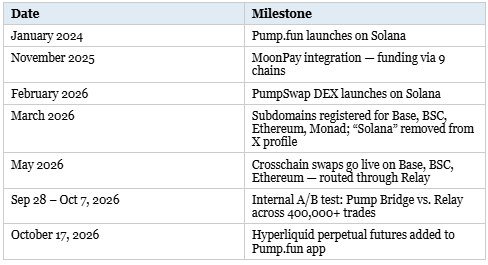
When Pump.fun launched on Solana in January 2024, crosschain infrastructure was someone else’s problem. The platform was native to a single, fast, cheap blockchain, and Solana’s low fees meant there was little reason for users to route capital in from other networks. Two years later, that picture has changed fundamentally. Pump.fun now supports crosschain trading across Robinhood Chain, BNB Smart Chain, Base, Arc, and Ink, and the plumbing that carries those trades has become a competitive battleground in its own right.
The original solution was straightforward: outsource the bridging problem to Relay, a specialist crosschain routing provider also used by Pump.fun’s main rival, Fomo. But over time, relying on a third-party infrastructure layer that your competitor also uses creates an obvious strategic vulnerability. If both platforms use the same bridge, neither can win on bridge quality. And if that bridge has a double-digit error rate — as Pump.fun now claims was the case — both platforms are absorbing the user-experience cost.
On October 21, 2026, Pump.fun made Pump Bridge the default crosschain route for all in-app trades, ending its dependence on Relay. The move was accompanied by an unusually detailed data release: an A/B test covering more than 400,000 trades, with head-to-head latency distributions, error rates, and execution quality comparisons. The message, directed as much at Fomo’s users as at its own, was explicit: Pump.fun’s bridge is faster, more reliable, and — for now — free to use.
This article breaks down what the Pump Bridge data actually shows, what it leaves unsaid, how it fits into the broader Pump vs. Fomo rivalry, and what it means for traders deciding where to execute their next crosschain memecoin buy.
Section 1: The Crosschain Problem in Memecoin Trading
How Crosschain Swaps Work in a Social Trading App
When a user on Pump.fun or Fomo wants to buy a token that lives on a different blockchain from their source funds — say, buying a token on BNB Smart Chain with ETH sitting on Ethereum Base — the app needs to do several things in rapid succession: lock or burn the source asset, communicate with the destination chain, release the destination token, and update both accounts. This process typically involves a relayer network — a set of nodes that monitor both chains and execute the corresponding transactions.
The quality of this relayer infrastructure determines two things that matter enormously in memecoin trading: speed and reliability. Memecoins are volatile by design; a buy that takes 4 seconds instead of 2 can land at a meaningfully worse price when a token is moving fast. And a failed transaction is worse than a slow one — it ties up capital, may require manual recovery, and erodes the user’s confidence in the platform.
This is why bridge performance is not merely a technical footnote. In the context of social trading apps built for retail memecoin buyers, it is a core product quality metric, on par with the app’s interface speed and the quality of its social feed.
Pump.fun’s Crosschain Expansion Timeline
Section 2: The A/B Test — What the Data Shows
Test Design and Sample Size
The performance data Pump.fun published is based on a randomized, in-app experiment. Users were assigned to one of two treatment groups — Pump Bridge or Relay — and then reassigned several times over the course of the test window (September 28 to October 7, 2026) to control for time-of-day and user-behavior effects. The total sample covered more than 400,000 trade outcomes across five chains: Robinhood Chain, BNB Smart Chain, Base, Arc, and Ink.
The chain-level distribution in the timed sample was heavily skewed. Robinhood Chain accounted for approximately 53% of the 383,326 timed trades, and BSC accounted for roughly 39%. Base, Arc, and Ink together made up the remaining ~8%. This matters for interpretation: if Pump Bridge’s performance advantage is concentrated on Robinhood Chain or BSC, the headline numbers may not represent the experience on less-trafficked chains. Pump.fun says the underlying datasets are available for outside researchers, but independent verification has not been published as of the announcement date.
Speed: Latency Distribution Head-to-Head
The headline speed result is that the median buy on Pump Bridge completed in 1.95 seconds, versus 3.88 seconds on Relay — a 2x improvement. But the tails of the distribution are equally revealing:
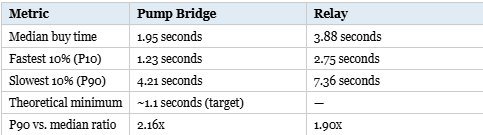
One of the more striking claims in the data is that 90% of Pump Bridge transactions completed before a typical Relay transaction even finished. The P10 figure for Pump Bridge (1.23 seconds) is faster than the median for Relay (3.88 seconds). The fastest Pump Bridge buys, at around 1.23 seconds, were within 0.13 seconds of the theoretical minimum of approximately 1.1 seconds — the floor set by the block time and confirmation requirements of the participating chains.
Pump.fun frames that 1.1-second target as an engineering goal: the infrastructure is designed to eventually push median times toward that floor. Whether that is achievable at scale across all five supported chains during peak activity is not addressed by the published data.
Reliability: Error Rate Comparison
The error rate improvement is the most commercially significant figure in the release. A buy error rate of 11.2% on Relay means that, in the test window, more than one in ten crosschain buy attempts failed. On Pump Bridge, that rate fell to 0.9% — statistically one failed buy for every 111 attempts.
Pump.fun puts this in consumer terms: a trader making 10 crosschain buys per day would experience more than one failed transaction daily on Relay. On Pump Bridge, that same trader would expect roughly one failure every 11 days. Failed transactions in memecoin trading are not merely inconvenient — they often mean missing a price move, sitting out of position while the transaction is unwound, and paying gas or bridge fees on the failed attempt. Reducing error frequency from daily to roughly weekly is a meaningful quality-of-life improvement for active traders.
Execution Quality: The Price Impact Gap
The third metric Pump.fun published is execution quality: the gap between the spot price shown in the app and the price at which the trade actually filled. This metric is particularly important for memecoin traders, because high-volatility assets can move significantly in the time between initiating a crosschain swap and having the destination tokens land in the wallet.
Pump.fun reports that the median execution gap on Pump Bridge was 3.0%, compared to 3.6% on Relay — approximately 17% better fill quality. For a $500 buy, this difference amounts to about $3 per trade. The platform estimates that a trader making ten $500 buys per day could save approximately $11,000 per year at that differential, if the gap holds consistently.
There are two important caveats to read alongside this figure. First, the comparison was made using completed USDC buys under $500; larger trades and different token pairs may show different price impact patterns. Second — and this is noted in Pump.fun’s own data — even on Pump Bridge, the median fill still lands 3.0% below the spot price shown in the app. This is not a slight on the bridge; it reflects the fundamental nature of crosschain swaps, which always involve some slippage, AMM price impact, and latency risk. But traders who see a price in the app and expect to fill at that price are consistently receiving 3% less, which is worth understanding before making active memecoin buying decisions.
Section 3: Fees, Costs, and the Business Model Behind Pump Bridge
Zero Bridge Fees — For Now
Pump.fun’s announcement emphasizes that Pump Bridge currently charges no additional bridging fee on top of the trade itself. This is a meaningful differentiator in a market where bridge fees can range from 0.1% to 0.5% on top of the underlying transaction costs. Keeping bridging free removes a source of friction and makes the total cost of a crosschain trade on Pump.fun more predictable.
The qualifier “currently” is worth noting. Bridge infrastructure has ongoing operational costs: the relayer nodes must be maintained, gas fees must be paid on the destination chain, and the system must be scaled as trading volume grows. Zero bridge fees are a standard product launch posture — the goal is to capture users and trading volume before introducing fees later. Traders who factor bridge costs into their strategy should treat the current zero-fee structure as a promotional condition rather than a permanent feature, even if Pump.fun has not signaled any change.
The 0.45% Platform Fee and Referral Code Structure
For wallets without a referral code, Pump.fun charges a 0.45% platform fee per trade. Cofounder alon has positioned this as the lowest fee among social trading apps, noting that rival Fomo charges approximately $1 per swap (roughly 0.5% on a $200 trade, or higher percentages on smaller trades).
The referral code structure creates a two-tier fee environment: users who enter through a referral code may receive a reduced platform fee, while those trading directly absorb the 0.45% baseline. For high-frequency traders doing ten or more trades per day, the difference between 0.45% and a lower referral rate could compound meaningfully over a month of active trading.
Hyperliquid Perps: Expanding the Revenue Stack
One week before the Pump Bridge launch, on October 17, 2026, Pump.fun added perpetual futures trading via Hyperliquid integration. The move extends the platform beyond memecoin spot trading into leveraged derivatives, which carry higher fees and higher user risk. Hyperliquid perp trading on Pump.fun carries fees of up to 0.10% per order and is currently restricted for users in the United States and Ontario, Canada, likely for regulatory reasons.
The perps addition is strategically significant: it makes Pump.fun a more complete trading platform rather than a specialized memecoin launchpad, and it competes directly with Fomo’s own Hyperliquid builder-code fee revenue. Both platforms are converging on the same set of features — social feed, spot trading, crosschain swaps, and perpetual futures — which means that execution quality and fee structure will increasingly determine which platform retains and grows its user base.
Section 4: Pump.fun vs. Fomo — The Bridge as a Competitive Weapon
Why Relay’s Role in the Rivalry Matters
Relay’s position as the shared bridge provider for both Pump.fun and Fomo was, from a competitive strategy perspective, a liability for Pump.fun. As long as both platforms used the same infrastructure for crosschain trades, neither could claim a meaningful advantage in bridge performance. The 11.2% error rate on Relay in Pump.fun’s test window was not a Pump.fun problem in isolation — Fomo users routing through Relay would have been experiencing the same failure frequency.
By building and deploying Pump Bridge, Pump.fun has transformed bridge quality from a shared weakness into a potential competitive advantage. If the 92% error-rate reduction and 2x speed improvement hold in production — and if Fomo continues routing through Relay — Pump.fun users will consistently have a better crosschain execution experience. That difference is difficult for Fomo to neutralize without either building its own bridge or switching bridge providers.
The State of the Pump vs. Fomo Revenue War
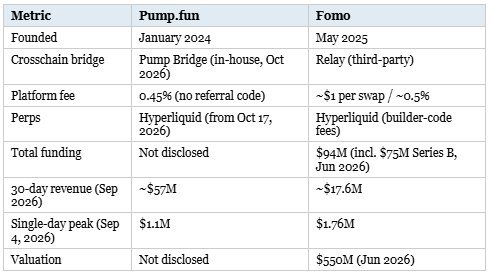
The Pump Bridge launch is the latest move in what has become one of crypto’s more entertaining competitive battles. Fomo, which launched in May 2025, has grown rapidly: it raised $75 million in a Series B in June 2026 at a $550 million valuation and has accumulated over 625,000 users. Its social trading model — real-time trade feeds, leaderboards, user follows, and one-tap copy trading — has found a distinct audience from Pump.fun’s memecoin-launchpad-first model.
The revenue competition between the two has been tight. On September 4, 2026, Fomo posted $1.76M in daily protocol revenue versus Pump.fun’s $1.1M — a single-day lead of roughly 60%. Over 30 days, however, Pump.fun retained a commanding lead with approximately $57M in cumulative revenue versus Fomo’s $17.6M, reflecting the difference in user base maturity and platform scale.
Pump.fun’s Aggressive Recruitment Push
Bridge infrastructure is not the only front in this rivalry. In August 2026, leaked contracts revealed that Pump.fun was offering top Fomo traders a $20,000 signing bonus plus $30,000 per month to switch platforms exclusively. Recruits were required to close their Fomo accounts, move all positions to Pump.fun, trade only through a new Pump.fun wallet, link their public X accounts, and maintain a minimum of $25,000 in monthly trading volume.
At $380,000 per year per recruit, the acquisition cost is significant — but it reflects the platform’s calculation that a high-volume, high-profile trader brings organic followers and trading volume that justifies the spend. The recruitment campaign coincided with Fomo posting six consecutive weeks of all-time-high trading volume above $2 million per week, signaling that Pump.fun viewed the rival platform as a genuine threat to its user base.
The Pump Bridge launch and the X post from cofounder alon — titled “How your social trading app has been robbing you” — are positioned in the same combative spirit. By publicly benchmarking against Relay (the bridge Fomo still uses) and inviting comparison on error rates and execution quality, Pump.fun is extending the rivalry from user acquisition into infrastructure credibility.
Section 5: What the Pump Bridge Launch Means for Traders
Practical Impact for Active Crosschain Buyers
For traders who regularly buy tokens across chains — moving from Base to BSC, or routing Robinhood Chain memecoins through a Solana-native wallet — the Pump Bridge numbers suggest a meaningfully better execution environment, assuming the test results translate to production. The combination of faster settlement (1.95s median), fewer failed transactions (0.9% vs. 11.2%), and slightly better fills (3.0% vs. 3.6% median gap) compounds into a more reliable, less frustrating trading experience.
The practical significance of the error rate improvement deserves particular emphasis. In the Relay test window, 1 in 9 crosschain buy attempts failed. For a trader making 10 buys per day, that is potentially one failed transaction every day. Each failed crosschain swap typically involves some combination of: gas fees paid on the source chain, capital temporarily locked in the bridge, time spent identifying and recovering the failed transaction, and the opportunity cost of missing the entry price. An 11-day failure interval instead of a daily one meaningfully reduces all of these costs.
What to Watch: Limitations of the Published Data
Pump.fun’s data is credible in structure — the test design (randomized, in-app, with reassignment) is reasonable methodology, and the sample size of 400,000+ trades is large. But several gaps in the published information are worth flagging:
Self-reported data: All figures come from Pump.fun. No independent third-party auditor has published a verification of the test conditions or results.
Chain concentration: Robinhood Chain (53%) and BSC (39%) dominate the sample. Performance on Base, Arc, and Ink — which together account for ~8% of trades — is not separately disclosed.
No high-volatility stress test: The test window (Sept 28–Oct 7) may not have captured peak memecoin market conditions. Speed and error rates under maximum load (a major token launch with thousands of simultaneous buyers) may differ.
Execution gap still present: The median fill at 3.0% below spot is an improvement on Relay, but it is still a real cost. Traders benchmarking their strategy should use 3% as a realistic slippage expectation on Pump Bridge, not zero.
No bridge fee — yet: Zero bridge fees are a launch condition. Traders should monitor whether fees are introduced as the service matures.
Section 6: The Broader Picture — Infrastructure as a Moat
Why In-House Infrastructure Is a Recurring Theme in Crypto
Pump.fun’s move from Relay to Pump Bridge follows a pattern seen repeatedly across successful crypto platforms: once trading volume reaches a threshold where third-party infrastructure costs or quality become a strategic constraint, platforms build their own. Uniswap built its own router. Binance built its own chain. Coinbase built Base. The common thread is that infrastructure ownership gives a platform control over fees, performance, and the roadmap for future improvements.
For Pump.fun, the timing is significant. The platform’s crosschain trading only went live in May 2026 — five months before the Pump Bridge launch. The rapid move to in-house infrastructure suggests either that Relay’s performance was degrading at scale, that the error rate was higher than Pump.fun had expected, or that the platform had always planned to internalize the bridge once volume justified the development investment. The publication of detailed A/B test data — rather than simply announcing the switch — suggests the latter: Pump.fun wanted the launch to do marketing work, not just infrastructure work.
PumpSwap, MoonPay, and the Full Infrastructure Stack
Pump Bridge is one component in a broader infrastructure build-out. Pump.fun launched PumpSwap, its own decentralized exchange, in February 2026 — a move that similarly reduced reliance on external DEX liquidity and gave the platform direct control over trading fees on Solana. The MoonPay integration, announced in November 2025, allows users to fund accounts with tokens from nine chains (Arbitrum, Base, Bitcoin, BSC, Ethereum, Hyperliquid, Plasma, Polygon, and Solana), with MoonPay handling the cross-chain routing for fiat on-ramps.
Taken together, these components — PumpSwap (on-chain execution), MoonPay (fiat on-ramp), Pump Bridge (crosschain settlement), and Hyperliquid perps (leverage) — describe a platform that is progressively internalizing the entire trading stack. Each layer reduces the number of external providers that can become a performance bottleneck or a shared vulnerability with competitors.
Frequently Asked Questions
What is Pump Bridge?
Pump Bridge is Pump.fun’s proprietary crosschain bridge, built in-house to replace the third-party Relay protocol for routing crosschain trades within the Pump.fun app. It became the default crosschain route on October 21, 2026. It currently charges no additional bridging fee beyond the platform’s standard 0.45% trade fee.
What was wrong with Relay?
According to Pump.fun’s internal A/B test (September 28–October 7, 2026), Relay had a buy error rate of 11.2% and a median buy time of 3.88 seconds. The platform says more than 10% of Relay trades took longer than 7.36 seconds. Pump.fun characterized this as a systematic problem that was costing users money on failed transactions and worse execution prices. Relay has not publicly responded to these claims.
Is Fomo still using Relay?
As of the Pump Bridge launch announcement on October 21–22, 2026, Fomo had not announced any change to its crosschain routing provider. Pump.fun’s launch materials explicitly noted that Relay “remains in use” at Fomo, and rival Fomo had not publicly responded to the Pump Bridge performance claims.
What chains does Pump Bridge support?
The A/B test covered five chains: Robinhood Chain, BNB Smart Chain (BSC), Base, Arc, and Ink. Robinhood Chain accounted for approximately 53% of the timed trades, and BSC for approximately 39%, reflecting the dominance of the Robinhood Chain memecoin meta in Pump.fun’s current crosschain volume.
Does Pump Bridge charge a fee?
Pump Bridge currently charges no additional bridging fee. Pump.fun’s standard platform fee is 0.45% per trade for wallets without a referral code. This is the total fee structure as announced; users should monitor whether a separate bridging fee is introduced as the service scales.
What is the price impact on Pump Bridge crosschain trades?
In the A/B test, the median execution gap between the app’s displayed spot price and the actual fill was 3.0% on Pump Bridge, compared to 3.6% on Relay. The comparison was based on completed USDC buys under $500. Even on Pump Bridge, a 3% deviation from displayed price is a meaningful cost on larger orders. Traders should account for this slippage when planning entry sizes.
What is the Pump.fun vs. Fomo rivalry about?
Pump.fun (launched January 2024) and Fomo (launched May 2025) are both mobile-first platforms targeting retail memecoin and crypto traders, primarily on Solana and its crosschain ecosystem. They compete on social features (trade feeds, copy trading, leaderboards), platform fees, crosschain execution quality, and product breadth (including Hyperliquid perpetual futures integration on both platforms). Fomo has raised $94 million in total funding and had 625,000+ users as of mid-2026; Pump.fun has not disclosed its funding. Over 30 days through September 2026, Pump.fun generated roughly $57M in protocol revenue vs. Fomo’s $17.6M.
Conclusion: Bridge Quality Is Now a Product Category
The launch of Pump Bridge marks a moment where crosschain infrastructure moved from a background technical detail to a front-page product differentiator. Pump.fun published 400,000+ trade data points, released percentile-level latency distributions, and explicitly benchmarked its competitor’s provider. That level of transparency — even accounting for the fact that the data is self-reported — sets a new standard for how crypto platforms communicate about infrastructure quality.
For traders, the practical takeaway is clear: if the A/B test results hold in production, crosschain buying on Pump.fun will be faster, more reliable, and better-priced than on a platform still using Relay. The 3.0% median execution gap is the honest number to internalize — better than Relay’s 3.6%, but still a real cost that should inform position sizing and trade frequency.
For the broader competitive picture, the bridge war is just one front. Fomo has more venture funding, a strong social product, and a loyal user base. Pump.fun has more cumulative revenue, a growing infrastructure stack, and a willingness to spend aggressively to recruit rival traders. The addition of Hyperliquid perps one week before the Pump Bridge launch suggests Pump.fun is accelerating across multiple product dimensions simultaneously, with the clear goal of making Fomo’s comparative advantages smaller every month.
Whether Fomo responds by building its own bridge, switching providers, or competing on dimensions where infrastructure quality is less visible — social features, copy trading depth, creator tools — will determine whether the Pump Bridge launch becomes a durable competitive advantage or simply an opening move in the next chapter of the memecoin platform wars.
Want to join the discussion? Login and create a profile to comment.