Ripple and Robinhood Strike Strategic RLUSD Deal — 28.6 Million Retail Customers and Bitstamp's Institutional Business Now in Scope
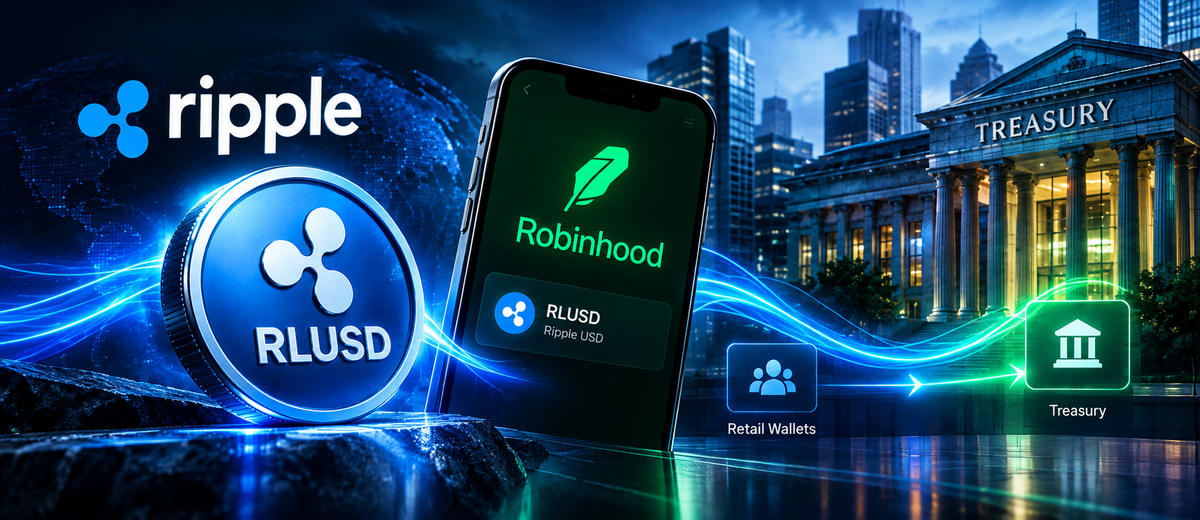
Ripple and Robinhood announced a wide-ranging strategic partnership on October 27, 2026 that positions RLUSD as the primary stablecoin across Robinhood's retail and institutional operations. The deal is more expansive than a distribution arrangement: it integrates RLUSD at three distinct layers of Robinhood's business — consumer product (the Robinhood app, in progress), institutional exchange (Bitstamp, live now via XRPL settlement), and corporate treasury (Ripple Treasury for Robinhood's own internal operations). Announced the day after Ripple's OCC trust bank approval and the same week Moody's assigned RLUSD an A2 investment-grade rating, the partnership completes a week of developments that have elevated RLUSD into a qualitatively different category of institutional credibility. XRP traded at $1.33 at publication, up 2.3% over 24 hours, with a market cap near $84 billion.
Key Takeaways
Ripple and Robinhood announced a strategic partnership on October 27, 2026, making RLUSD a key stablecoin across Robinhood's digital asset ecosystem
RLUSD is immediately live on Robinhood Chain and on Bitstamp by Robinhood; the Robinhood retail app integration follows later in 2026 with no exact date yet confirmed
Robinhood plans to use RLUSD on the XRP Ledger for institutional settlement through Bitstamp's growing institutional client business
Robinhood serves 28.6 million funded customers globally — the scale of the potential RLUSD retail distribution channel
Robinhood will integrate Ripple Treasury to automate its own global treasury operations, including cash and liquidity management, cash flow forecasting, payments, and intercompany netting
Ripple Prime's relationship with Bitstamp is expanding: lending and margin financing across approximately 20 digital assets, with spot trading access for Ripple Prime clients on Bitstamp and perpetual futures support planned for later in the year
RLUSD has grown to more than $2.4 billion in market value since its December 2024 launch; total stablecoin supply has now surpassed $300 billion globally
XRP was trading at $1.33, up 2.3% over 24 hours, with a market capitalisation of approximately $84 billion (CoinPaprika, October 28, 2026)
Three Layers of Integration: Retail, Institutional, and Treasury
What distinguishes this partnership from a straightforward stablecoin listing arrangement is its scope across three distinct business domains within the Robinhood-Bitstamp ecosystem. Most distribution deals place a stablecoin in a single product or venue; the Ripple-Robinhood deal simultaneously targets Robinhood's consumer base, Bitstamp's institutional client network, and Robinhood's own internal financial operations.
Layer One: Robinhood Chain and Bitstamp — Live Now
RLUSD is already available on Robinhood Chain — the blockchain Robinhood has developed for its digital asset products — and on Bitstamp by Robinhood, the global crypto exchange that Robinhood acquired in 2025. Bitstamp is one of the world's oldest and most established cryptocurrency exchanges, founded in Slovenia in 2011 and holding regulatory licenses across multiple jurisdictions. The acquisition gave Robinhood access to Bitstamp's institutional client base, European market presence, and global exchange infrastructure.
On Bitstamp, RLUSD will be used specifically for institutional settlement on the XRP Ledger — connecting Ripple's payment infrastructure directly to the exchange's institutional business. The XRP Ledger is a natural home for this function: it was designed from the ground up for fast, low-cost financial asset settlement, and Ripple's existing relationships in cross-border institutional payments mean the infrastructure for XRPL-based settlement is already mature.
Layer Two: The Robinhood App — Coming Later in 2026
The most consequential element of the partnership in terms of potential reach — RLUSD inside the main Robinhood retail application — remains a forward plan. Robinhood expects to add RLUSD to its primary consumer app later in 2026, giving the stablecoin access to 28.6 million funded customers globally.
To put that number in context: 28.6 million funded accounts is a distribution channel of a scale that very few stablecoins have approached through any single institutional partnership. If even a small percentage of those users choose to hold RLUSD for its intended purposes — payments, a stable unit of account within the Robinhood ecosystem, or a vehicle for earning yield on stablecoin balances (if Robinhood enables such products) — the impact on RLUSD's market cap could be material.
Robinhood has not confirmed an exact date for the app rollout, and the companies' joint statement characterises it only as happening "later this year." This is a reminder that retail distribution commitments require regulatory and technical readiness that can move timelines, and investors should weight the forward commitment accordingly.
Layer Three: Ripple Treasury Inside Robinhood's Operations
Perhaps the most operationally significant element of the deal for understanding how Ripple sees its long-term role in financial infrastructure is the internal treasury integration. Robinhood plans to adopt Ripple Treasury to automate its own global treasury operations — including:
Cash and liquidity management: Optimising how Robinhood holds and deploys the cash it has available across its global operations
Cash flow forecasting: Predicting incoming and outgoing cash flows with greater accuracy and speed, enabling better deployment decisions
Payments: Processing internal and external payments through Ripple's payment infrastructure
Intercompany netting: Reducing the volume of actual cash transfers between Robinhood's business units and subsidiaries by netting offsetting internal obligations before settlement
Intercompany netting is a fundamental treasury efficiency technique. Large companies with multiple subsidiaries across different currencies and jurisdictions often accumulate large volumes of internal receivables and payables that could theoretically cancel each other out. Without netting, each of these is settled individually — generating unnecessary foreign exchange conversions, bank fees, and settlement delays. A blockchain-based netting system using RLUSD as the settlement asset could compress this process dramatically, reducing the number of actual currency transfers Robinhood needs to execute.
This layer of the deal means Robinhood is not just distributing RLUSD to its customers — it is deploying RLUSD in its own corporate operations. That is a qualitatively different level of commitment than a listing relationship, and it provides Ripple with a proof-of-concept for enterprise treasury management using stablecoin infrastructure that carries the credibility of a Robinhood-scale deployment.
Ripple Prime's Expanded Role Within Bitstamp
The partnership also extends and formalises Ripple Prime's relationship with Bitstamp beyond what the two parties previously had in place. The announcement describes the Robinhood-Ripple relationship as building on an "existing relationship across financing, liquidity, and market access," suggesting that Ripple Prime has already been providing services to Bitstamp's institutional operations.
The new arrangement expands Ripple Prime's institutional services to include:
Lending and margin financing across approximately 20 digital assets: This is the core prime brokerage function — providing institutional clients of Bitstamp with the ability to borrow against their digital asset holdings or to use leverage for trading. The roughly 20-asset coverage is meaningful in that it extends well beyond the largest cap assets (Bitcoin and Ethereum), potentially including assets in Ripple's existing Prime portfolio.
Spot trading access on Bitstamp for Ripple Prime clients: Ripple Prime's institutional client base now has direct access to Bitstamp's order books for spot trading — connecting Prime's liquidity and financing infrastructure with one of the world's most established exchange venues. For institutional clients who want both prime brokerage services and exchange access through a single prime relationship, this integration reduces operational complexity significantly.
Perpetual futures on Bitstamp — planned for later this year: The partnership also includes a forward commitment to enable perpetual futures trading on Bitstamp through the Ripple Prime relationship. Perpetual futures — crypto contracts without expiry that track spot prices through a funding rate mechanism — are the dominant derivatives product in crypto by open interest and volume. Bringing them to Bitstamp through Ripple Prime would expand the range of institutional trading strategies accessible through the integrated relationship.
Monica Long's Statement: The Enterprise-Grade Thesis
Ripple President Monica Long's statement on the partnership captures the company's positioning for RLUSD beyond its use as a trading or payment instrument:
"From bringing RLUSD to retail and institutional markets to helping Robinhood manage its own treasury operations, this partnership reflects growing institutional demand for integrated solutions that support both customer-facing offerings and core financial operations."
The phrase "integrated solutions" in Long's framing is doing important work. Ripple is not pitching RLUSD as just another stablecoin to be listed alongside USDT and USDC — it is pitching a stack that includes the stablecoin, the institutional payment infrastructure (XRPL), the prime brokerage and lending service (Ripple Prime), and the treasury management product (Ripple Treasury) as a coherent, end-to-end offering for large financial platforms.
For Robinhood, accepting this integrated stack means committing to RLUSD not just as a consumer product but as infrastructure for its institutional business (Bitstamp) and its own corporate financial operations. That depth of integration creates mutual dependency: the more Robinhood's operations run through Ripple's infrastructure, the more both parties need the relationship to succeed. This is exactly the kind of enterprise relationship that creates durable commercial ties and recurring revenue rather than a one-time listing agreement that could be easily superseded by a competing stablecoin offer.
The Context: RLUSD's Week of Regulatory and Commercial Momentum
The Robinhood partnership announcement on October 27 arrives as part of a concentrated week of developments that has materially elevated RLUSD's standing:
OCC Trust Bank Approval (earlier this week): Ripple's receipt of final approval from the Office of the Comptroller of the Currency for Ripple National Trust Bank places RLUSD's reserve management under federal banking supervision — giving it regulatory standing that USDC has also now achieved through its own OCC approval in July 2026, but that the vast majority of stablecoins lack.
Moody's A2/P-1 Investment-Grade Rating (this week): Moody's assigned investment-grade credit ratings to RLUSD's reserves under its Stablecoin methodology — reportedly the first such investment-grade rating assigned to any stablecoin. The A2/P-1 designation is precisely the kind of third-party credit credential that institutional counterparties with investment-grade mandates require before engaging with a financial instrument.
Robinhood Partnership (October 27): The distribution deal with one of the US's largest retail brokerages and Bitstamp's global institutional exchange brings RLUSD access to 28.6 million funded retail accounts and a significant institutional client base simultaneously.
Together, these three developments — federal banking oversight, investment-grade credit rating, and major distribution agreement — form a mutually reinforcing set of institutional credentials. Each one makes the others more credible: an OCC-supervised stablecoin with a Moody's A2 rating is a more attractive product for Robinhood to integrate; Robinhood's distribution scale makes Moody's investment-grade assessment more consequential; and the combination of all three makes RLUSD's enterprise positioning increasingly defensible.
The XRP Connection: How the Partnership Affects the XRP Ledger
The announcement has clear implications for XRP's utility and the XRP Ledger's transaction activity, though they are indirect rather than mechanistic.
Robinhood's plan to use RLUSD on the XRP Ledger for institutional settlement through Bitstamp means that institutional trades — potentially involving significant transaction volumes given Bitstamp's institutional scale — will be settled using XRPL infrastructure. Each XRPL transaction requires a small amount of XRP as a transaction fee, and XRPL's settlement role for an institutional venue like Bitstamp could drive meaningful incremental XRPL activity.
The RLUSD market cap of more than $2.4 billion and the $84 billion XRP market cap (at $1.33) exist within the same ecosystem — the XRP Ledger — meaning that institutional adoption of RLUSD settlement on XRPL reinforces the network's position as serious financial infrastructure rather than a speculative blockchain. For XRP holders, the argument is that a more actively used XRPL validates the network's utility case and supports the long-term valuation of XRP as the native asset required for all XRPL transactions.
XRP's 2.3% gain at the time of publication may partly reflect market participants pricing in the combined effect of the Moody's rating, the Robinhood partnership, and the broader RLUSD institutional momentum from the week's announcements.
Stablecoin Supply at $300 Billion: What the Milestone Means
The article notes that total stablecoin supply has now surpassed $300 billion — a threshold that reflects the asset class's transition from crypto-native trading infrastructure into broader financial market utility.
The $300 billion milestone has taken the stablecoin market from a predominantly retail and DeFi-focused tool toward an instrument that handles genuine institutional settlement, corporate treasury management, cross-border payment flows, and on-chain financial market infrastructure. USDT accounts for the largest share of that supply; USDC is a distant second; and RLUSD, at $2.4 billion, is a smaller but fast-growing participant in a market dominated by entrenched incumbents.
For Ripple, the Robinhood partnership is partly a distribution strategy designed to close that gap. By embedding RLUSD in one of the US's most widely used retail financial apps and simultaneously handling Bitstamp's institutional settlement volume, Ripple is attacking both ends of the market — the retail long tail and the institutional wholesale volume — through a single partner relationship.
Whether RLUSD can grow its $2.4 billion market cap significantly through the Robinhood distribution depends on multiple variables: how quickly the Robinhood app integration launches, what RLUSD use cases Robinhood enables within the app, whether the institutional Bitstamp settlement flows drive measurable RLUSD supply growth, and how the regulatory environment for stablecoin distribution evolves as the GENIUS Act's January 2027 implementation date approaches.
What the Robinhood App Rollout Means — and What It Does Not Yet Confirm
The most transformative element of the partnership for RLUSD's growth trajectory — app integration with 28.6 million funded customers — has not yet launched. This warrants careful framing.
"Later this year" encompasses the remaining months of 2026, and no specific launch date has been disclosed. The integration will require Robinhood to build and test the user-facing product, address any regulatory requirements for stablecoin distribution within its licensed brokerage framework, and ensure RLUSD can be held, transferred, and used in ways that comply with applicable rules in each of the jurisdictions where Robinhood operates.
Each of these workstreams takes time, and crypto product launches have a history of timeline overruns. The partnership is confirmed, the strategic intent is genuine, and the commitment is public — but "live in the Robinhood app" is a meaningfully different milestone from "announced as a planned feature," and investors and market observers should maintain that distinction in their assessment of RLUSD's near-term distribution trajectory.
Summary
Ripple's October 27, 2026 partnership with Robinhood integrates RLUSD across three distinct tiers of the Robinhood-Bitstamp ecosystem: live deployment on Robinhood Chain and Bitstamp's institutional platform via XRPL settlement; a forthcoming retail app integration that would bring RLUSD to 28.6 million funded customers; and Robinhood's adoption of Ripple Treasury for its own internal treasury management operations including cash flow forecasting, payments, and intercompany netting. Ripple Prime's expanded role at Bitstamp — lending and margin financing across ~20 assets, spot access for Prime clients, and planned perpetual futures — adds a prime brokerage dimension to what would otherwise be a distribution deal. The announcement follows Ripple's OCC national trust bank approval and Moody's A2/P-1 investment-grade rating for RLUSD within the same week, creating a mutually reinforcing set of regulatory, credit, and commercial developments that have materially advanced RLUSD's institutional positioning. With RLUSD's market cap now above $2.4 billion and total stablecoin supply passing $300 billion globally, the Robinhood partnership adds a potential consumer-scale distribution channel to a stablecoin that already has the institutional credentials to compete for enterprise adoption — with the Robinhood app rollout the critical near-term milestone that will determine how quickly retail distribution translates into market cap growth.
Want to join the discussion? Login and create a profile to comment.