Ripple Prime Joins DTCC’s 50-Plus-Firm Tokenization Push Alongside BlackRock and JPMorgan — What It Means for XRP
Key Takeaways
Ripple Prime is among more than 50 financial institutions in the DTCC Industry Working Group developing tokenized securities infrastructure, alongside BlackRock, JPMorgan, Goldman Sachs, and Circle.
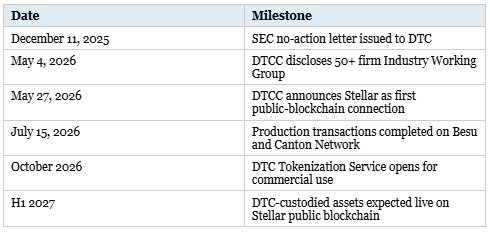
DTCC’s subsidiary, the Depository Trust Company (DTC), completed production-grade tokenized transactions on July 15, 2026, covering U.S. Treasuries, equities, and ETFs on the Hyperledger Besu and Canton Network blockchains.
The DTC Tokenization Service is commercially available as of October 2026, operating under a three-year SEC no-action letter issued in December 2025.
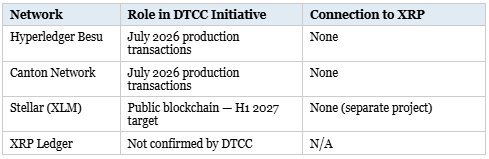
Stellar, not XRP Ledger, is DTCC’s identified public-blockchain connection — DTC-custodied assets are expected to go live on Stellar in the first half of 2027.
XRP Ledger has no confirmed role in DTCC’s settlement system; Ripple Prime’s participation is as an institutional brokerage, not as a blockchain infrastructure provider.
The initiative covers Russell 1000 stocks, major-index ETFs, and U.S. Treasury bills, bonds, and notes — assets collectively representing trillions of dollars in DTC custody.
Introduction: The Largest Post-Trade Infrastructure Move in a Generation
The Depository Trust & Clearing Corporation has spent decades as the invisible backbone of American capital markets. Its subsidiary, the Depository Trust Company, provides custody and asset servicing for more than $114 trillion in securities — a figure so large it exceeds the annual GDP of every economy on Earth combined. Now, for the first time in its 50-year history, DTCC is bringing those assets onto blockchain infrastructure, and it has assembled more than 50 of Wall Street’s most powerful institutions to do it.
Ripple Prime — the institutional brokerage arm created when Ripple acquired Hidden Road for $1.25 billion in 2025 — is one of those 50-plus participants. That fact alone generated significant excitement in XRP communities, with investors drawing a direct line from Ripple’s inclusion to the XRP Ledger playing a central role in DTCC’s settlement infrastructure.
The reality is more nuanced, and understanding it requires separating three distinct questions: what DTCC is actually building, what role Ripple Prime specifically plays within that initiative, and what role, if any, the XRP Ledger has been confirmed to take. This article addresses all three, drawing on DTCC’s official announcements, the SEC no-action letter, and coverage of the July 2026 production transactions.
Section 1: What Is the DTC Tokenization Service?
From $114 Trillion in Custody to On-Chain Settlement
The DTC Tokenization Service is a new infrastructure layer that allows DTC-custodied assets — stocks, ETFs, and Treasury securities — to be represented as tokens on pre-approved blockchain networks while retaining all of their existing legal characteristics. The tokenized version of a Microsoft share, for instance, carries the same dividend entitlements, voting rights, and investor protections as the conventional share held through a traditional brokerage. What changes is the settlement mechanism: instead of the legacy Continuous Net Settlement (CNS) system, ownership can transfer on-chain in near real-time.
This matters enormously for market structure. Traditional securities settlement in the United States operates on a T+1 cycle — trades settle the business day after they are executed. That one-day gap requires collateral to be posted by all counterparties to cover the risk that a transaction does not complete. By enabling atomic, on-chain settlement — where payment and delivery occur simultaneously in a single transaction — tokenized securities could eliminate much of that collateral requirement. DTCC CEO Frank La Salla has described the initiative’s core purpose as finding ways to "free up trapped liquidity."
The SEC No-Action Letter: Regulatory Foundation
The legal foundation for the service is an SEC no-action letter issued on December 11, 2025. The letter authorizes DTC to operate its tokenization service for a defined set of highly liquid assets on pre-approved blockchain networks, under specific conditions designed to preserve investor protections and market integrity.
The authorization is valid for three years, meaning it runs through December 2028. It is not permanent regulation; the SEC retains the ability to revisit the terms as the technology matures and as the agency gains experience with live tokenized markets. The three-year window was deliberately chosen to allow the industry to build confidence in the infrastructure while keeping regulatory flexibility intact.
Eligible assets under the no-action letter are:
Russell 1000 constituent equities — the thousand largest US-listed companies by market capitalization
ETFs tracking major indices — including products like the iShares Core S&P 500 ETF (IVV), State Street SPDR S&P 500 ETF (SPY), and Invesco QQQ Trust (QQQ)
U.S. Treasury bills, bonds, and notes — the core instruments of global fixed-income markets
Timeline: From Announcement to Commercial Launch
Section 2: Who Is in the Working Group and What Are They Testing?
The Full Participant List
DTCC’s Industry Working Group, disclosed in May 2026, encompasses more than 50 organizations spanning every major category of financial institution. The complete list of publicly confirmed participants includes:
Alpaca, Anchorage Digital, Apex Clearing Corporation, Backpack, Bank of America, BetaNXT, BitGo Bank & Trust N.A., Bitwave, BlackRock, BNP Paribas, Broadridge, Charles Schwab, Circle, Citadel Securities, Citi, Digital Asset, DriveWealth, DRW, EDX Markets, Fireblocks, FIS, Fi-Tek, Franklin Templeton, Goldman Sachs, Hilltop Securities, HSBC, Interchange Clearing, Invesco, Jefferies, J.P. Morgan, Lloyds Bank, Marex, Mirae Asset Securities, Morgan Stanley, Nasdaq, NYSE Group, Ondo Finance, Payward (Kraken), Principal Bank, Raymond James, RBC, Ripple Prime, Robinhood, RQD*Clearing, SEI, State Street, StoneX, Talos, TD Securities, Tel-Aviv Stock Exchange, TradeStation, Tradeweb, UBS, Velocity Clearing, Virtu Financial, Vision Financial Markets, and Wells Fargo.
The breadth of this list is striking. It includes all four major US investment banks (Goldman Sachs, JPMorgan, Morgan Stanley, Citi), the two largest US stock exchanges (NYSE and Nasdaq), the world’s largest asset manager (BlackRock), leading crypto-native firms (Circle, Ondo Finance, Anchorage, Fireblocks), and international institutions (BNP Paribas, Lloyds, RBC, TASE). Ripple Prime sits in the middle of this group as one of the crypto-adjacent participants, alongside Circle, Ondo, and Anchorage.
What the July 2026 Production Transactions Covered
On July 15, 2026, DTCC announced the successful completion of production-grade transactions — not tests, but actual live trades — involving tokenized securities. Nearly 40 organizations participated. The transactions covered:
Securities lending — short-term borrowing of securities backed by collateral, a market with trillions of dollars in daily activity
Collateral transfers — moving collateral between counterparties to meet margin requirements
Repurchase agreements (repos) — short-term borrowing using securities as collateral, a critical overnight funding market
Equity delivery-versus-delivery (DVD) — simultaneous exchange of one security for another without a cash leg
ETF round trips — JPMorgan tokenized a portion of its Invesco QQQ Trust holdings, settled them on-chain, and converted them back to conventional form
The last of these — the QQQ round trip — is particularly significant because it demonstrated the full lifecycle of tokenized securities: from conventional asset to on-chain token and back again, with all entitlements preserved throughout. It is a proof of concept for the interoperability between tokenized and traditional markets that will be essential for institutional adoption.
Which Blockchains Did DTCC Choose?
The July 2026 production transactions ran on two private, permissioned blockchain networks:
Hyperledger Besu is an enterprise-grade, open-source Ethereum client developed under the Linux Foundation’s Decentralized Trust (LFDT) umbrella. It supports private transactions and permissioned networks, making it suitable for institutional use cases where participant identity must be controlled and transaction privacy maintained.
Canton Network is a privacy-focused institutional blockchain built by Digital Asset — a company that is itself a working group member. Canton is specifically designed for financial markets, with features such as sub-transaction privacy (where counterparties see only the parts of a transaction relevant to them) and guaranteed interoperability between different financial applications running on the network.
Neither Hyperledger Besu nor Canton Network has any technical or organizational connection to the XRP Ledger. They are architecturally distinct networks developed by separate organizations for different purposes.
Section 3: Ripple Prime’s Role — What Is and Is Not Confirmed
Ripple Prime as Institutional Brokerage
Ripple Prime exists because of Ripple’s $1.25 billion acquisition of Hidden Road, announced in April 2025. Hidden Road was a prime brokerage — a firm that provides clearing, financing, and execution services to institutional clients, primarily hedge funds and asset managers. Prime brokers occupy a specific niche in financial markets: they stand between their clients and the broader market infrastructure, handling the operational complexity of large-scale securities trading.
After the acquisition, Hidden Road was rebranded as Ripple Prime and positioned as Ripple’s entry point into institutional capital markets. The firm brought with it established clearing relationships with major custodians and settlement infrastructure, which is precisely the kind of operational credential that qualifies it for participation in a DTCC working group focused on clearing and settlement.
Ripple Prime’s role in the DTCC working group is therefore as a clearing and settlement participant — a firm that will use the DTC Tokenization Service to clear and settle tokenized securities on behalf of its institutional clients. This is consistent with its function as a prime brokerage. It does not imply, and DTCC has not confirmed, that Ripple Prime is contributing XRP Ledger technology to the service’s infrastructure.
The XRP Ledger Question
The XRP Ledger (XRPL) is a public, open-source blockchain developed and maintained by a community of validators, with Ripple as a major contributor. It is known for fast settlement finality (3–5 seconds), low transaction fees, and a built-in decentralized exchange. Ripple has long positioned the XRPL as suitable infrastructure for cross-border payments and, more recently, tokenized real-world assets.
However, DTCC has not identified the XRP Ledger as a component of its tokenization service. The two blockchains used in production transactions — Hyperledger Besu and Canton Network — are separate from the XRPL. The one public blockchain that DTCC has explicitly named as a future integration is Stellar, not XRP Ledger.
It is worth noting that XRP and Stellar (XLM) are entirely separate projects. They were developed by different organizations, use different consensus mechanisms, have different governance structures, and are not interoperable at the protocol level. The fact that DTCC chose Stellar as its public-blockchain partner is not evidence that XRP Ledger was considered and rejected; it is simply a separate decision about a separate network.
Section 4: The Stellar Integration — DTCC’s Multichain Strategy
Why Stellar and Why H1 2027?
DTCC’s announcement on May 27, 2026, that it would connect its tokenization service to the Stellar public blockchain was a significant signal about the organization’s strategic direction. Stellar is a public, permissionless blockchain with a focus on cross-border payments and financial inclusion, a track record of enterprise adoption, and a native stablecoin issuance framework used by Circle (USDC is available on Stellar) and others.
The choice of Stellar reflects DTCC’s desire to give the tokenized securities a reach beyond the permissioned networks used for institutional settlement. The Besu and Canton Network integrations serve the needs of large institutions that want privacy and control over participant identity. A Stellar integration would make DTC-custodied assets accessible to a broader ecosystem of wallets, DeFi protocols, and digital-asset platforms that interact with public blockchains.
The H1 2027 timeline for Stellar gives DTCC time to establish the permissioned-network infrastructure — which is operationally more complex — before extending into the public-blockchain ecosystem. It also allows the SEC no-action letter framework to build a track record on the permissioned networks before DTCC requests or receives any clarification needed for public-chain activity.
What a Multichain Strategy Means for XRP Investors
The Stellar announcement contains an important architectural signal for anyone tracking the competitive landscape of blockchain infrastructure: DTCC is explicitly pursuing a multichain approach rather than selecting a single blockchain for all use cases. The same institution may use Besu for one transaction type, Canton for another, and Stellar for public-market access.
This multichain philosophy does not preclude future integration with additional public blockchains, including the XRP Ledger. But it also does not confirm any such integration. The correct reading of the current evidence is that the XRP Ledger has not been chosen for the DTCC initiative — and that Ripple Prime’s participation as a clearing firm does not constitute a selection of XRPL as infrastructure.
XRP investors who are tracking potential institutional adoption of the XRP Ledger should monitor: whether Ripple formally proposes XRPL integration to DTCC; whether the SEC no-action letter framework is extended to additional public blockchains beyond Stellar; and whether Ripple Prime begins executing transactions through the DTC Tokenization Service that could eventually be settled on XRPL.
Section 5: Why This Initiative Matters for Capital Markets
Freeing Trapped Liquidity
The $114 trillion figure that DTCC cites for DTC-custodied assets is not simply a large number — it represents a vast pool of capital that is, in many cases, operationally immobile. Securities held in traditional custody can be lent, repurchased, and pledged as collateral, but these operations require days of settlement and substantial pre-funded collateral buffers to manage the risk of failure.
Atomic settlement — where the transfer of a security and the corresponding payment occur simultaneously in a single on-chain transaction — could dramatically reduce these buffers. A collateral transfer that today requires posting margin for 24 hours could, in a tokenized world, be executed, confirmed, and unwound in minutes. The freed capital could be redeployed into productive use: additional lending, more efficient hedging, or expanded market-making activity.
Fintech analyst Simon Taylor has highlighted a related implication: if the securities leg of a transaction settles on-chain atomically, the cash leg will eventually need to as well. This creates a natural demand for regulated, on-chain cash instruments — stablecoins like USDC or tokenized bank deposits — as the settlement currency for tokenized securities. Circle’s presence in the working group, alongside USDC’s availability on multiple networks including Stellar, positions it well for this role.
T+0 Settlement and Its Market-Structure Implications
The shift from T+1 to T+0 (or even real-time) settlement has implications that extend well beyond operational efficiency. For retail investors, faster settlement means faster access to proceeds from securities sales, reducing the friction of moving between investment types. For institutional investors, it reduces the credit exposure created by unsettled trades. For regulators, it reduces the systemic risk concentration that occurs when large volumes of trades are simultaneously unsettled.
The DTCC initiative is not yet at T+0 for all transaction types. The July 2026 production trades demonstrated specific use cases — repo, securities lending, collateral transfer, ETF round trips — rather than a complete replacement of the existing settlement system. Full T+0 settlement for conventional retail equity trades is a longer-term ambition that requires changes not just to settlement infrastructure but to market microstructure, regulatory frameworks, and broker-dealer operations.
The Role of Crypto-Native Firms in Institutional Infrastructure
The composition of DTCC’s working group is itself a statement about how far the institutional tokenization landscape has matured. Circle, Ondo Finance, Anchorage Digital, Fireblocks, Ripple Prime, Robinhood, and Payward (the parent company of Kraken) are sitting in the same working group as Goldman Sachs, State Street, and the NYSE. This is not a crypto advisory council — it is an operational infrastructure group that completed real production transactions in July 2026.
The crypto-native participants bring specific capabilities that traditional institutions lack: experience with smart-contract development, blockchain operations, digital-asset custody, and on-chain compliance tooling. Circle’s involvement is particularly notable given that USDC is likely to serve as a settlement currency for tokenized securities transactions on networks where it is available. Ondo Finance, which tokenizes US Treasury products on public blockchains, provides real-world-asset tokenization expertise. Fireblocks provides the digital-asset custody and operations infrastructure that many of the traditional institutions use for their blockchain activities.
Section 6: Implications for XRP and Ripple’s Institutional Strategy
What Ripple Gains From the DTCC Relationship
Even absent any confirmed XRP Ledger integration, Ripple Prime’s participation in the DTCC working group is strategically significant for Ripple as a company. It positions Ripple Prime — and by extension, Ripple — at the table where the next generation of securities infrastructure is being designed. The relationships built in this working group, the operational experience gained from clearing tokenized securities, and the credibility of being named alongside BlackRock and Goldman Sachs in official DTCC announcements all have real value.
The $1.25 billion acquisition of Hidden Road was always about more than a single clearing firm. It was about establishing Ripple’s presence in institutional capital markets at a moment when those markets are undergoing a structural transformation. The DTCC working group membership is validation that the acquisition achieved its strategic purpose.
The Path Forward for XRP Ledger in Institutional Finance
The XRP Ledger’s strongest institutional use case to date remains cross-border payment settlement. Ripple’s Payments product, which uses XRP as a bridge currency for fiat-to-fiat transfers, has been adopted by financial institutions in markets where correspondent banking is expensive and slow. The XRPL’s 3–5 second finality and sub-cent transaction fees remain competitive advantages for payment use cases.
For the XRPL to become part of DTCC’s tokenization infrastructure, two things would need to happen: DTCC would need to identify XRPL as a pre-approved blockchain under the SEC no-action letter framework, and Ripple would need to demonstrate that the XRPL meets the regulatory, operational, and technical requirements for holding tokenized U.S. securities. Neither step has been publicly initiated.
The XRPL does have a real-world asset (RWA) ecosystem that is growing independently of the DTCC initiative. Franklin Templeton — also a DTCC working group member — has tokenized money market funds on multiple blockchains. Ondo Finance has deployed tokenized Treasury products across several networks. Whether either of those institutions chooses the XRPL for future tokenized security deployments would be a more direct indicator of XRPL’s institutional trajectory than Ripple Prime’s clearing membership in a DTCC working group.
Frequently Asked Questions
Is Ripple Prime part of DTCC’s tokenization working group?
Yes. Ripple Prime is confirmed as one of more than 50 participants in the DTCC Industry Working Group for the DTC Tokenization Service. It participates as an institutional prime brokerage, a role it inherited from Hidden Road, which Ripple acquired in 2025 for $1.25 billion.
Does this mean XRP will be used by DTCC for settlement?
No. DTCC has not confirmed any role for the XRP Ledger in its tokenization infrastructure. The July 2026 production transactions used Hyperledger Besu and Canton Network — both permissioned, private blockchains with no connection to XRP Ledger. The public blockchain that DTCC has explicitly identified is Stellar, which is a separate network from XRP Ledger.
What assets can be tokenized under the DTCC initiative?
Under the SEC no-action letter issued in December 2025, the DTC Tokenization Service covers Russell 1000 constituent equities (the 1,000 largest US-listed stocks), major-index ETFs, and U.S. Treasury bills, bonds, and notes. These assets remain DTC-custodied and carry all existing entitlements and investor protections.
Which blockchains did DTCC use for the July 2026 production trades?
The July 15, 2026 production transactions used two permissioned institutional blockchains: Hyperledger Besu (an enterprise Ethereum client developed under the Linux Foundation’s Decentralized Trust umbrella) and the Canton Network (developed by Digital Asset, a working group member). Participants could choose between the two networks for settlement.
What is Stellar’s role and when will it go live?
DTCC announced on May 27, 2026 that it will connect its tokenization service to the Stellar public blockchain. DTC-custodied assets are expected to become available on Stellar in the first half of 2027. Stellar is the first public blockchain that DTCC has selected for integration, reflecting the organization’s multichain strategy.
What is the SEC no-action letter and why does it matter?
The SEC issued a no-action letter to DTC on December 11, 2025, authorizing it to operate the DTC Tokenization Service for a defined set of assets on pre-approved blockchains. The letter is valid for three years (through December 2028) and forms the legal foundation for the entire initiative. Without it, offering tokenized securities through DTC infrastructure would require explicit rule changes, which are slower to achieve than no-action relief.
When did the DTC Tokenization Service become commercially available?
The DTC Tokenization Service launched commercially in October 2026, following production-grade transactions in July 2026. The May 2026 working group disclosure set a Q4 2026 target; the actual launch month is October 2026 per DTCC’s public communications.
Conclusion: Participation Is Not Integration — But It Is a Start
The DTC Tokenization Service is one of the most significant structural changes to US securities infrastructure in decades. The decision to bring $114 trillion of DTC-custodied assets onto blockchain networks — initially permissioned, eventually including public chains — reflects a genuine institutional conviction that blockchain settlement is not a speculative technology experiment but a viable operational upgrade.
Ripple Prime’s inclusion among the 50-plus working group participants is a legitimate milestone. It confirms that the $1.25 billion Hidden Road acquisition achieved its stated purpose: establishing Ripple as an institutional market participant with the clearing relationships and operational credentials to sit at the same table as BlackRock, Goldman Sachs, and the NYSE.
What the DTCC membership does not confirm is any role for the XRP Ledger in the service’s blockchain infrastructure. DTCC’s chosen networks are Hyperledger Besu and Canton Network for permissioned settlement, and Stellar for public-blockchain access. Those are the facts as confirmed by DTCC’s own official announcements. The absence of XRP Ledger from the current infrastructure does not permanently foreclose a future role — DTCC has explicitly adopted a multichain approach — but it means that XRP investors should calibrate their expectations based on what has been confirmed rather than what has been inferred.
For the broader digital asset ecosystem, the more important signal from DTCC’s initiative may be the stablecoin implication: when the securities leg of a transaction settles on-chain, the cash leg will follow. The working group’s inclusion of Circle and Ondo Finance, alongside the Stellar integration that makes USDC-on-Stellar a natural settlement currency candidate, suggests that regulated stablecoins are being positioned — deliberately — as the cash layer for tokenized capital markets.
Want to join the discussion? Login and create a profile to comment.