Stablecoin Transfer Volume Hits $891 Billion in Q3 2026 — The Always-On Dollar Is Here

Key Takeaways
Adjusted stablecoin transfer volume reached $891 billion in Q3 2026, up from roughly $216 billion in Q1 2023 — a near-quadrupling in just three years.
Organic stablecoin flows now average more than $400 million per hour, with 73% of screened volume flowing outside US banking hours over the 12 months to 31 July 2026.
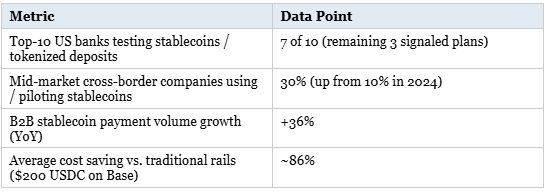
Seven of the ten largest US banks have tested or piloted stablecoins or tokenized deposits, while the remaining three have publicly signaled plans to follow.
The number of blockchain addresses holding stablecoins has reached 293 million — exceeding the combined cardholder base of American Express and Discover.
Sending $200 USDC on the Base network costs approximately 86% less than equivalent traditional payment rails.
Market-cap supply has stalled near $300 billion for twelve months, yet velocity has roughly doubled — the real story is not supply but speed of circulation.
Introduction: Why $891 Billion Matters
Stablecoins were once dismissed as a niche on-ramp for crypto speculators. The Q3 2026 data published in "The Always-On Dollar," a report commissioned by Coinbase and conducted by The Block Research, erases that narrative entirely. In a single quarter, adjusted stablecoin transfer volume hit $891 billion — a figure that rivals the quarterly settlement output of major card networks and marks a watershed moment for dollar-denominated digital assets.
That number is not noise. It has nearly quadrupled from the approximately $216 billion recorded in Q1 2023, and the trajectory points toward $1.5 trillion per quarter by the end of 2027. Crucially, the growth is not being driven by speculative crypto trading: 73% of screened transfer volume occurs outside US banking hours, demonstrating that stablecoins are handling real-economy flows — cross-border remittances, B2B settlement, supply-chain finance, and increasingly, AI-agent micropayments — at a pace traditional finance cannot yet match.
This article unpacks the full findings of the report, contextualizes the data against the broader financial landscape, and examines what the velocity paradox, the bank adoption curve, and the emerging regulatory framework mean for the future of digital dollars.
Section 1: Unpacking the $891 Billion Figure
Adjusted Volume vs. Raw On-Chain Data
The $891 billion figure uses an adjusted methodology. Raw on-chain stablecoin volume is heavily inflated by smart-contract loops, arbitrage bots, and intra-protocol transfers that have no economic counterpart. The Block Research’s methodology screens out these non-organic flows, leaving a figure that more accurately reflects genuine value transfer between distinct economic actors.
Even on an adjusted basis, the growth curve is steep. From roughly $216 billion in Q1 2023 to $891 billion in Q3 2026 represents a compound quarterly growth rate that far outstrips traditional digital payment infrastructure at comparable stages of adoption.
The $400 Million-Per-Hour Benchmark
The report translates the quarterly headline into an average hourly transfer rate of more than $400 million. That hourly cadence is particularly significant because it is continuous: stablecoin rails do not close for weekends, public holidays, or end-of-day settlement windows. The "always-on" framing in the report title is not marketing language — it is a literal description of how blockchain-based settlement works.
For context, the SWIFT network processed roughly $150 trillion in total messages in 2023, but that figure is distributed across business days only, and many transfers sit in correspondent-banking queues for 24 to 72 hours before final settlement. A $400 million-per-hour stablecoin flow that settles in seconds represents a qualitatively different infrastructure proposition.
The 73% Off-Hours Signal
Perhaps the single most telling statistic in the report is that 73% of screened transfer volume — measured over the 12 months to 31 July 2026 — occurred outside US banking hours. This is not a quirk of time zones: it confirms that a majority of stablecoin usage is driven by participants in markets where the US dollar is scarce, expensive to access, or critically important as a store of value.
Emerging-market remittance corridors, cross-border B2B invoice settlement, and supply-chain payments between Asia and Latin America are prime candidates. Where a wire transfer from a bank in Lagos or Manila requires multiple correspondent hops, waiting days and paying percentage-point fees, a USDC transfer on Base or Solana settles in seconds for fractions of a cent.
Section 2: The Velocity Paradox — When Supply Stalls but Usage Soars
Stablecoin Market Cap: A Misleading Headline
At the time of publication, the total stablecoin market capitalization tracked by DeFiLlama stood at approximately $301.42 billion — down marginally from $303.14 billion a year earlier, with circulating supply of roughly $305 billion representing less than a 0.5% year-on-year increase. For much of the past twelve months, supply has oscillated between $300 billion and $320 billion without a decisive breakout.
Observers who track stablecoin market cap as their primary health indicator might conclude that adoption has plateaued. The velocity data tells a completely different story.
Velocity: From 15× to 30×
Stablecoin velocity — the number of times a unit of supply changes hands over a given period — roughly doubled between 2025 and 2026, rising from an average of approximately 15 times per year to approximately 30 times per year. The same dollar, in other words, is being put to work twice as hard.
The divergence is even sharper at the token level. USDC’s velocity is estimated to have climbed from approximately 45 times to approximately 80 times annually, reflecting its dominant role in payments, B2B settlement, and AI-agent transactions. USDT, by contrast, has a velocity of roughly 7 times — consistent with its predominant use case as a savings proxy and capital-flight vehicle in high-inflation emerging markets such as Turkey, Argentina, and Vietnam.

This divergence is analytically important. Policymakers and investors who conflate stablecoin supply with stablecoin activity risk dramatically underestimating the network’s economic throughput. Monthly on-chain stablecoin volume hit a record $19 trillion in May 2026, with the 2026 average running at roughly $10 trillion per month — more than double the $4 trillion monthly average recorded in 2025.
Section 3: Bank Adoption — From Skepticism to Pilot Programs
Seven of the Top Ten US Banks Are Now Testing Stablecoins
"The Always-On Dollar" documents a seismic shift in the posture of the US banking sector. Seven of the ten largest US banks by assets have now either tested stablecoins or piloted tokenized deposit products. The remaining three have publicly signaled that similar programs are forthcoming.
This is a reversal from a stance that, as recently as 2022, saw most major banks issue cautious public statements about the risks of crypto assets. The shift reflects multiple converging pressures: competitive threat from fintech and crypto-native payment rails, direct client demand from corporate treasury and supply-chain teams, and the regulatory clarity beginning to emerge from the GENIUS Act framework.
Mid-Market Corporate Adoption: From 10% to 30%
Among mid-market companies engaged in cross-border transactions, the report finds that 30% are now using or actively piloting stablecoins as a payment instrument — up from just 10% in 2024. That tripling in two years reflects the maturation of B2B stablecoin payment infrastructure, with platforms offering compliance tooling, FX conversion, and treasury management alongside raw settlement capability.
B2B stablecoin payment volume grew by 36% year-on-year, confirming that corporate adoption is not merely exploratory but is generating measurable transaction throughput. For CFOs evaluating whether to participate, the peer-group data is becoming difficult to ignore.
Section 4: The Cost Efficiency Argument
86% Cheaper on Base
One of the most concrete data points in the report addresses the unit economics of stablecoin payments. Sending $200 USDC on the Base network — Coinbase’s Ethereum Layer 2 — costs approximately 86% less than equivalent transfers through traditional payment rails, once fees, FX spread, and intermediary charges are accounted for.
For small-business owners sending $200 to a supplier in a different country, this is the difference between paying $10-$15 in fees and paying less than $2. Scaled across millions of transactions, the aggregate savings translate directly into expanded margins or lower consumer prices.
Macro-Level Efficiency: $155 Billion Added to Global GDP
The report models what would happen if 80% of international transactions migrated to stablecoin rails. The modeled outcome is an additional $155 billion in annual global GDP — captured through reduced friction, faster settlement, and the elimination of dead time in correspondent banking chains.
A separate but related modeling exercise estimates that approximately $3 trillion in liquidity is currently locked up as collateral across cross-border payment systems, acting as a friction tax on global trade. Stablecoin settlement — which does not require the same pre-funded nostro accounts — could theoretically free much of that capital for productive use. The report acknowledges that partial redeployment of that capital into bank lending could have offsetting macroeconomic effects, and that these projections are model outputs rather than guaranteed outcomes.
Section 5: 293 Million Addresses — Scale in Context
Bigger Than American Express and Discover Combined
The number of blockchain addresses holding stablecoins has reached 293 million, according to the report’s data. For scale, the combined cardholder base of American Express and Discover — two of the four major US card networks — is smaller than this figure. On a different comparison, the stablecoin address count is nearly double the combined mobile banking user count of JPMorgan Chase, Bank of America, Wells Fargo, and Citigroup.
These comparisons require a methodological caveat that the report’s authors are careful to include: one blockchain address does not equal one user. A single individual may control dozens of addresses, and a single address may be controlled by a protocol, a smart contract, or a custodian holding funds on behalf of many beneficiaries. The 293 million figure therefore represents a ceiling on individual user count rather than a floor, and direct comparisons to consumer financial product user bases should be read with that in mind.
That said, even discounting heavily for multi-address users and protocol-controlled accounts, the scale is substantial and the growth trend is real.
What the Address Count Actually Measures
A more analytically robust takeaway from the 293 million figure is what it implies about infrastructure readiness. That many addresses interacting with stablecoin contracts means a vast installed base of wallets, on-ramps, and apps capable of sending and receiving dollar-denominated digital value. The addressable market for stablecoin payment applications — consumer, B2B, or AI-agent — is much larger than it was 24 months ago.
Section 6: AI Agents and the Next Wave of Stablecoin Demand
McKinsey's $3–5 Trillion AI Agent Commerce Forecast
The report frames a future demand driver that goes beyond human-to-human or business-to-business payments: AI agents. McKinsey projects that by 2030, between $3 trillion and $5 trillion of global B2C commerce could be mediated by AI agents acting on behalf of consumers. These agents — booking travel, managing subscriptions, purchasing digital goods, paying for API calls — require a payment layer that is programmable, instant, and capable of transacting at machine speed.
Stablecoins are the obvious candidate. USDC’s already-elevated velocity relative to USDT is at least partly attributable to its growing use in AI-agent payment flows, where the combination of instant settlement, programmable transfer logic, and dollar denomination is uniquely suited to automated transaction execution.
USDC vs. USDT: Two Different Use Cases
The velocity gap between USDC (~80×) and USDT (~7×) is not a product-quality difference; it reflects fundamentally different user populations. USDT is predominantly held as a savings instrument in countries with unstable local currencies — Turkey, Argentina, Vietnam, Nigeria — where residents want dollar exposure without the complexity of a US bank account. Velocity is low because holders are not transacting; they are storing.
USDC, by contrast, is predominantly held by participants who are actively transacting: US-regulated businesses, DeFi protocols, stablecoin payment platforms, and increasingly, AI agents. Its higher velocity is a feature of its use case, not evidence of superior demand.
Section 7: Consumer Survey — Banks Are Missing the Stablecoin Conversation
42% of US Adults Are More Likely to Bank with Crypto-Offering Institutions
The National Crypto Association (NCA) consumer survey cited in the report contains findings that should alarm retail bank CEOs. Forty-two percent of US adults — approximately 112 million people — say they would be more likely to bank with an institution that offers cryptocurrency services. Eighteen percent specifically want access to stablecoins through their existing bank account.
Against that backdrop of latent demand, 64% of respondents say their bank has never raised the subject of cryptocurrency with them, and 43% do not know whether their bank offers any crypto-related products at all. The demand signal is there; the supply-side communication is failing entirely.
The Communication Gap as a Competitive Risk
For community banks and regional lenders watching the top-ten institutions move into stablecoin pilots, the survey data suggests a window of competitive vulnerability. Customers who want crypto access and cannot find it at their primary bank are already being targeted by crypto-native neobanks, fintech challengers, and exchange-backed financial products.
The GENIUS Act framework, expected to require final implementing rules by January 2027, will create the legal infrastructure for bank-issued stablecoins. Institutions that have piloted tokenized deposit products ahead of that deadline will be better positioned to launch compliant consumer-facing products quickly.
Section 8: Market Cap Forecasts and the Road to $1.5 Trillion Quarterly Volume
The Always-On Dollar's Own Projection: $1.5T by End of 2027
The report’s central forward projection is that adjusted quarterly stablecoin transfer volume will reach $1.5 trillion by the end of 2027. That would represent a further doubling from Q3 2026’s $891 billion figure. The projection is grounded in the observed adoption trajectories across B2B payments, AI-agent commerce, and bank tokenization programs, rather than speculative assumptions about crypto market cycles.
Market Cap vs. Velocity: The Two Forecasting Frameworks
Most institutional stablecoin forecasts focus on market capitalization — the total supply of stablecoins outstanding. The major public forecasts present a wide range of outcomes:
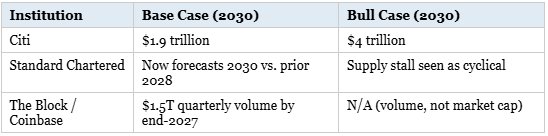
Standard Chartered’s forecast revision is notable. The bank originally expected the stablecoin market cap to reach $2 trillion by 2028; it has since pushed that milestone to 2030, citing the current supply plateau between $300 billion and $320 billion. Analysts at Standard Chartered characterize the stall as cyclical — driven by subdued crypto market sentiment and on-ramp friction — rather than structural, and maintain that regulatory clarity from the GENIUS Act is the key catalyst for the next supply expansion phase.
A potential complication is the January 2027 deadline for GENIUS Act implementing rules. If regulators miss that deadline or issue restrictive guidance, it could dampen the pace of bank-issued stablecoin launches and slow the market-cap recovery that most bull forecasts depend on.
The Velocity Lens: A Trillion-Dollar Economy Running on $300 Billion
The more striking analytical insight may be that the stablecoin ecosystem has effectively built a multi-trillion-dollar-per-year payment economy on a static $300 billion supply base. At an average velocity of 30 times, that supply base turns over roughly $9 trillion worth of economic value annually — and that figure is growing rapidly as USDC velocity continues to climb. The stablecoin network is, in this sense, already a large-scale payment infrastructure. The market-cap debate is about how much larger the reserves will grow; the velocity data shows that the infrastructure is already working at scale.
Section 9: Regulatory Context — The GENIUS Act and What Comes Next
Stablecoin policy in the United States has been in a prolonged holding pattern, with legislative attempts to establish a federal framework repeatedly stalling. The GENIUS Act — the Guiding and Establishing National Innovation for US Stablecoins Act — is the most advanced attempt to break that impasse.
The Act establishes a tiered framework in which issuers below a certain asset threshold can choose between federal and state charters, while larger issuers are required to obtain federal authorization. It mandates 1:1 reserve backing with high-quality liquid assets, regular attestation, and consumer protection disclosures.
For banks already piloting tokenized deposits and stablecoins, the GENIUS Act provides a pathway to formal authorization for retail distribution. The January 2027 deadline for implementing rules is the key near-term milestone. Issuers and platforms that have invested in compliance infrastructure ahead of that deadline — KYC/AML tooling, reserve attestation processes, legal entity structuring — will be positioned to move faster than late entrants once the rules are finalized.
The regulatory risk is not that the GENIUS Act will block stablecoins; it is that delays in finalizing rules could temporarily slow institutional adoption just as the ecosystem is building momentum. Standard Chartered’s forecast revision reflects exactly this risk.
Frequently Asked Questions
What is the "The Always-On Dollar" report and who published it?
"The Always-On Dollar" is a research report commissioned by Coinbase and conducted by The Block Research. It examines stablecoin transfer volume, adoption metrics, and market projections, with a particular focus on the role of stablecoins as real-economy payment infrastructure rather than speculative crypto assets.
What does "adjusted stablecoin transfer volume" mean?
Adjusted volume strips out non-organic on-chain activity such as smart-contract loops, automated arbitrage, and intra-protocol transfers that do not represent genuine value exchange between distinct economic actors. The resulting figure is intended to reflect actual person-to-person, business-to-business, and protocol-to-user economic transfers.
Why has stablecoin supply been flat while transfer volume is surging?
The apparent paradox is explained by velocity. The same pool of stablecoins — roughly $300 billion to $320 billion in circulation — is changing hands much more frequently. Average velocity doubled from approximately 15 times per year in 2025 to approximately 30 times per year in 2026, meaning the same supply base is processing twice the economic value. Monthly on-chain volume hit a record $19 trillion in May 2026, with a 2026 average of roughly $10 trillion per month.
What is the difference between USDC and USDT in terms of use cases?
USDT dominates in emerging markets where users primarily hold stablecoins as a dollar savings proxy rather than a payment instrument. Its velocity is approximately 7 times per year. USDC is dominant among payment platforms, regulated businesses, DeFi protocols, and AI-agent use cases; its velocity is estimated at approximately 80 times per year. The gap reflects use-case difference, not product quality difference.
Are the 293 million blockchain addresses holding stablecoins equivalent to 293 million users?
No. One individual can control many addresses, and one address can represent a custodian holding funds on behalf of many users. The 293 million figure is best understood as a measure of infrastructure scale and addressable market size rather than a precise count of individual stablecoin holders.
What is the GENIUS Act and when does it take effect?
The GENIUS Act is the primary pending US federal stablecoin legislation. It establishes reserve requirements, attestation standards, and a tiered charter framework for stablecoin issuers. Final implementing rules are expected by January 2027. The Act is widely seen as the regulatory catalyst that would unlock large-scale bank-issued stablecoin distribution to retail customers.
What does Standard Chartered say about stablecoin market cap?
Standard Chartered has revised its forecast for a $2 trillion stablecoin market cap from 2028 to 2030, citing the current supply plateau. The bank characterizes the stall as cyclical rather than structural and maintains that GENIUS Act clarity is the primary catalyst for the next expansion phase.
Conclusion: The Infrastructure Is Already Here
The $891 billion stablecoin transfer volume figure for Q3 2026 is not a prediction or a projection — it is a measurement of a payment network that is already operating at a scale comparable to major global financial infrastructure. The "always-on" characteristic is not aspirational; it is a description of how the system works today, 24 hours a day, 7 days a week, without settlement windows, correspondent intermediaries, or holiday closures.
The data points that follow from that headline tell a coherent story: 73% of flows happen outside US banking hours because the users who depend most on stablecoin infrastructure are the ones underserved by US banking hours. B2B adoption has tripled among mid-market companies in two years. Seven of the ten largest US banks are no longer waiting to see what happens — they are participating in pilots. Consumer demand is clear, and the communication gap between banks and their customers represents both a risk and an opportunity.
The velocity paradox — a stagnant $300 billion supply running an economy that generates $10 trillion per month in on-chain volume — is perhaps the most important reframe the report offers. Tracking stablecoin market cap alone is like measuring the health of a river by the depth of its reservoir: the flow rate tells you more.
As the GENIUS Act implementation timeline approaches and major banks prepare consumer stablecoin products, the Q3 2026 data represents a baseline from which the next leg of adoption will be measured. The always-on dollar is not coming; it is here, and it is scaling.
Want to join the discussion? Login and create a profile to comment.