Tesla Profit Sinks 43% as Musk Pours Cash Into Robots and Robotaxis
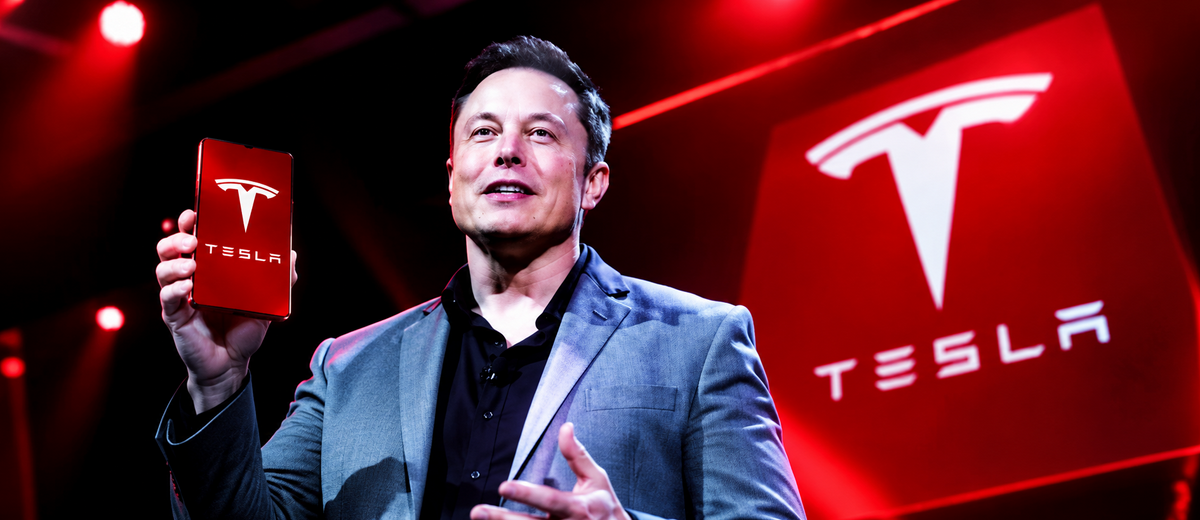
Tesla earned $787 million last quarter, down from $1.37 billion a year earlier, as spending on humanoid robots and self-driving cars surged. Optimus has entered production, and Tesla says it is aiming to get Cybercabs to customers by year-end.
In brief
Q3 net income fell 43% to $787 million on roughly flat revenue of $28.05 billion, as R&D rose 69% and capital spending more than doubled to $4.73 billion.
Tesla has begun producing Optimus humanoid robots in Fremont, California; Musk targets 20,000 a week but says that is at least a year away, with outside deliveries around the end of 2027.
Tesla says it is trying to get Cybercabs to customers by the end of 2026, while a federal safety audit remains open — its sworn answers to regulators are due October 30.
Tesla's profit fell sharply last quarter, dropping 43% to $787 million from $1.37 billion a year earlier, according to its quarterly filing. The electric-vehicle maker channeled money into humanoid robots and driverless taxis while delivering roughly 2% fewer cars — a quarter that captures a company deliberately trading near-term earnings for long-shot bets on automation.
The numbers: flat sales, shrinking profit, soaring investment
Revenue held roughly flat at $28.05 billion, but the profitability picture deteriorated beneath that steady top line. Operating profit — what remains after the costs of running the business — fell 56% to $718 million. The squeeze came from two deliberate spending decisions: research spending jumped 69% to $2.76 billion, and capital expenditures, the money poured into factories and equipment, more than doubled to $4.73 billion.
At a glance, here is how the quarter broke down:
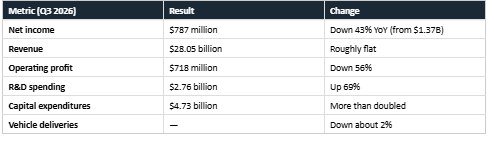
The takeaway is that Tesla's core car business is no longer growing the bottom line, while the costs of its next chapter are climbing fast. For investors, the central question is whether the robot and robotaxi programs begin generating revenue before the spending does lasting damage to margins.
Optimus enters production in Fremont
That heavy spending is aimed at two products moving from concept toward the real world: Optimus, a humanoid robot designed to take over dangerous and repetitive jobs, and the Cybercab, a two-seat robotaxi — a self-driving taxi summoned from an app — built with no steering wheel or pedals.
Tesla said Wednesday that Optimus has entered production, with units now coming off a line at its Fremont, California, factory. “The bots coming off this line are the first production-quality bots that we have manufactured,” Tesla wrote in its shareholder letter — a notable milestone for a program that has so far lived mostly in demonstrations.
Still, Musk was candid about how far the ramp has to go. He wants to reach 20,000 Optimus units a week, but said getting there will take at least a year because the design is still changing. He put deliveries to outside customers around the end of 2027, and singled out the robot's hand as the hardest hardware problem — alongside the open question of whether the machine holds up beyond a month of real use.
It's worth weighing those targets against Tesla's track record and a tightening field. The company has missed Optimus goals before, including an aim of roughly 10,000 robots in 2025, so the 20,000-a-week figure deserves caution. Competition is also intensifying: Figure AI, a startup backed by Microsoft, OpenAI and Nvidia, unveiled its Figure 02 humanoid in 2024, underscoring that Tesla is no longer the only serious contender in general-purpose robotics.
Cybercab targets year-end — under a regulatory cloud
On the robotaxi, Lars Moravy, Tesla's vice president of vehicle engineering, told the earnings call the vehicles may reach customers this year: “We're trying to get Cybercabs to customers by the end of this year, 2026.” For now, every Cybercab built so far is destined for Tesla's own robotaxi fleet, and Musk said most will stay Tesla-owned and be offered as “transport as a service” rather than sold outright.
Tesla has not said who will buy Cybercabs first, though it posted a form last month for people interested in purchasing robotaxis, and it has not announced a price. The target it has cited publicly is under $30,000. Musk said the robotaxi business should become noticeable in Tesla's overall financials in the second quarter of 2027 and would “probably” be “a big deal by Q3 or Q4 of next year,” though Tesla has not disclosed how much revenue the service currently generates.
Hanging over the year-end timeline is a regulatory complication: the push to put Cybercabs on public roads is unfolding while a federal safety audit remains open. Tesla's sworn answers to regulators are due October 30, a deadline that could shape how quickly the rollout actually proceeds, regardless of the company's stated ambitions.
A possible Tesla–SpaceX combination enters the picture
The earnings report arrived alongside a far larger corporate question. Musk said on SpaceX's earnings call that the Tesla and SpaceX boards have each formed special committees of independent directors to study a potential combination of the two companies, though no terms have been agreed. Independent-committee reviews are the standard governance mechanism for deals involving a controlling insider — here, Musk sits atop both companies — which is designed to address the obvious conflict-of-interest concerns such a merger would raise.
Any deal would face a steep approval bar. It would need support from holders of 50% of all outstanding Tesla shares — a threshold Musk himself called “quite a high hurdle.” Tesla's annual shareholder meeting is set for December 3, though no merger vote is on the agenda, meaning the committees' work is only beginning and a combination, if it happens at all, remains some way off.
The bottom line
Tesla's third quarter lays bare the trade-off at the heart of its strategy: a car business that is holding revenue steady but no longer expanding profit, paired with an aggressive, expensive wager that humanoid robots and autonomous taxis become the company's next growth engines. The milestones are real — Optimus is now in production and Cybercabs are being built — but so are the risks, from missed targets and rising competition to an open federal safety audit. Whether this quarter marks the low point before an automation-driven payoff, or the start of a longer margin squeeze, will depend on execution over the next several quarters, not promises made on an earnings call.
This article is for informational purposes only and does not constitute financial or investment advice. Figures are drawn from Tesla's quarterly filing and earnings commentary; forward-looking targets are company projections, not guarantees. Always do your own research before investing.
Want to join the discussion? Login and create a profile to comment.