Tether Claims a 94% Drop in Iran-Linked Volume While the Senate Puts USDT at the Centre of Iran’s Shadow Banking Network
Tether CEO Paolo Ardoino says the company’s address freezes have produced a 94% decline in Iran-linked stablecoin volumes — a figure he has not substantiated with any published data. The claim came in a post rebutting a Senate subcommittee report, published three weeks earlier, that found 84% of 846 Iran-linked sanctioned wallets transacted almost exclusively in USDT. The Senate report has since been referred to the Treasury and the Justice Department.
Key Takeaways
Tether CEO Paolo Ardoino claimed on Monday that the company’s freezes have driven a 94% decline in Iran-linked stablecoin volumes since 2023, without providing a baseline, time period, methodology or asset scope for the figure.
A Senate report titled “Tethered to Terrorism”, published 28 September by Democratic staff of the Senate Permanent Subcommittee on Investigations, found that 84% of 846 wallets sanctioned for Iran-related activity transacted exclusively or nearly exclusively in USDT.
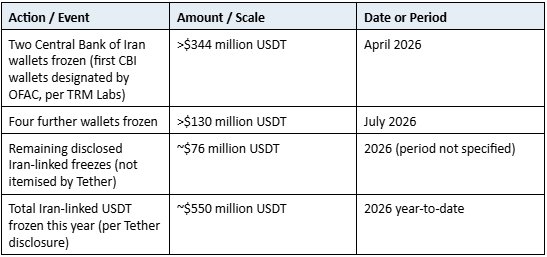
Tether’s own disclosure said it froze nearly $550 million in Iran-linked USDT in 2026, including the first two Central Bank of Iran wallets ever designated by OFAC, identified by TRM Labs.
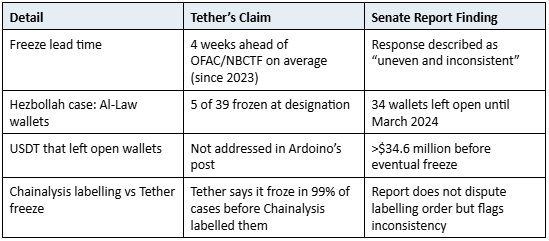
A Hezbollah case in the Senate report contradicts Tether’s “four-week lead time” claim: 34 of 39 wallets tied to a Hezbollah financier were left open until March 2024, and more than $34.6 million in USDT left those wallets in the interim.
TRM Labs estimated Iranian crypto volume at $11.4 billion in 2024 and $10 billion in 2025, a 12% decline — far below the 94% drop Tether claims for USDT specifically.
Senator Blumenthal referred the Senate report’s findings to the Treasury and Justice Department; as of the report’s publication, Tether had acknowledged the subcommittee’s June letter without responding to it.
The Senate Report: What “Tethered to Terrorism” Found
On September 28, Democratic staff of the Senate Permanent Subcommittee on Investigations published a report examining how cryptocurrency, and USDT specifically, featured in Iran’s sanctions-evasion activity. The staff analysed 846 wallets that had been sanctioned or targeted for seizure between June 2021 and August 2026 on the grounds of ties to Iran and its proxies, including Hezbollah.
The headline finding: 84% of those 846 wallets transacted exclusively or nearly exclusively in USDT. That share was high enough for the report’s authors to describe Tether’s stablecoin as central to a shadow banking network operating in defiance of US sanctions. Senator Richard Blumenthal, the subcommittee’s ranking member, formally referred the findings to the Treasury Department and the Justice Department after publication.
What the Report Says About Tether’s Response
The Senate report does not describe Tether as entirely unresponsive. It acknowledges that the company has, in some instances since late 2023, responded to wallet designations. But the overall assessment is that the effort has been "uneven and inconsistent." The report credits Tether with cooperating in specific high-profile cases while flagging that this cooperation was not applied uniformly across the 846 wallets studied.
Ardoino’s Rebuttal: What Tether Is Claiming
Paolo Ardoino’s response, posted on X the same day as the news coverage of the Senate report, made two central claims. The first is that Tether has on average frozen addresses four weeks ahead of official designation by OFAC or Israel’s National Bureau for Counter Terror Financing since 2023. The second is that the 94% decline in Iran-linked stablecoin volumes is the result of those freezes.
The Verification Problem
Neither claim can be independently checked as stated. Tether has not published the dataset behind the 94% figure, has not named the baseline volume it is measured against, has not confirmed which time period the decline covers, and has not said whether it counts USDT alone or all stablecoins. The 99% pre-Chainalysis labelling claim — that Tether froze addresses before blockchain analytics provider Chainalysis formally labelled them in 99% of relevant cases — similarly rests on unpublished internal data.
These are not minor methodological gaps. A 94% claim is a striking number that, if true and verifiable, would substantially change the evidentiary picture the Senate report presents. Without the underlying data, it is a counter-assertion, not a counter-argument.
The Hezbollah Case: Where the Four-Week Claim Breaks Down
The Senate report contains at least one documented case that does not fit Tether’s stated four-week-lead claim. Israel’s National Bureau for Counter Terror Financing designated 39 wallets tied to Tawfiq Muhammad Sa’id Al-Law, described in the report as a Hezbollah financier, in June 2023.
What Happened to the 34 Open Wallets
Of those 39 wallets, Tether froze five at the time of Israel’s designation. The remaining 34 were left open. More than $34.6 million in USDT moved through those open wallets between June 2023 and March 2024, when Tether eventually froze them — shortly before OFAC sanctioned Al-Law directly.
The sequence matters. If Tether’s policy is to freeze four weeks before official US sanction, the March 2024 freeze — which predated the OFAC designation — is consistent with that specific claim. But it also means a nine-month window elapsed after Israel’s designation during which the majority of the designated wallets remained active and processed tens of millions in USDT. The Senate report treats this as evidence of inconsistency; Ardoino’s post does not address this specific case.
Tether’s Own Disclosure: $550 Million Frozen in 2026
Alongside the Senate report’s publication, Tether released its own disclosure of Iran-related enforcement actions. The document said the company had supported freezes of nearly $550 million in Iran-linked USDT in 2026.
The Two Central Bank of Iran Wallets
The largest single item in the disclosure was a pair of wallet addresses in April 2026. TRM Labs, the blockchain intelligence firm, identified these as the first wallets belonging to the Central Bank of Iran ever to be designated by OFAC. The freeze covered more than $344 million in USDT. A further $130 million-plus was frozen across four wallets in July 2026.
The remaining roughly $76 million in the $550 million total is not itemised in Tether’s disclosure. The company did not specify how many wallets or transactions it covers, or over which months those freezes occurred.
TRM Labs’ Broader Iran Crypto Volume Data
TRM Labs’ estimates for Iranian crypto volume provide context for the 94% claim, though the comparison is not direct.

TRM puts the total Iranian crypto market at approximately $11.4 billion in 2024, declining to roughly $10 billion in 2025 — a fall of about 12%. If USDT volumes specifically fell 94% over a comparable period, while the broader Iranian crypto market fell only 12%, one of two things would have to be true: either Iranian actors dramatically substituted other assets or venues for USDT, or the 94% figure applies to a narrower or more recent period than the TRM data covers.
The Substitution Problem
The Senate report acknowledges this dynamic. If USDT is frozen or becomes too risky to use, sophisticated sanctions evaders have options: other dollar-pegged stablecoins, non-USD stablecoins, privacy-enhanced cryptocurrencies, or over-the-counter brokers operating outside the reach of Tether’s freeze mechanism. A steep fall in USDT-specific activity would confirm that Tether’s freezes are working as a deterrent — but it would not confirm that the underlying sanctions evasion has stopped. It may simply have moved.
USDT’s Market Position and the Regulatory Stakes
Tether’s USDT has a market capitalisation of approximately $183 billion, according to CoinGecko, making it the largest stablecoin by a significant margin. Its scale is both why it features so prominently in the Senate report and why the regulatory and legal stakes around the outcome of Blumenthal’s referral are significant.
What the Referral to Treasury and Justice Means
Referring findings to the Treasury Department and the Justice Department does not automatically result in enforcement action. It opens a channel for investigators at those agencies to examine the evidence and determine whether it warrants a formal inquiry, subpoena or prosecution. The Senate Permanent Subcommittee on Investigations has historically been effective at producing referrals that lead to significant enforcement outcomes, but the timeline from referral to any action can span years.
Tether had received the subcommittee’s initial letter, sent in June, and confirmed receipt without formally responding to it as of the report’s publication date. Whether the company has since engaged with the subcommittee or the referred agencies has not been publicly disclosed.
The Jurisdiction Question
Tether operates as a British Virgin Islands company and issues USDT through Tether International, which is headquartered in El Salvador. US regulatory jurisdiction over the company has been a point of ongoing legal debate. The Justice Department would likely need to establish a US nexus — such as the use of US financial infrastructure or US dollar correspondent banking — to pursue any action. The fact that USDT transactions are denominated in US dollars and ultimately settled through dollar-pegged mechanisms may provide that nexus, but it has not been tested in court in this context.
Frequently Asked Questions
What did the Senate report “Tethered to Terrorism” find?
The Senate Permanent Subcommittee on Investigations found that 84% of 846 wallets sanctioned or seized for Iran-linked activity between June 2021 and August 2026 transacted exclusively or nearly exclusively in USDT. The report described Tether’s stablecoin as central to Iran’s shadow banking network and was referred to the Treasury and Justice Departments by Senator Blumenthal.
What is Tether’s response to the Senate report?
CEO Paolo Ardoino posted on X that Tether has, since 2023, frozen Iran-linked addresses an average of four weeks before OFAC or Israel’s NBCTF officially designates them, and that these freezes have driven a 94% decline in Iran-linked stablecoin volumes. Tether has not published the data behind the 94% figure.
How much has Tether frozen in Iran-linked USDT?
Tether disclosed that it froze nearly $550 million in Iran-linked USDT in 2026. The largest single action was freezing two Central Bank of Iran wallets in April 2026, covering more than $344 million — identified by TRM Labs as the first CBI wallets ever designated by OFAC. A further $130 million was frozen in July 2026.
What is the Hezbollah case that contradicts Tether’s claim?
Israel’s NBCTF designated 39 wallets tied to alleged Hezbollah financier Tawfiq Muhammad Sa’id Al-Law in June 2023. Tether froze five of them at the time and left 34 open until March 2024, during which more than $34.6 million in USDT moved through those wallets. The Senate report cites this as an example of inconsistent enforcement.
How large is Iran’s overall cryptocurrency market?
TRM Labs estimated Iranian crypto volume at approximately $11.4 billion in 2024 and $10 billion in 2025, a decline of roughly 12%. These figures cover all cryptocurrencies, not USDT alone, and come from TRM Labs rather than from Tether or the US government.
Disclaimer: This article is for informational purposes only and does not constitute legal or financial advice. The allegations and findings described are drawn from a published US Senate subcommittee staff report and public statements. They are allegations, not adjudicated facts. Readers should consult primary sources for the complete record.
Want to join the discussion? Login and create a profile to comment.