XRP Price Analysis: $11.8 Billion Token Reserve Overhang and Rebuilding Open Interest Collide at the $1.25 Support Zone
CryptoQuant’s aggregate exchange reserve data show 11.81 billion XRP held across trading platforms — a reading in the 99th percentile of the past 12 months. At the same time, total XRP open interest has recovered to approximately $1.40 billion, up 2.5% in 24 hours. XRP is trading near $1.29–$1.31 after rebounding from the $1.25 zone, which remains the most watched level in the market: a hold here could ease the supply overhang thesis, while a sustained break below it puts $1.00 in view.
Key Takeaways
CryptoQuant’s aggregate data place XRP exchange reserves at approximately 11.81 billion tokens, a reading in the 99th percentile of the past 12 months — the highest point in the one-year comparison window.
Elevated exchange reserves represent a supply overhang: tokens held on platforms are immediately available for sale. Whether this overhang becomes a price drag depends on the direction of flows — deposits add supply pressure, withdrawals reduce it.
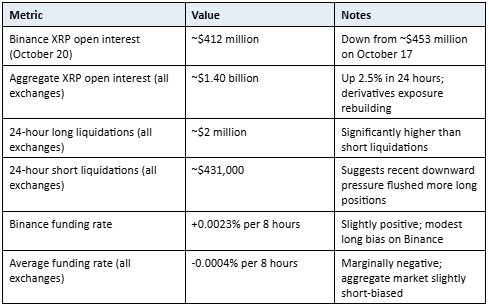
Binance XRP open interest fell from ~$453 million on October 17 to ~$412 million on October 20, but aggregate open interest across all exchanges rose to ~$1.40 billion (+2.5% in 24 hours), indicating derivatives exposure is rebuilding.
Long liquidations over the latest 24-hour period reached ~$2 million versus ~$431,000 in short liquidations, suggesting the recent downside move cleared more bullish leverage than bearish.
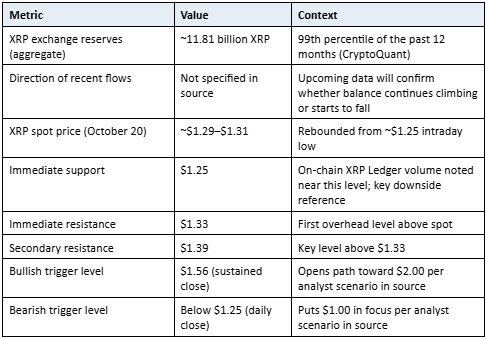
The $1.25 support level is the most critical near-term reference: on-chain XRP Ledger volume increased near this level, which some analysts interpret as a sign of a potential local bottom. A break below it targets $1.00.
Above spot, $1.33 is the immediate resistance, $1.39 is the secondary level, and a sustained close above $1.56 would, per the analyst scenario cited in the source, open a path toward $2.00.
XRP Ledger payment volume on October 17 was approximately 119.5 million XRP, down 72.3% from the prior day and well below the 30-day average of approximately 629.3 million XRP, representing a mixed on-chain demand signal.
Understanding Exchange Reserves: Why 11.81 Billion XRP Matters
Exchange reserves measure the total quantity of a token held in wallets controlled by trading platforms. Unlike tokens held in private wallets, hardware wallets, or cold storage, exchange-held tokens are available for trading immediately. When a holder wants to sell, they typically move tokens to an exchange first; when they want to reduce immediate selling exposure, they withdraw to a private wallet.
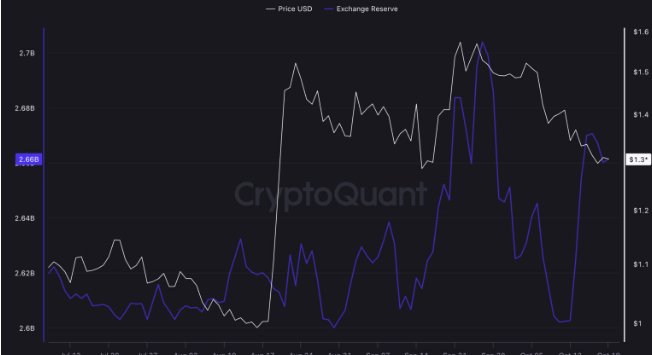
CryptoQuant’s aggregate reserve figure for XRP stands at approximately 11.81 billion tokens as of October 20, placing the reading in the 99th percentile of the past 12-month range. In practical terms, this means exchange-held XRP supply is near its highest level over the past year, according to the data referenced in the source article.
Why Direction of Flow Matters as Much as the Level
A high reserve level is not, by itself, a sell signal. The critical variable is the direction of flow. If the 11.81 billion balance is growing because holders are depositing tokens to exchanges in preparation for selling, that represents a supply increase that could weigh on price — particularly near a contested support zone where buyers must absorb that supply. If the balance is falling because holders are withdrawing to private wallets, that removes immediately available supply and reduces the overhang.
The source article explicitly notes that “upcoming data will show whether the 11.80 billion balance continues to climb or starts to fall.” This is the key forward data point. A sustained reserve decline would be a constructive signal for price; continued growth would keep the supply concern live.
How Elevated Reserves Interact With Support Zones
The interaction between exchange reserves and price support levels is a commonly referenced dynamic in on-chain analysis. When a token is trading near a support zone and exchange reserves are elevated, sellers have more immediately available supply to push through the bid side of the order book. Buyers at the support must absorb not only normal market-driven selling but also any incremental selling from the elevated reserve pool.
This is why the $1.25 level carries more significance than it would in a lower-reserve environment: the cost for bulls to defend that level is higher when more tokens are sitting ready to sell on exchanges.
Derivatives Market: Leverage Reset and Rebuilding Open Interest
Derivatives data provide a different lens on the current XRP setup. Futures open interest measures the total value of outstanding contracts — a useful proxy for how much leveraged exposure is in the market and in which direction.
What the Liquidation Asymmetry Signals
Long liquidations of approximately $2 million against $431,000 in short liquidations over the most recent 24-hour period reflect an asymmetric clearing event: the recent downside move in XRP price forced more long positions to close than short ones. Forced long liquidations occur when price drops below the liquidation price of a leveraged long position; the exchange closes the trade automatically, which adds to selling pressure in a feedback loop.
The fact that long liquidations significantly outpaced short liquidations suggests the most recent leg down was driven at least in part by forced selling from over-leveraged longs. Once those positions are closed, the mechanical selling pressure from that source is removed — which is one reason why a leverage reset can sometimes precede a stabilisation or recovery.
The Funding Rate Signal: Mixed Bias Across Venues
Funding rates in perpetual futures markets are periodic payments between long and short position holders, used to keep the perpetual price anchored to the spot price. When funding is positive, longs pay shorts — indicating the market is net long and willing to pay a premium for that exposure. When funding is negative, shorts pay longs — indicating net short bias.
Binance shows a slightly positive funding rate of +0.0023% per eight hours, suggesting a modest long bias on that specific platform. The aggregate across all exchanges has turned marginally negative at -0.0004% per eight hours, suggesting the broader derivatives market has shifted to a slight short-bias or near-neutral positioning. Neither reading is extreme, but the divergence between Binance and the aggregate market is worth noting — it indicates Binance traders are slightly more bullish than the cross-exchange average.
The $1.25 Support: On-Chain Activity and Technical Significance
XRP rebounded from approximately $1.25 to trade near $1.29–$1.31 at the time of writing. The source article notes that analysts identified increased XRP Ledger on-chain volume near the $1.25 level, which has been cited as a possible indicator of a local bottom — the interpretation being that increased activity near a price floor may reflect buyers stepping in at that level.
XRP Ledger Payment Volume: A Mixed On-Chain Picture
XRP Ledger payment volume on October 17 was approximately 119.5 million XRP, a decline of 72.3% from the previous day and substantially below the reported 30-day average of approximately 629.3 million XRP. A single-day reading of 72.3% below the prior day is significant, but the cause is not specified in the source. On-chain payment volume on XRP Ledger can be driven by many factors including institutional transfers, exchange deposits and withdrawals, and activity from applications built on the network.
The low volume figure relative to the 30-day average is a mixed signal: it could reflect reduced selling activity (fewer tokens moving to exchanges) or reduced overall demand. Without directional flow data, the single-day volume number is informative but not conclusive.
Technical Levels Above and Below $1.25
With XRP trading near $1.29–$1.31, the technical map from the source article is as follows. Immediate resistance sits at $1.33, the first level buyers must clear to demonstrate upside momentum. The secondary resistance level is $1.39. Per the analyst scenario cited in the source, a sustained close above $1.56 would open a path toward $2.00.
On the downside, $1.25 is the immediate support and the level that defines the current technical structure. Below it, $1.00 is the next key level identified in the source — a psychologically significant round number and a level that would represent a meaningful retracement from current prices.
Full Support and Resistance Reference Map
Two Competing Forces: Supply Overhang vs. Demand Recovery
The current XRP setup is characterised by two competing forces pulling in opposite directions.
The Supply Overhang Case
With 11.81 billion XRP held on exchanges at the 99th percentile of the past year, the potential for sustained spot selling is elevated. If holders who have moved tokens to exchanges begin selling into bids, particularly near the $1.25 support zone, the downward pressure could be substantial. Elevated exchange reserves do not guarantee selling — some of those tokens may be held for reasons other than near-term sales — but they represent a structural supply risk that would need to be absorbed by buyers.
The Demand Recovery Case
Against the supply overhang, several factors could support price. First, aggregate open interest has recovered to $1.40 billion, suggesting that derivatives market participants are rebuilding positions — which, if skewed to the long side, represents incremental demand. Second, the leverage reset from long liquidations has cleared some of the over-extended positioning that contributed to the recent downside move. Third, on-chain activity near $1.25 has been noted as a possible bottom signal by analysts referenced in the source.
The source article also briefly references US spot XRP ETF activity before the sentence appears to be cut off in the original text. This reference is reproduced here as-is, without additional detail that was not provided in the source.
What Resolves the Standoff
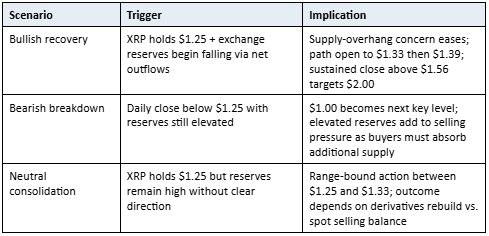
The outcome between these two forces most likely resolves through observable data in the days following the October 20 session. A decline in exchange reserves — meaning net outflows from platforms to private wallets — would reduce the structural supply pressure and make the demand recovery case more credible. Sustained reserve growth would keep the supply overhang thesis live. A daily close below $1.25 would be the clearest bearish signal; a daily close above $1.33 and then $1.39 would indicate buyers are winning the standoff at support.
Scenario Analysis: Three Paths From Here
Frequently Asked Questions
What does it mean that XRP exchange reserves are in the 99th percentile?
CryptoQuant’s data place the approximately 11.81 billion XRP currently held across exchanges at or near the highest level seen over the past 12 months — the 99th percentile of that range. It means more XRP than usual is sitting on trading platforms, where it is immediately available to be sold. Elevated reserves are a potential supply pressure signal, but the direction of flows — whether holders are depositing more or withdrawing — matters as much as the absolute level.
Why did Binance XRP open interest fall while aggregate open interest rose?
Binance XRP open interest fell from approximately $453 million on October 17 to $412 million on October 20, indicating that leveraged positioning on Binance specifically declined over that period. At the same time, aggregate open interest across all exchanges rose to $1.40 billion, up 2.5% in 24 hours. This divergence suggests that while Binance saw a net reduction in XRP derivatives exposure, other platforms saw growth — the overall market is rebuilding derivatives positions even as the largest single exchange reduced its exposure.
What does the long liquidation data tell us about the current XRP setup?
Over the most recent 24-hour period, long liquidations reached approximately $2 million versus $431,000 in short liquidations. The asymmetry suggests the recent downside move forced more leveraged longs out of positions than leveraged shorts, clearing some of the over-extended bullish positioning. Once liquidated, those positions no longer create mechanical sell pressure through the feedback loop of forced closes. A leverage reset of this kind can sometimes stabilise a market, though it does not by itself guarantee a price recovery.
What is the significance of the $1.25 support level for XRP?
The $1.25 level is the most closely watched near-term price reference for XRP. The source article identifies increased XRP Ledger on-chain volume near this level as a possible sign of a local bottom — buyers may be stepping in at this price. Technically, if XRP loses $1.25 on a daily close, the next identified level is $1.00, which would represent a further decline from current prices. The $1.25 zone also matters structurally because defending it while exchange reserves are elevated requires a larger buyer base to absorb available supply.
What would need to happen for XRP to target $2.00?
Per the analyst scenario cited in the source article, XRP would need to sustain a close above $1.56 to open a path toward $2.00. That would first require clearing $1.33 (immediate resistance) and $1.39 (secondary resistance) with conviction. From the current price near $1.30, the move to $1.56 represents approximately 20% upside. The supply-overhang scenario would need to resolve through reserve outflows and demand absorption for that trajectory to be technically credible.
Want to join the discussion? Login and create a profile to comment.